
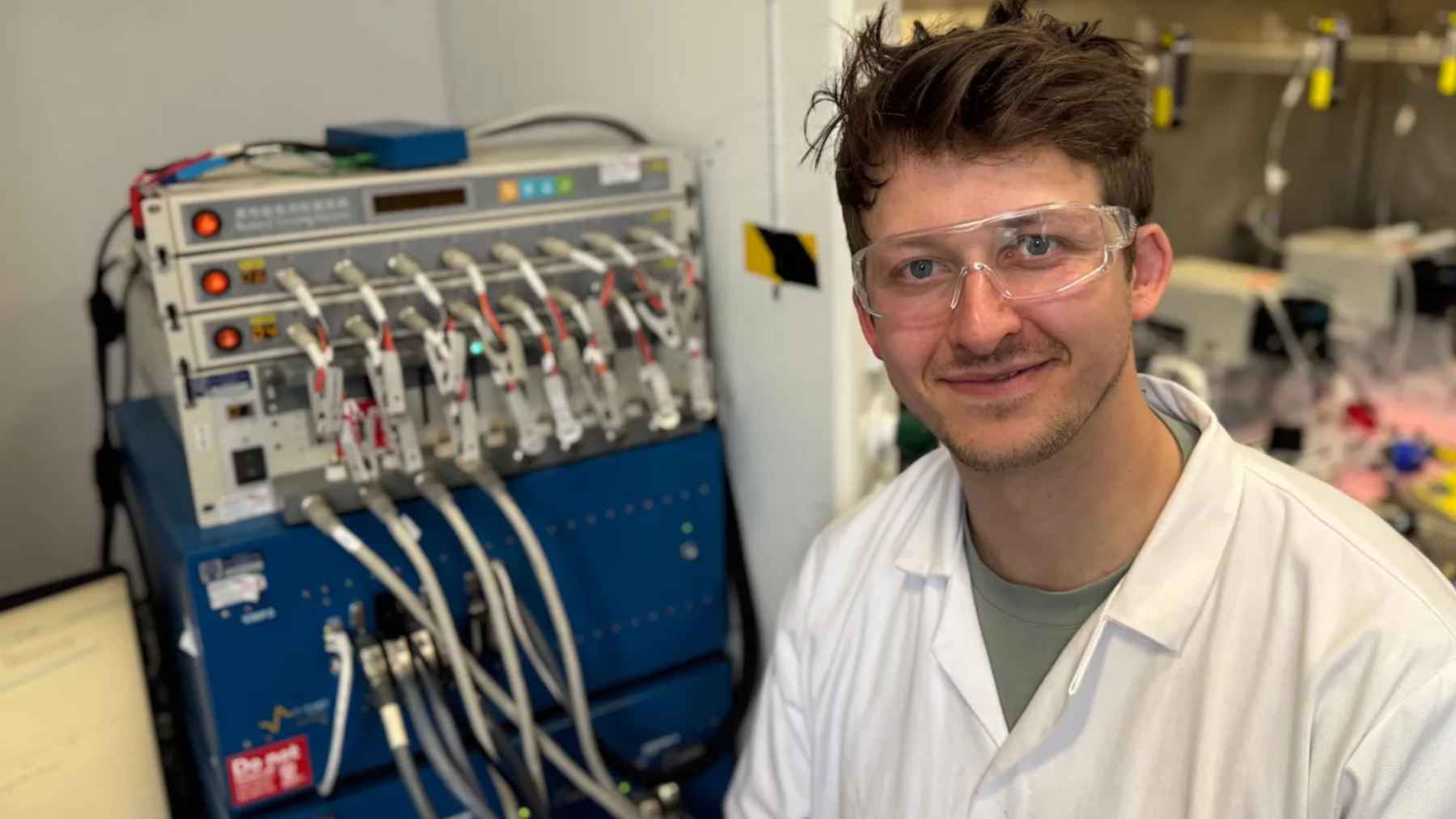
A laboratory tool that once cost as much as $4,050 can now be built for about $100, thanks to a 3D-printed design developed at Queen’s University Belfast. The researchers have also released the design for free, hoping it will accelerate work on iron-based flow batteries that can store wind and solar electricity for hours at a time.
The headline number is striking, but the real breakthrough is easy to miss. This is not a $100 battery ready to power a neighborhood. It is a low-cost test cell that gives laboratories around the world the same hardware and instructions, tackling a major problem that has quietly slowed flow battery research for years.
A $100 cell, not a $100 power plant
Dr. Hugh O’Connor began experimenting with 3D-printed cells during his doctoral research after finding that commercial laboratory units could cost roughly $2,700 to $4,050. “After a lot of trial and error, eventually these started to work really well,” he said. The original peer-reviewed cost analysis put the build at $107.43 and calculated savings of more than 95% compared with commercial test cells.
It is important to understand what that price covers. The flow frames can be printed, but the complete cell must still be assembled with electrodes, a membrane, seals, current collectors, and endplates. A commercial storage installation would also need electrolyte tanks, pumps, controls, power electronics, and many cells connected in a larger stack.
The price matters because a cheaper test platform allows researchers to build more cells, alter internal channels, and compare several designs without spending thousands of dollars each time. It turns experimentation from a major purchase into something closer to rapid prototyping.
How a flow battery works
A flow battery stores electrical charge in liquid electrolytes held in separate tanks. Pumps move those liquids through an electrochemical cell, where a membrane keeps the two sides apart while ions and electrons complete the charging or discharging process.
That arrangement separates power from energy capacity to a large extent. The cell stack determines how much power the system can deliver, while larger tanks can extend how long it runs. This makes flow batteries attractive for stationary storage lasting 10 hours or more, rather than for phones or most passenger cars.
Think about a calm evening after solar output has faded. The grid still needs electricity, homes still need air conditioning during that sticky summer heat we all know, and the electric bill does not care that the wind stopped. Long-duration storage can act as a buffer, saving surplus renewable power instead of wasting it or relying as heavily on fossil-fuel backup.
Iron could reduce supply pressure
The most established flow battery systems commonly use vanadium in their liquid electrolytes. Vanadium is more abundant in Earth’s crust than lithium, but production is concentrated in relatively few locations and its price can swing sharply. That creates a supply and financing risk for projects expected to operate for decades.
Queen’s researchers are therefore developing an iron-based chemistry, using an element that is easier to source. But there is an important technical distinction. The 3D-printed cell is a flexible testing platform, not a block of iron that emerges fully formed from a printer, and the original open-source design was validated with a vanadium electrolyte.
That flexibility may be one of its strongest features. Laboratories can use the same cell architecture to compare iron-based and other water-based chemistries under more consistent conditions. The better the comparison, the easier it becomes to identify which materials are genuinely ready for larger stacks.
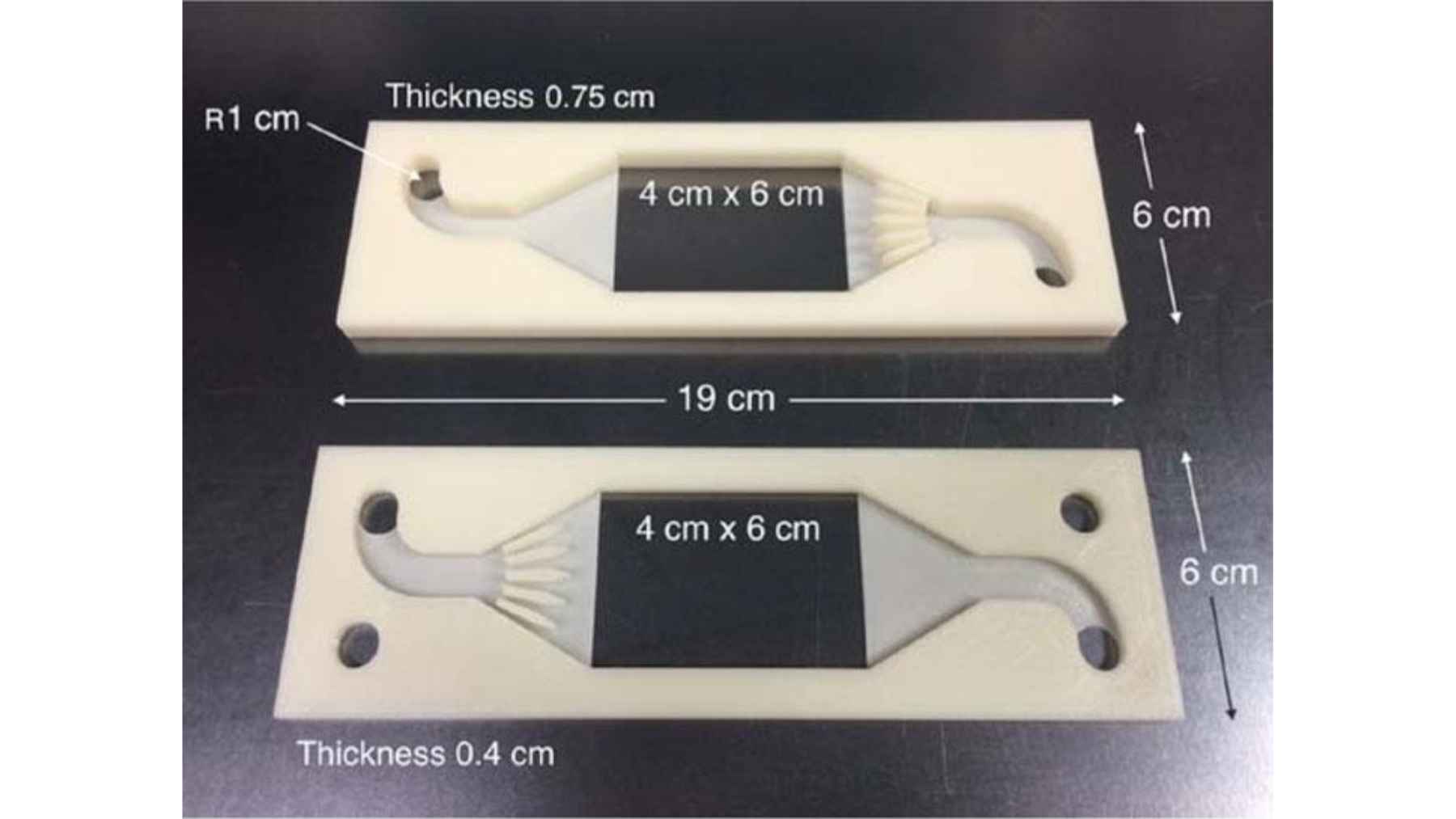
A 3D-printed flow battery cell design shows the dimensions and internal channels used for low-cost laboratory testing.
The hidden problem was inconsistent testing
Flow battery research involves many small choices that can change the result. Electrode cutting, membrane preparation, pump calibration, electrical connections, temperature, and even how the cell is tightened can affect apparent efficiency and capacity.
A 2025 study led by O’Connor examined 26 published papers containing full-cell cycling data. None reported details on electrode cutting, pump calibration, or repeat testing, while fewer than one in four described several other influential parameters. That makes comparing one laboratory’s “breakthrough” with another laboratory’s result much harder than it sounds.
The latest multi-institutional study made the problem even clearer. Eight participant groups at seven academic institutions used identical cell hardware, electrolyte chemistry, and experimental prompts, yet researchers still observed meaningful differences in charge-discharge profiles and other performance measurements.
Shared equipment helped, but it did not make human procedures and material variation disappear.
Why the “Ikea-style” manual matters
O’Connor and his supervisor briefly considered selling the cell to other researchers. Instead, they released the design and prepared what the team called an “Ikea-style instruction manual” so participating laboratories could assemble and operate it in the same way.
The Queen’s cell has now been distributed through a wider collaboration involving more than 35 research groups, including teams at MIT, Harvard, and the University of Cambridge. Scientists can perform nominally identical tests and then investigate why results still diverge.
From a business perspective, giving the design away could create more value than selling a limited number of units. If enough laboratories adopt the platform, it may become a common reference point for researchers, funders, and companies evaluating new battery materials. It is less a product sale and more an attempt to build an ecosystem.
What must happen before industry can use it
The researchers are now moving beyond individual cells and testing larger stacks and complete systems. That step matters because a promising chemistry on a single laboratory test bench can behave differently once pumps, multiple cells, seals, and control equipment are operating together.
There is still a long engineering checklist. Teams must examine durability, efficiency, electrolyte stability, component costs, and performance over repeated cycles, while proving that larger systems can be manufactured and maintained safely. Standardization will not solve every problem, but it can prevent laboratories from repeatedly chasing results caused by inconsistent testing.
That is the practical value of this project. The 3D-printed cell will not light homes tomorrow, but it could help researchers decide much faster which flow battery ideas deserve to be scaled. Sometimes the tool that lets everyone measure the same thing is the breakthrough that moves an industry forward.
The statement was published on Queen’s University Belfast.