
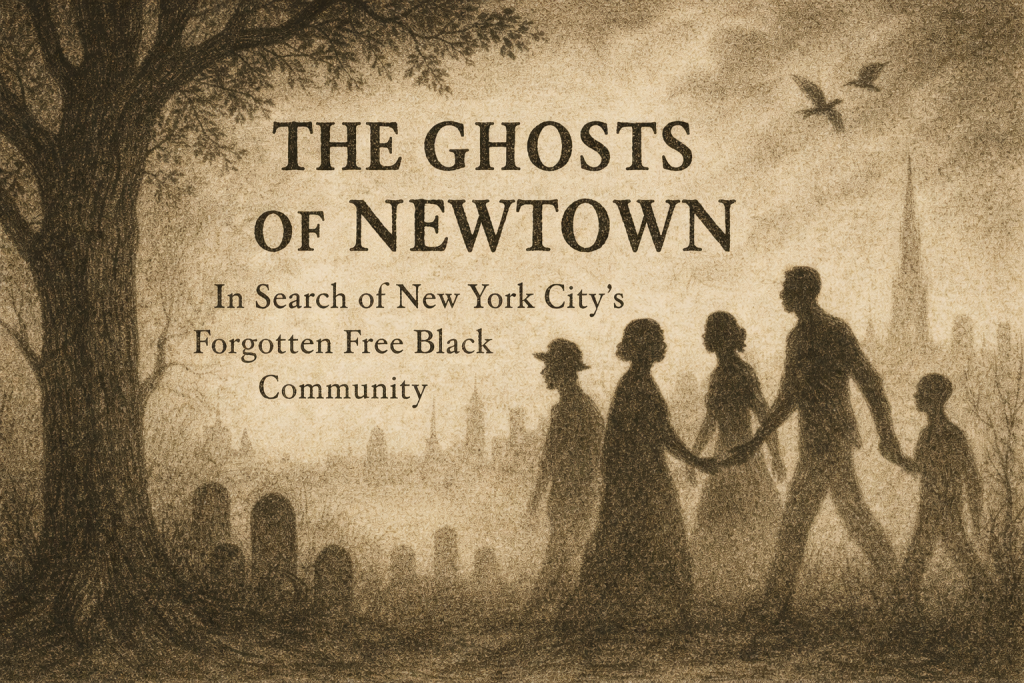
 In the early nineteenth century, resilient free Black community lived in Newtown, the rural village that would later become Elmhurst, Queens.
Census records, historical maps, manumission documents, 19th century newspaper articles, and correspondences show that Black families lived, worked, and raised children here decades before the Civil War.
Yet today, almost no visible trace of that community remains. In a direct response to the physical and historical erasure of one of New York City’s most significant early free Black settlements, Scientific Inquirer has announced the launch of the Wall of Ghosts.
The digital memorial is a central component of the Ghosts of Newtown project—a partnership between Scientific Inquirer editor Marc Landas and Jack Jaramillo and Gregory J. Cassagnol — dedicated to restoring the history of abolitionist Queens “to its rightful place in American history.”
While other historic sites like Weeksville in Brooklyn, Seneca Village in Manhattan or Sandy Ground on Staten Island are celebrated, Newtown’s story has remained largely absent from the public landscape.
At it’s peak in the 1850s, the size of its free Black population rivaled Weeksville’s. The farms, houses, and roads where these families once lived have been paved over by urban development. Their stories survive mostly in archival records — census pages, property documents, and scattered historical references.
 These records reveal a network of Black American families who navigated a society that often limited their rights, including property requirements that restricted Black voting.
Despite their contributions to Queens’ early history, no monument, marker, or public memorial acknowledges their presence.
“For too long, the history of Newtown (modern-day Elmhurst) has been allowed to fade as the neighborhood underwent rapid demographic transformations,” an announcement of the project said.
“This erasure reached a tragic peak in the spring of 2026 when concrete was poured over the Elmhurst African Burial Ground by 90 Queens Inc.—a site where experts estimate the remains of up to 290 individuals lie, many of whom were enslaved people whose labor built western Queens,” organizers said. “The Wall of Ghosts serves as a defiant countermeasure to this silence, reclaiming the names of 161 documented individuals found in records spanning from 1755 to 1829.”
The Wall of Ghosts pairs real names — such as Eve, Cesar, and Garrett Remsen — with imagined portraits to give a visual identity to a community that produced figures of international renown. Among those who called this community home were:
James W.C. Pennington (ca. 1807-1870): A teacher at the Newtown schoolhouse on Dutch Lane (now Corona Avenue) who escaped slavery to become the first Black student to attend Yale and a world-renowned abolitionist leader.Samuel Ringgold Ward (1817-ca. 1866): A fugitive-turned-preacher and radical orator who occupied the same Newtown pulpit before reshaping transatlantic history.John Bunyan Reeve (1831-1916): A former Newtown schoolteacher and protégé of James W.C. Pennington, Reeve went on to organize the theology department at Howard University, carrying Newtown’s legacy of faith and learning onto the national stage.
You can explore the Wall of Ghosts here, and sign a Change.Org petition for a permanent physical monument.
Read more about Black History in New York State.
Illustrations, from above: Wall of Ghosts promotional image; and an imagined portrait of Loo, a Newtown, Queens freedom seeker, from Wall of Ghosts (created by AI using original escape notice.)