
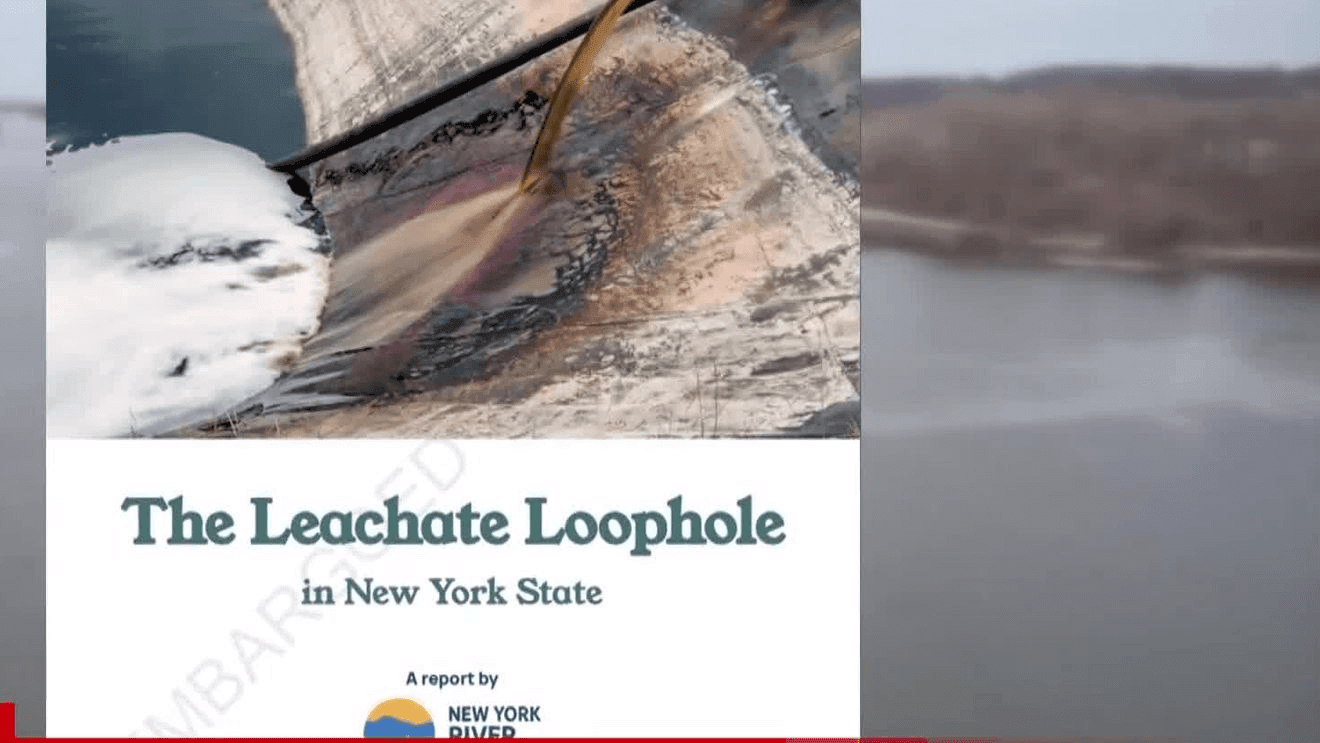
New York River Watch released a new report this week, “The Leachate Loophole in New York State”.
The report examines public records to determine the path of landfill leachate, and where it’s treated, and where it’s not, leading to its dumping into drinking water sources.
“We accounted for 523 million gallons of leachate across New York State each year from 2019 to 2023,” Jen Epstein, New York River Watch Director of Science, said. “We’re taking this very controlled stream of of waste that we understand to be very risky, and we’re letting it lose back into the water, and we’re shifting the burden of dealing with it to these communities that are using the drinking water. It’s a financial burden, but it’s also a burden of protecting public health, and that’s a big deal.”
Leachate can contain plastics, chemicals, toxic metals, PFAs, Pesticides and more. The report finding about 1/3 of the 523 million gallons was discharged into drinking water sources. Municipal filtration systems then are tasked with making sure the water is safe to drink.
“If the landfill is going to discharge that leachate directly from the landfill site, the Clean Water Act applies, and the landfill needs to acquire a permit and it needs to treat that leachate for some water quality standards. Very few landfills do that. What most of them do is that they dispose of the leachate by either trucking or sending it through a pipe to sewage plants. Clean Water Act also applies at the sewage plants, and because these sewage plants are designed to treat human waste, the types of sampling parameters that are required in these permits are focused on indicators of human waste. The sewage plants are not equipped and they’re not monitored for the broad range of toxic chemicals that are present in leachate. So, the bulk of it passes through,” Epstein says.
In July, the DEC released what they call “First-In-Nation” draft Regulations proposed to help stop PFAs at landfills from entering waterways, it would require treatment of environmental contaminants in leachate at landfills.
Also, to help support local implementation the State is making $77.8 million in federal infrastructure grants available to address emerging contaminants in leachate, and $495 million in State grants to address the State’s standards for emerging contaminants.
Those revisions would require currently active municipal solid waste (MSW) landfills and currently active construction and debris (C&D) landfills to treat leachate and remove contaminants, while ensuring proper disposal, needing to meet certain standards of limiting contaminants.
On Thursday, Riverkeeper, an environmental nonprofit group, received a capital grant of $50,000 to fund a new water testing device.
“We focus on protecting and restoring the Hudson River source to sea. So the Hudson River is 315 miles. We got a big area to cover. We also focus on ensuring New York City has clean drinking water, and so that is our our mission and what we’re here to do,” Drew Gamils, Senior Attorney at Riverkeeper says.
Gamils says those draft regulations need to be stronger, saying the current proposal puts too much of a burden on municipal drinking water facilities.
“It’s a good first step,” she said. “But to me, they’re inadequate, and they miss a lot of key issues. They exclude inactive landfills, ash fill landfills, which is definitely a category that should be regulated. They aren’t thinking about where these leachate treatment facilities are going to be placed, kind of on a statewide level, and I think we can do better to to think about that when we’re adopting these regulations, and I think they can go farther to require additional standards for leachate treatment, be a little bit stricter in what chemicals are going to be removed and at what levels they have to be removed.”
The New York River Watch report aligns with her perspective, as it found that roughly 45 inactive landfills disposed leachate at New York State municipal sewage treatment plants.
“We really have to take a step back and think this through holistically before a dime of public taxpayer money is applied to this, and make sure that we’re also holding accountable chemical companies, landfills that are managing this waste, and really making sure we’re not penalizing downstream communities who are not aware of this practice, who are drinking this water, and who are not should not be held to account for sure,” Rebecca Martin, Executive Director of New York River Watch, says.
While they say thanks mainly to the filtration systems the State’s water is safe to drink, the process needs to improve in order to maintain confidence, and improve New York’s water moving forward.
DEC is hosting two virtual public comment hearings on September 2, at 1 p.m. and 6 p.m. Pre-registration is required to speak during the meeting.
DEC is accepting public comment on the proposed revisions until September 9, 2026.
Watch the full interview with New York River Watch here:
Watch the full interview with Drew Gamils of Riverkeeper here: