
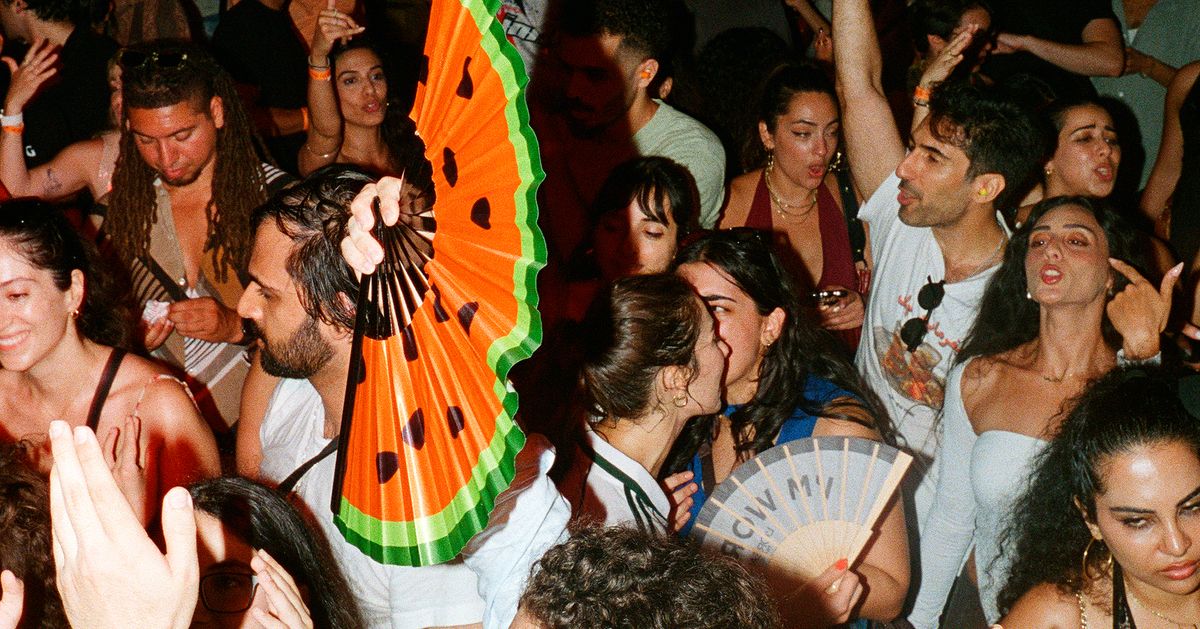
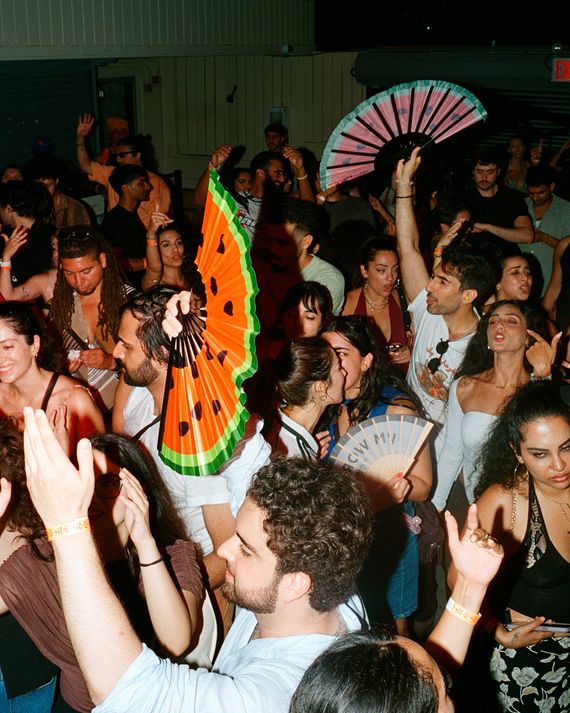
A Haza party at Elsewhere in August.
Photo: Dean Majd
At its conception in 2024, the Rangarang Show was a fairly niche entry in the Middle Eastern party scene in New York: a Persian-language lip-sync battle named after a beloved pre-Revolution variety show in Iran that broadcast performances by the country’s greatest singers. The concept was nostalgia meets queer Brooklyn, and co-founders Milad Ahmadi and Mahya invited guests to wear ’70s disco glam and take turns performing. The first event drew an intergenerational and enthusiastic crowd, so they threw it a handful more times. They were gearing up for another bash slated for January 10 of this year — a sold-out party at the Sultan Room — as news broke that the Iranian government had shut down the internet and begun a violent crackdown on protesters. It was too late to cancel, they decided, so they transformed the event into a no-cost vigil where audience members could play music, read poetry, and donate to a human-rights organization supporting activists in Iran. Although the turnout was modest, the result was a moving ceremony. “People came with their instruments,” says Mahya. “It was one of the most beautiful events we’ve had because it was so genuine.”
When to celebrate has been a fraught question for the SWANA diaspora, the occasions for joy so frequently punctured by mourning. Tragedy in Gaza, Iran, and Lebanon has given New Yorkers with ties to the region new reasons to gather, protest, and grieve, whether for their homeland or relatives, for their parents’ birthplace, or in solidarity with nations they consider neighbors. The founders of Rangarang (“colorful” in Persian) met during the Women Life Freedom movement in 2022, when Iranian New Yorkers discovered, as if for the first time, just how numerous they were. In the aftermath of October 7, 2023, two of the city’s most established parties, Laylit and Haza, temporarily paused, even though that meant one fewer place for the community to convene with the only people who knew exactly what they were going through.
Habibi City
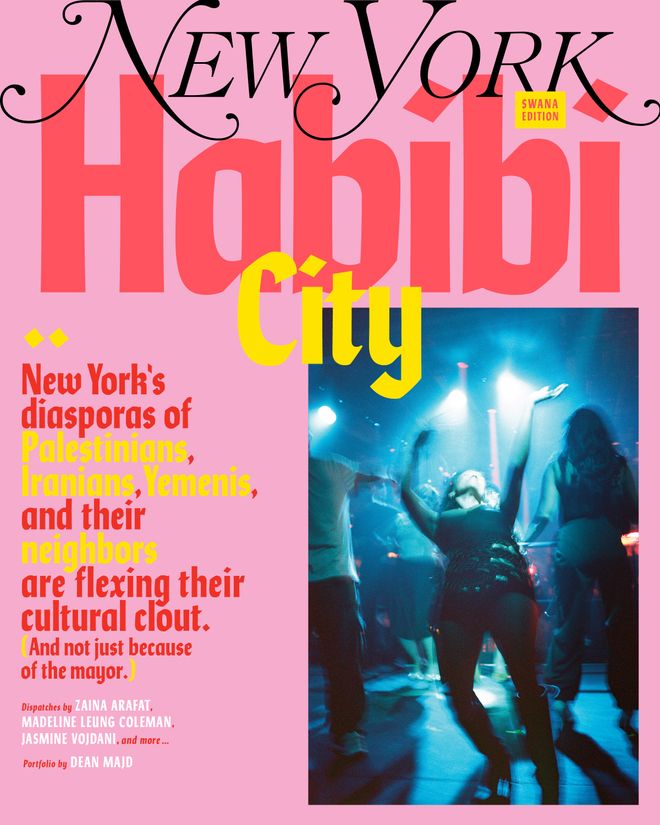
Twenty, even ten years ago, the thought of hearing any kind of Middle Eastern music in a club in New York was near unimaginable, but from 2017 on, an emerging set of recurring parties slowly started to challenge that. That year, Assia Belkiss, a Moroccan New York native, dreamed up a queer-, POC-, and women-centered party called Yalla! Party Project. Next came Disco Tehran, which reimagined the multicultural music scene of pre-Revolution Iranian clubs. Then there was Laylit, whose founders wanted to showcase the broad spectrum of Arab music from dabke to shaabi to pop to electronic, and Haza, devoted to Arab, Asian, and African music and led by two Egyptian DJs who happened to meet at Yalla! Some of these parties began in cramped apartments, others at Bushwick venues like Mood Ring or the Sultan Room before graduating to Elsewhere or Knockdown Center. Over time, their DJs began playing at one another’s events and creating places where people in the diaspora could find one another, connect with their identity, and dance. Today, there are more SWANA parties than you can count, from rooftop dance sessions to ambient underground loft sets serving dinner. The original four — Yalla!, Laylit, Disco Tehran, and Haza — got into a groove of throwing parties several times a year.
During the increasingly frequent outbreaks of war, DJs faced the dilemma of how to get back to regular programming. No longer was the party merely a place to find one’s people and let loose; some DJs politicized the dance floor, applying the idea of “joy as resistance” to the right for Middle Eastern people to dance in a time of terrible violence. Others wondered how celebration could help resist oppression. In person, however, DJs say the return was positive, the demand still there. The idea was “if you feel like it, come for a couple of hours to let go and release,” says Saphe Shamoun, who co-founded Laylit along with Philippe Manasseh and Nadim Maghzal. Shamoun emphasizes that it’s possible to feel more than joy at a party: “Music is not just this pill you’ll take and you’ll feel happy and you start dancing. It is a complex web of emotions, and we should think about that range of feelings.”
Some came together to found new organizations, such as Palestine Forever, which began hosting benefit concerts in October 2023. Omar Ahmad, a Palestinian American composer and DJ who now steers Palestine Forever’s residency at the Lot Radio, recalls that, at one sold-out show co-hosted with Bushwick venue Nowadays in February 2024, the line to get in stretched several blocks. Ahmad, who also works in emergency medicine, played the headlining set, which included an experimental performance with audio of screaming Gazans during one strike on the Al-Shifa hospital emanating from the venue’s four-point sound system. “I was nervous to include it,” Ahmad says. “I was shaking. It was received with dead quiet. I don’t know if that’s what I wanted, but I can’t think of a better response than slowing down and being in it.” Ahmad’s sets the past few years have tended to foreground catharsis over joy and making people “feel seen while still being able to process and release through their bodies.”
As the scene grew, some moved on from partying while others tried to hold multiple truths at once. Earlier this year, Masquerade — a beloved Iranian bar in Williamsburg — filled with revelers celebrating the death of Ayatollah Ali Khamenei on the same day an American strike on a school in Minab, Iran, killed more than 100 children. A few weeks later, as Iranians debated how and whether to celebrate their New Year, Technowruz, the annual Persian New Year party at Nowadays, favored SWANA folk music and live keyboard-generated santoor, tanbur, setar, and daf; instead of dancing, attendees sat on cushions and drank tea. Other DJs were thinking up new forms for gathering. Mahfel hosted loft parties where sets include samples of classic Persian singers with contemporary Middle Eastern artists and halvah and dates were shared, a ritual of mourning. Haza, meanwhile, announced that it will end its parties in order to focus on community events, such as Arabic-language nights and food pop-ups.
Lately, the DJs have noticed an uptick in non-SWANA partygoers on the dance floor. At a recent Disco Tehran party on Elsewhere’s rooftop, Vincent, a French expat living in New York who came with a group of friends with ties to the region, tells me he preferred its “more open, more mixed environment,” which isn’t just playing Top 40. He’d thought about the war in Iran when he heard about the party. “It’s cool to be here to support Iranian culture,” he says. “I watched the Iran World Cup match in the same spirit, after the difficulty the team has faced, because we know people are not their government.” That same weekend, at a Club Joon soiree in Williamsburg — where an Azealia Banks song about cunnilingus played between Persian pop classics — I met a solo white man who told me he’d come there to try to meet an Iranian girl but had yet to make a connection.
Although the bigger parties now tour internationally, people in the scene say no one is doing SWANA nightlife like New York. While some DJs continue to lean into the sounds people grew up listening to, others find that, over time, playing Nancy Ajram club remixes can feel limiting. “At first, their crowds were down for whatever, because it was so new to them that I could play contemporary things that called out to me as a musician,” says Ahmad, who has performed at Laylit and Haza a handful of times. “Brands can become fixed, and a subset of people only got excited when it was music they knew. It feels like Arab Top 40 with a tilt.” Several DJs noted the cultural divide between attendees from abroad and those born in the U.S. “People who are first generation like me,” Shamoun says, “are like, ‘We’ve heard this track a million times.’ It’s the second generation that’s fascinated by our parties.”
No matter what you’re looking for, many of these parties have an undeniable magic. On the last Saturday of July, Laylit and Disco Tehran had dueling events blocks apart. Laylit’s stock was manifestly up; it had taken over Elsewhere’s 26,000 square feet with a slate of 13 DJs and still ended up turning people away. Inside, the dance floor was electric, and Palestinian keffiyehs worn as shawls or bandannas peppered the crowd. As for Rangarang, Mahya and Ahmadi are still working out how to return to form. Resistance, they think, can mean doing exactly what is prohibited in the country you or your parents grew up in. Mahya, who moved from Iran to the U.S. as a child, will never forget when her older brother dropped in on one of their shows and she found him crying on the dance floor; after their religious upbringing, he couldn’t believe she had finally found community. Ahmadi, who left Iran at 7 and moved to the city from Dubai in 2015, told a similar story. After not seeing his mother for nine years, he brought her to Rangarang. Although he’d come out to his family a few years before, she’d never seen him in his element, let alone being celebrated as a queer person. When Ahmadi called his mother onstage, he told the crowd that, at a certain time, he would never have imagined coming out to her. “Now she’s at my show where I’m dressed like a gay alien,” he said. His speech, inspired other queer Iranian men to bring their mothers onstage to sing together. “When joy and dance and freedom are the exact things forbidden by your regime,” Ahmadi asks, “is doing those things not literally protest?”
Thank you for subscribing and supporting our journalism.
If you prefer to read in print, you can also find this article in the August 10, 2026, issue of
New York Magazine.
Want more stories like this one? Subscribe now
to support our journalism and get unlimited access to our coverage.
If you prefer to read in print, you can also find this article in the August 10, 2026, issue of
New York Magazine.
More From This Issue