
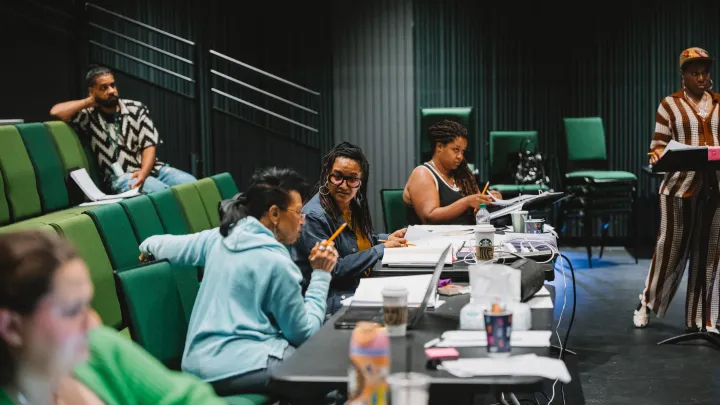
On a Friday afternoon at the end of July, six artists from the New York Theatre Workshop met in the Jack 1953 and Mac 2011 Morris Recital Hall at the Hopkins Center for the Arts to discuss their work as part of an artist-in-residence salon open to the public.
The artists had been at Dartmouth that week as part of an annual summer residency co-sponsored by the Department of Theater, the Hop, and NYTW, which invites playwrights, directors, composers and lyricists to share new work in a collaborative atmosphere.
Then, in the Hodgson Family Dance Studio, two of the artists, Hansol Kim, a lyricist, and Boram Han, a composer, explained to the audience, which was drawn from Dartmouth, the NYTW and the Upper Valley at large, the origin of their musical-in-progress, a two-person work titled Intermission.
The work follows a Korean actress who forms an unlikely friendship with a chatbot after learning she has cancer. It is based on Kim’s own experience of having returned home to South Korea after earning an MFA in graduate musical theater writing from New York University, only to be diagnosed with a Stage 4 blood cancer.
“My life suddenly stopped completely,” Kim told the audience in Hodgson. “My only goal was to survive, but after treatment my only goal was to write this musical for myself.”
From such experiences works of art can emerge. But, as a rule, works of art don’t spring up fully formed. They often need the kind of development and time that the NYTW affords artists through its residencies. This summer, the NYTW celebrated its 35th anniversary at Dartmouth, the longest partnership of its kind in NYTW’s history, says Rachel Silverman, NYTW’s associate artistic director for workshops and development.
Quote
We try to, and do, complement each other and work together. It’s part of the history of the way arts have evolved at Dartmouth.
Attribution
Mary Lou Aleskie, director, Hopkins Center for the Arts
Such a longstanding partnership between a theater and an academic institution is unique, says Mary Lou Aleskie, the Howard Gilman ’44 Executive Director of the Hop, and the workshop this summer took advantage of the newly reimagined Hop after its $123.8 million renovation and expansion.
“We haven’t found another project like this at another university,” she says. “We try to, and do, complement each other and work together. It’s part of the history of the way arts have evolved at Dartmouth. As with research in other disciplines at Dartmouth, we adapt and grow from the process, which includes learning from setbacks during the creative development of new works.”
The program brings together a wide array of composers, lyricists, playwrights, directors, actors, backstage crew, and Dartmouth faculty and students for a two-week theatrical odyssey of discovery and invention. One group of artists live and work at Dartmouth for the first week; a second group, for the second week.
This summer, 36 artists were in residence, along with NYTW staff. Ten pieces were workshopped and the public could attend two artist-in-residence salons where the artists talked about their ideas and performed brief excerpts from the works. There were also four public presentations of works in progress.
New York Theatre Workshop Associate Artistic Director Rachel Silverman, and theater artists Michael Breslin, Britton Smith, and Satchel Lee discuss new works in early development with an audience of Dartmouth students and community members in the Mindy Kaling Theater Lab. (Photo by Robert Gill)
Former NYTW artistic leaders James C. Nicola and Linda Chapman, who helped to initiate the residency program at Dartmouth in 1991, felt that “the mental space and the physical space to explore” in a place far removed from a city could be a critical element in an artist’s creative process, Silverman says.
While there had been a long tradition of summer theater productions in the Hop, faculty with the Department of Theater wanted Dartmouth to be seen as a place where things got made, not just shown.
One of the great advantages of NYTW at Dartmouth is that “there is no pressure to create a product; there is no pressure for Broadway at a certain date,” Aleskie adds.
“When so much of life as an artist is about how to survive,” Silverman says, the residency “unlocks a mental space of just being able to focus on making art.”
Over the years, the roster of theater artists visiting Dartmouth has included numerous Pulitzer Prize, Tony Award and Obie Award-winning playwrights, directors, actors, composers and designers. The Broadway hits Rent and Hadestown, which both won Best Musical Tonys, were partially developed under the auspices of NYTW at Dartmouth.
This year’s high-profile workshop performance was Nightbirds: The Story of Labelle, with a book by two-time Pulitzer Prize-winning playwright Lynn Nottage and music and lyrics by Nona Hendryx, a singer in the female trio Labelle, which shot to fame in the 1970s with the #1 Billboard single Lady Marmalade, combining soul, R&B and disco in a compulsive rhythm and vocals. Hendryx was at Dartmouth in 2025-26 as a Roth Visiting Scholar.
Nightbirds follows Hendryx, Patti LaBelle, and Sarah Dash as they form the group and throw off the 1960s convention of the girl group to transform themselves into an avatar of bold, unapologetic womanhood. (Although NYTW has been “in conversation” with Nottage before, Silverman says, this is the “first project we have worked on together.”)
While at Dartmouth, the artists stay in student dorms, eat a communal dinner together every night in the Class of ’53 Commons, and apart from their work, also spend some time off campus, taking in the landscapes and towns of the Upper Valley, and beyond.
The artists have broad latitude in how they spend their time: writing, composition, research in Dartmouth’s numerous libraries and spending time with faculty and undergraduates on campus participating in THEA 65 Summer Theater Lab from the Department of Theater.
Stefani Kuo 郭佳怡 shares a work-in-progress showing of Moonie, a solo piece exploring lineage, love, motherhood, and grief, with engagement from Summer Theater Lab students and professor Rob Grant, who collaborated with NYTW artists throughout the company’s residency. (Photo by Robert Gill)
The opportunity for students to observe the gestation of a play or musical and also talk to theater professionals is an invaluable practical education, says Robert David Grant, a lecturer teaching the theater lab this summer. (Grant is also an actor who has appeared with Yale Repertory Theater and in NCIS, The Equalizer, and HBO’s Succession.)
“Hopefully, what they’re seeing is that it’s messy, and people don’t know exactly where they’re going. It’s not just a bunch of virtuosic artists getting in a room and something inevitable comes out of it. It is the collision of all of these people making contributions that creates something that otherwise could never have existed,” Grant says.
Isabella Konecky ’28, who plans to major in English and history, and is also interested in creative writing, enrolled in the summer lab and says the totality of the experience, including the NYTW residency, has been “indescribably amazing.”
Assigned to shadow on Nightbirds, Konecky says that to be able to watch Nottage’s process and “the process of so many artists, was an incredible learning experience. A life in the arts can often seem impossible or even inconceivable, so to be surrounded by so many working creatives was really illuminating and worthwhile.”