
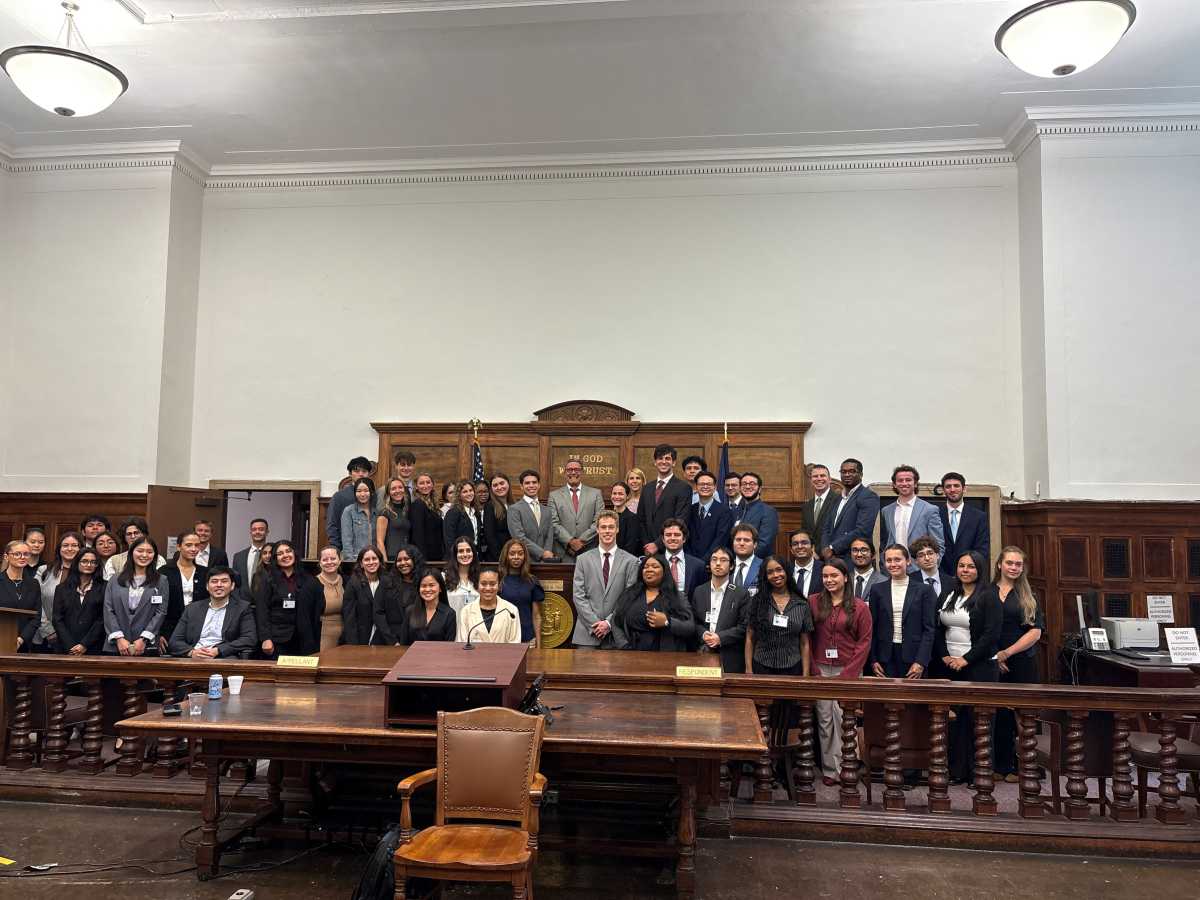
For a group of NYS Supreme Court judicial interns at Manhattan Supreme Court, the summer has been a lesson in law from those who have spent decades practicing it. Through discussions and meetings with judges and members of the Appellate Term, the interns gained insight into the responsibilities of legal professionals and the importance of public service.
The summer internship program, which started on May 26 and will wrap up this month, has expanded in recent years, in collaboration with Administrative Judge Suzanne Adams, with more than 400 undergraduate, law school, and high school students participating this year. Interns observe courtroom proceedings, visit Appellate courts, assist with legal research and drafting, and gain firsthand exposure to the range of jobs available within the legal profession.
Additionally, interns assist in drafting bench memos and decisions on motions, while supervised by chambers’ staff, and always overseen by the judges for whom they intern. As part of the program, the judges may choose their own interns, while others may prefer to have them assigned from a pool of resumes Justice Adams receives regularly.
Justice James d’Auguste’s 34 interns also participated in almost daily “Lunch and Learn” sessions, featuring judges, lawyers and other professionals. The programs, curated by Kawtar Merfouk and Larisa Blinderman, provide opportunities to learn, network, and hear firsthand accounts about public service.
A wide variety of guest speakers participate in the Lunch and Learn series, including former Presiding Justice of the Appellate Division, First Department, Rolando Acosta, to Deputy Chief Administrative Judge for the Office of Justice Initiatives Edwina Richardson, a vast number of judges from New York and other counties, as well as lawyers from around the country coming to speak on a myriad of topics, including commercial litigation or transaction law, as well as aviation, insurance, criminal, family and entertainment law, as some of the topics interns have expressed their interests lay.
The following pieces are authored by interns who participated in the program:
The Lunch and Learn experience
Featuring Justice Rolando Acosta
By Eric Martin, Emory Law School student
Justice Rolando Acosta’s career is inspirational, but it is his insights, rather than his experiences, that set him apart as a role model.
Justice Acosta began his career at legal aid in the South Bronx for the very same group that protected his family from eviction after they immigrated to the United States. From working in public service and supporting underprivileged youth in his community to becoming the first Dominican judge on the Appellate Division, First Department and its first Presiding Justice, to now pursuing private practice as a partner at Pillsbury Winthrop Shaw Pittman LLP, Justice Acosta has accumulated a wealth of experience.
As the New York Supreme Court’s summer intern class settled into the season, Justice Acosta’s words left a lasting impression on the group of aspiring lawyers. In the mere hour that His Honor had with the group, he managed to instill in them a sense of responsibility to both provide mentorship and to seek out the vast opportunities to find it among the professionals surrounding them.
As one intern, Yanis Park reflected, “What resonated most to me was Justice Acosta’s call for students and aspiring lawyers to keep showing up for their communities. Seeing someone who has dedicated decades to service across different facets of law, and who still leads with such a clear heart for people, was a powerful reminder of the kind of lawyer I want to become.”
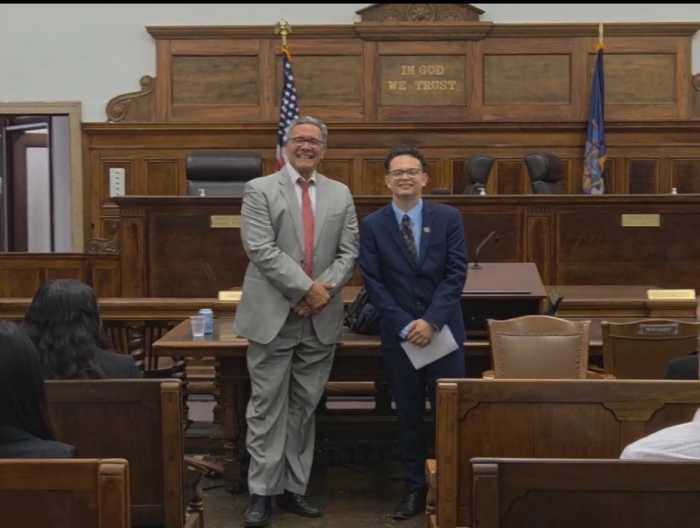 Justice Acosta and Giovanny Esquerra
While his extensive background is in public service, observers will be quick to point out his notable shift from public service to private firm practice. Justice Acosta shared that his daughter, an attorney at a prominent law firm, inspired him to take on the new challenge through her own experience and dedication to pro bono projects. He explained to the group of eager students that no matter what area of the law students choose to practice in, there is always an opportunity to use the resources available to make meaningful impact, underscoring the idea of required pro bono hours and the abundance of cash and resources at firms’ disposal, not to mention the ability to negotiate his contract, allowing ample room to express his perspectives on the ever changing legal landscape.
Entering his 44th year of practice, Judge Acosta left the students with one last piece of advice: not to get toward the end of their careers having only invested in themselves. As he said goodbye to the impressionable group, it was clear that Justice Acosta has dedicated, and continues to dedicate, his life and career to others, with much to be proud of.
Featuring Presiding Justice James, Justice Tisch, Justice Perez
By Eric Martin, Sharmie Azurel & Lilia Hessabi
The New York Appellate Term may resolve disputes, but first the Justices must resolve their own. With their unique position as an intermediary court, between the Trial Courts and the Appellate Division, justices hear a variety of cases, encouraging discourse regarding creative ways of approaching legal issues that can impact everyday New Yorkers.
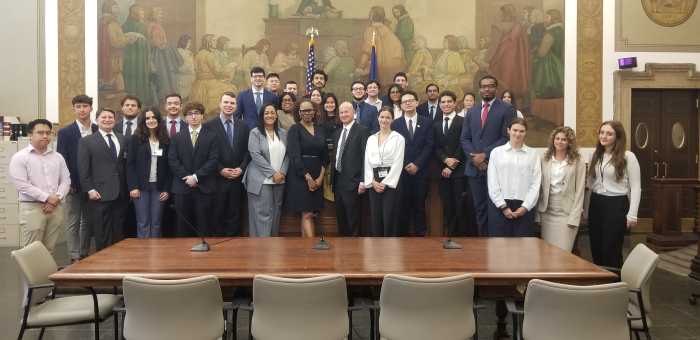 Appellate Term Lunch and Learn group.
At a June 15, 2026, lunch-and-learn lecture, the New York State Supreme Court’s judicial interns heard from Presiding Justice Ta-Tanisha James and Associate Justices Alexander Tisch and Bianka Perez of the Appellate Term, First Department. The justices described what happens when members of the panel disagree: how they test each other’s reasoning and reach decisions requiring the concurrence of at least two of the three justices who sit on any matter. The Appellate Term hears appeals from New York City’s Civil and Criminal Courts in Manhattan and the Bronx. Its docket runs to landlord-tenant disputes and misdemeanor criminal appeals, cases that carry heavy consequences for the parties involved, despite the Court’s position below the Appellate Division.
The Justices also discussed their paths to the bench and the importance of a diverse and ever-adapting judiciary. Justice James began not in the law, but as a schoolteacher in the Bronx. She earned her law degree from Fordham, clerked for Court of Appeals Judge George Bundy Smith, and joined the Appellate Term in 2022. Justice Perez, the first person of Dominican descent to serve on this bench, rose through the Civil and Criminal Courts in Bronx County after adjudicating cases at the City’s Office of Administrative Trials and Hearings. Justice Tisch, a George Washington University and St. John’s Law graduate, built his legal expertise through his experience in private practice, regulatory agencies, and various levels of the New York judiciary.
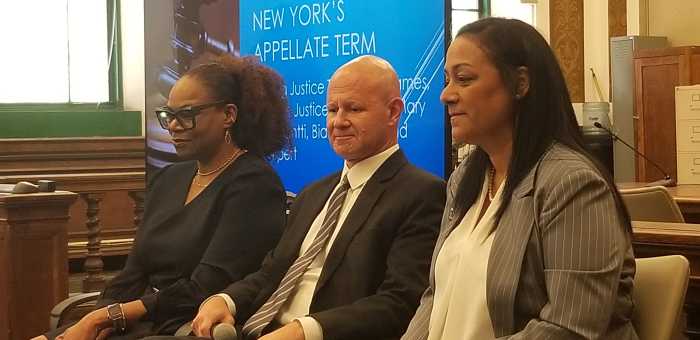 Appellate Term panel, Justices James, Tisch and Perez.
Justice Perez highlighted the distinct nature of their appointment to the Appellate Term. Unlike the trial court and the appellate division, appointed justices carry their full Supreme Court trial caseloads alongside their appellate work, reviewing a lower court’s exercise of discretion, while managing trials of their own. The candor with which they discussed that burden, the friction of disagreement, and the care required to get it right, was itself a demonstration of the independence they came to defend. “Our decisions impact [people’s] lives,” Presiding Justice James stated. The Justices were unequivocal that the intellectual rigor they bring to each case is not diminished by that position.
As each Justice brings their own subject matter expertise, they must also bring ingenuity when hearing cases as large as those that come through New York City. Through his experience, Justice Tisch describes lesser-known avenues for resolutions to cases. For smaller matters, he highlights the advantages of having small claims arbitrators hear cases to receive speedy judgments rather than using the traditional court timelines. Justice Perez and Justice James’ experiences, alike, working in criminal defense in the Bronx and leading the Harlem Community Justice Center respectively, taught them to practice by diligently collaborating with fellow Justices and writing opinions that create equitable and proper results.
All three returned to a foundational point: an independent judiciary is not an abstraction, but the cornerstone of democratic governance. Judges are constrained by the Constitution, by caselaw, and by statute.
More information about the New York Courts can be found online at the New York State Unified Court System.