
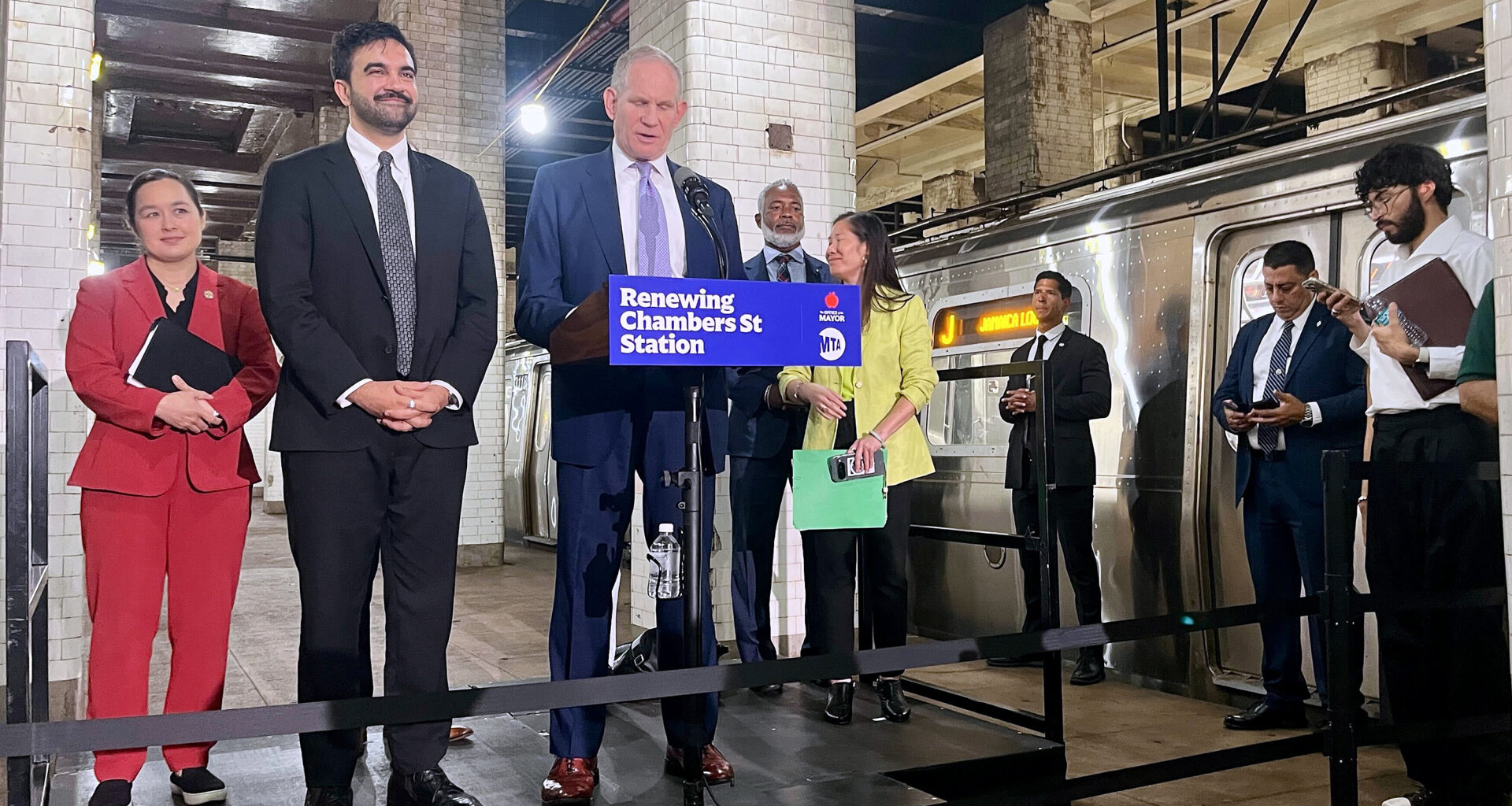
A plan to renovate one of the NYC subway system’s most neglected subway stations — the Chambers St. J and Z stop in Lower Manhattan — might also include some respite for sweaty straphangers.
The MTA and the City of New York jointly announced Monday a state-funded plan to studying the possibility of adding geothermal heat pumps to the station — and tying the system into the above-ground Dinkins Building at One Center St. and other nearby municipal buildings.
If feasible, the system would use geothermal heat pumps to cool the subway platform in the summer and heat the city government offices in the winter.
“Working with Mayor Mamdani and the MTA, we are harnessing cutting-edge climate technology for a truly cool purpose — making our subway stations tolerable during the summer and heating critical city buildings during the winter,” Gov Hochul said in a statement.
Michael Appleton/Mayoral Photography Office
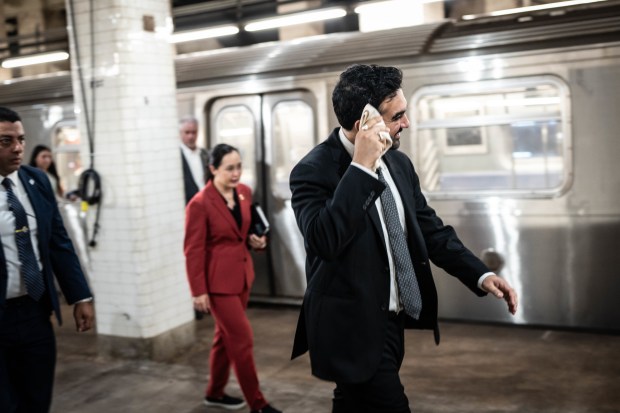
Mayor Mamdani wipes his brow after a press conference at the Chambers St. station on Monday. (Michael Appleton/Mayoral Photography Office)
MTA chairman Janno Lieber lauded the plan in a steamy presser on a disused Chambers St. platform.
“I don’t have to tell any New Yorker that it is brutal underground in the summertime,” Lieber told reporters.
The MTA boss said the adjacent City Hall station on the Nos. 4, 5 and 6 — which is included in the study — is among “the sweatiest in our system,” with peak average temps reaching 96 degrees last year.
“Anyone who has stood on a subway platform in August knows that our stations do not just get hot, they turn into underground saunas,” Mayor Mamdani said. “And if you, like me, do not know what a ‘summer suit’ is, and choose instead to commute in a wool one, let me tell you it is far from a therapeutic experience.”
Geothermic cooling functions similarly to ordinary air conditioning, but uses water to transfer excess heat further underground — rather than venting it outside as hot air like a traditional AC.
The MTA is exploring the possibility of geothermic cooling at other stations as well, and a handful of stations in the system do have some form of basic traditional air conditioning.
But the $800,000 study, funded by the New York State Energy Research and Development Authority, would explore the possibility of a network — combining heat pumps on Chambers St. Station’s disused middle platform with the interconnected steam-heat lines of the municipal buildings above ground, allowing the same system to also heat city government buildings in the winter.
The geothermal feasibility study is expected to be complete by the end of the year.
The broader renovation of Chambers St. — which despite its disrepair is on the National Register of Historic Places — is paid for by a portion of the MTA’s capital budget funded by congestion pricing.
That work is expected to include restoration of the station’s mosaics, terra cotta ornamentation and marble work, along with structural repairs and improvements to the station stairwells, lighting, and other infrastructure. A contract for that work is expected to be awarded by December.