
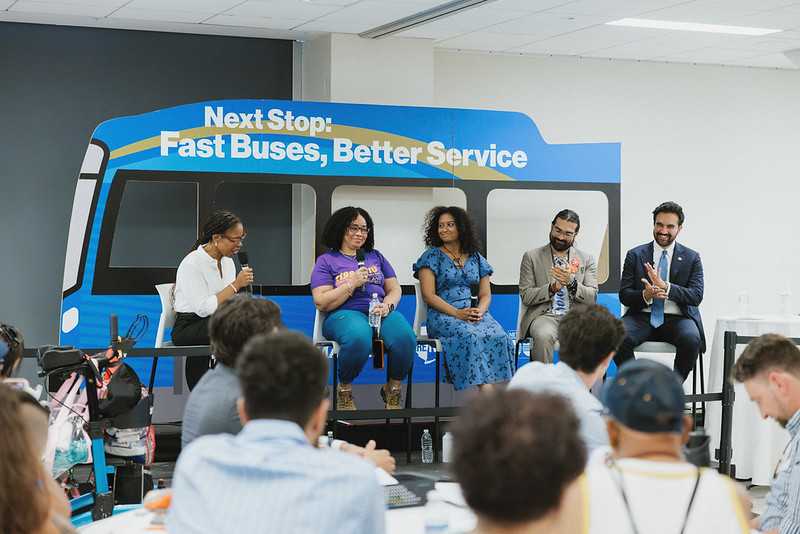
Central Brooklyn bus riders got their first chance to weigh in on proposals for speeding up routes running through their portion of the borough at Brooklyn College last week.
A large room on the CUNY Campus was packed with just over 100 people on Aug. 6, all gathered for Mayor Zohran Mamdani’s “Central Brooklyn Bus Rider Town Hall” event. The workshop-style session was the first of several the city and state will hold to gather public feedback on their joint plan aimed at making buses faster: “Next Stop.”
Besides the mayor himself, the crowd included officials such as Elizabeth Adams, the city’s senior advisor for fast and free buses; city Department of Transportation (DOT) Commissioner Mike Flynn, MTA NYC Transit President Demetrius Crichlow, and Public Advocate Jumaane Williams. Also in attendence were DOT and MTA staffers, transit and safe streets advocates, influencers invited by the Mayor’s Office of Mass Engagement, and regular bus riders.
Attendees, sitting at round tables that each bore one of 13 specific bus route numbers touched by Next Stop, were asked to consider its proposals for boosting bus speeds on three vital Central Brooklyn corridors: Flatbush, Utica, and Church Avenues.
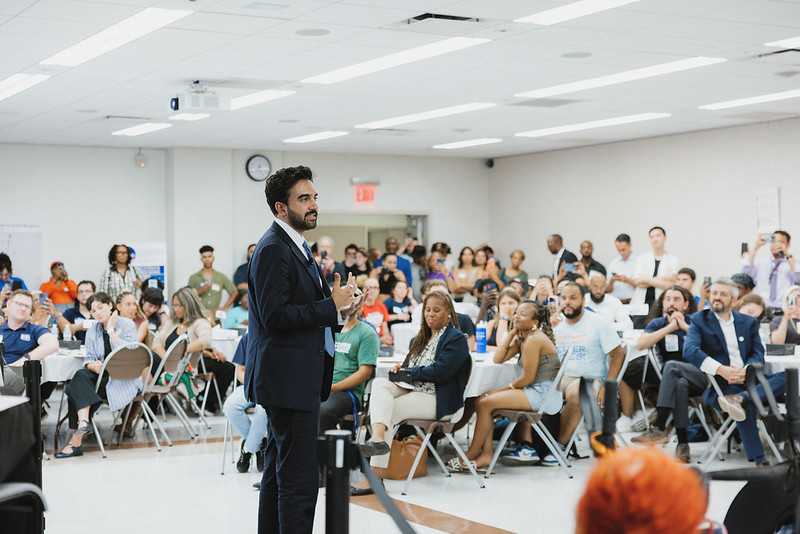 Mayor Zohran Mamdani addresses the crowd at his Central Brooklyn Bus Rider Town Hall event at Brooklyn College. Thursday, Aug. 6, 2026.Kara McCurdy/Mayoral Photography Office.
The three thoroughfares were among the first five identified in the plan that will get “rapid bus corridors,” the city’s latest attempt to implement bus rapid transit-style designs on its streets.
“What we are so excited about is that in a city where everyone deserves better buses, we are going to bring the first bus rapid transit route right here to Flatbush,” Mamdani told the attendees.
“What that’s going to mean is that you don’t have to run that fast for that one bus you see, because you actually know that there will be another bus after that,” he continued. “You know that in fact you will see a bus regularly, and that bus will move at a regular speed, and it will go so fast that it won’t just be those who have no other option that are riding the bus.”
The city and the MTA selected Flatbush, Utica, and Church Avenues because they host some of the city’s busiest bus routes. The 13 routes traveling on the three Central Brooklyn routes move as slowly as average speeds of 2 to 5 miles per hour.
Moriah Richardson, an MTA transportation planner, said during a presentation that buses on Flatbush Avenue primarily serve riders who are Black (59%), women (72%), and households with a yearly income of less than $80,000 (74%) — citing a 2024 study published by the Pratt Institute and the advocacy group Riders Alliance.
“These slow bus speeds on these corridors have a direct impact on those riders,” Richardson said. ” These are neighborhoods that rely on the bus and public transit to get around and are being punished for it, which underlies the need for us to do better.”
While implementing bus rapid transit designs on the three corridors is the plan’s long-term goal, the city and MTA also presented more immediate ideas to speed up bus service on those routes. Those include the installation of busways — a design that restricts access to just buses, emergency vehicles, and trucks — as well as more pedestrian space, greenery, and street furniture.
Much of the event focused on DOT and MTA officials getting a better understanding of riders’ everyday experiences on the 13 Central Brooklyn routes affected by Next Stop, as well as what improvements they would most like to see.
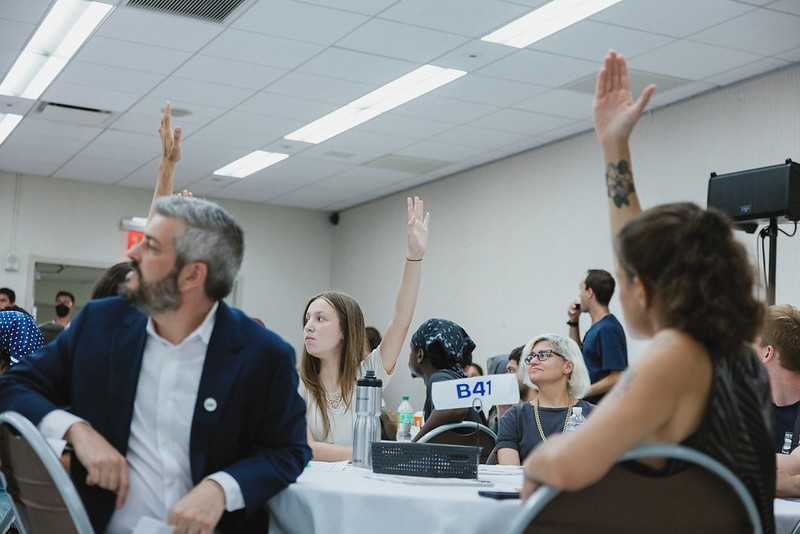 City Department of Transportation Commissioner Mike Flynn at Mayor Zohran Mamdani’s Central Brooklyn Bus Rider Town Hall event. Thursday, Aug. 6, 2026.Kara McCurdy. Mayoral Photography Office.
Flynn said the purpose of such events is to develop a “rider-centered plan,” the central goal of which is to speed up city buses by up to 20% on 50 “priority” corridors.
“This is just one of many such workshops we’re going to have,” the DOT commissioner said. “We’re looking to hear from you, not only for input on this plan, but even if you have ideas about how we can best capture the experiences, the perspectives, the priorities of bus riders across the city. We’re really just at the beginning of this process.”
Attendees were asked to share the most frustrating parts of their bus trips and what they would immediately change about riding the bus if they had a “magic wand.” Additionally, they were asked to discuss all of the community stakeholders that should be part of redesigning the bus corridors, highlight locations along the corridors where they want to see safety improvements, and make suggestions for parking and loading regulations along the impacted roads.
“Providing us this feedback will help us gain deeper familiarity with your neighborhoods and ensure that we have a holistic project that is sensitive to the community needs,” Richardson said. “This feedback is absolutely foundational for all that we do.”
One Central Brooklyn rider who attended the event, named Wayne Lewis, said he regularly takes the B44 and B41 routes. The former runs on Nostrand and Bedford Avenues between Williamsburg and Sheepshead Bay, while the latter goes down Flatbush Avenue between Downtown Brooklyn and Marine Park.
The Crown Heights resident said that on both routes, “the timing is off.” He added that in his neighborhood, he feels like bike lanes take away from road space that could be used by buses.
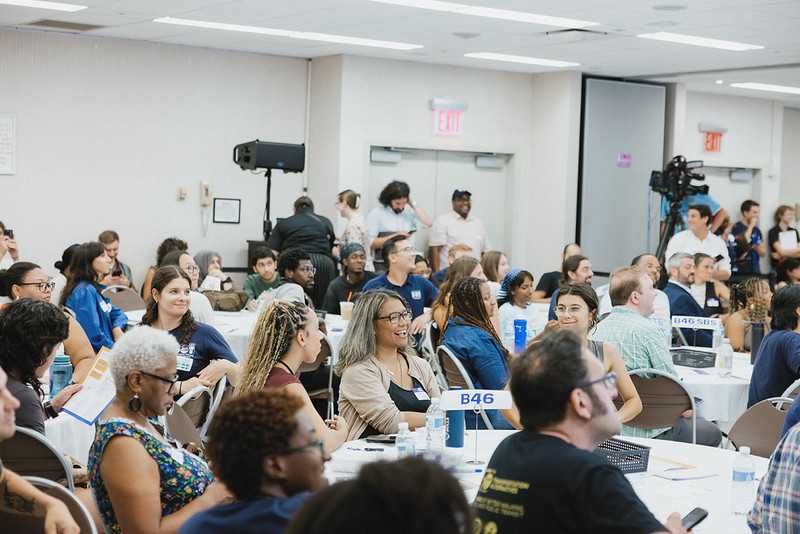 The crowd at Mayor Zohran Mamdani’s Central Brooklyn Bus Rider Town Hall event at Brooklyn College. Thursday, Aug. 6, 2026.Kara McCurdy. Mayoral Photography Office.
Lewis added that he also takes the B43 and B45 buses, which run between Crown Heights and Greenpoint and Downtown Brooklyn, respectively. Both of those routes, he said, are quite slow.
“The 43 bus can be a little faster,” he said. “It’s slow. It’s a very slow bus. And the B45 is another slow bus. Even more slow coming from downtown. It’s gotta come all the way up.”
Crichlow said there are several things the MTA can do in the near term to improve service. Those include operational changes, such as improving communications systems and adjusting schedules.
“There’s a lot of things we can improve both on the service side, but also the communication side,” Crichlow said. ” here are opportunities for us to just improve the communication. How we run our service. What schedules are we running? What’s the headways on the schedule? So I think there are definitely a lot of things that we can do, even in the short term.”