
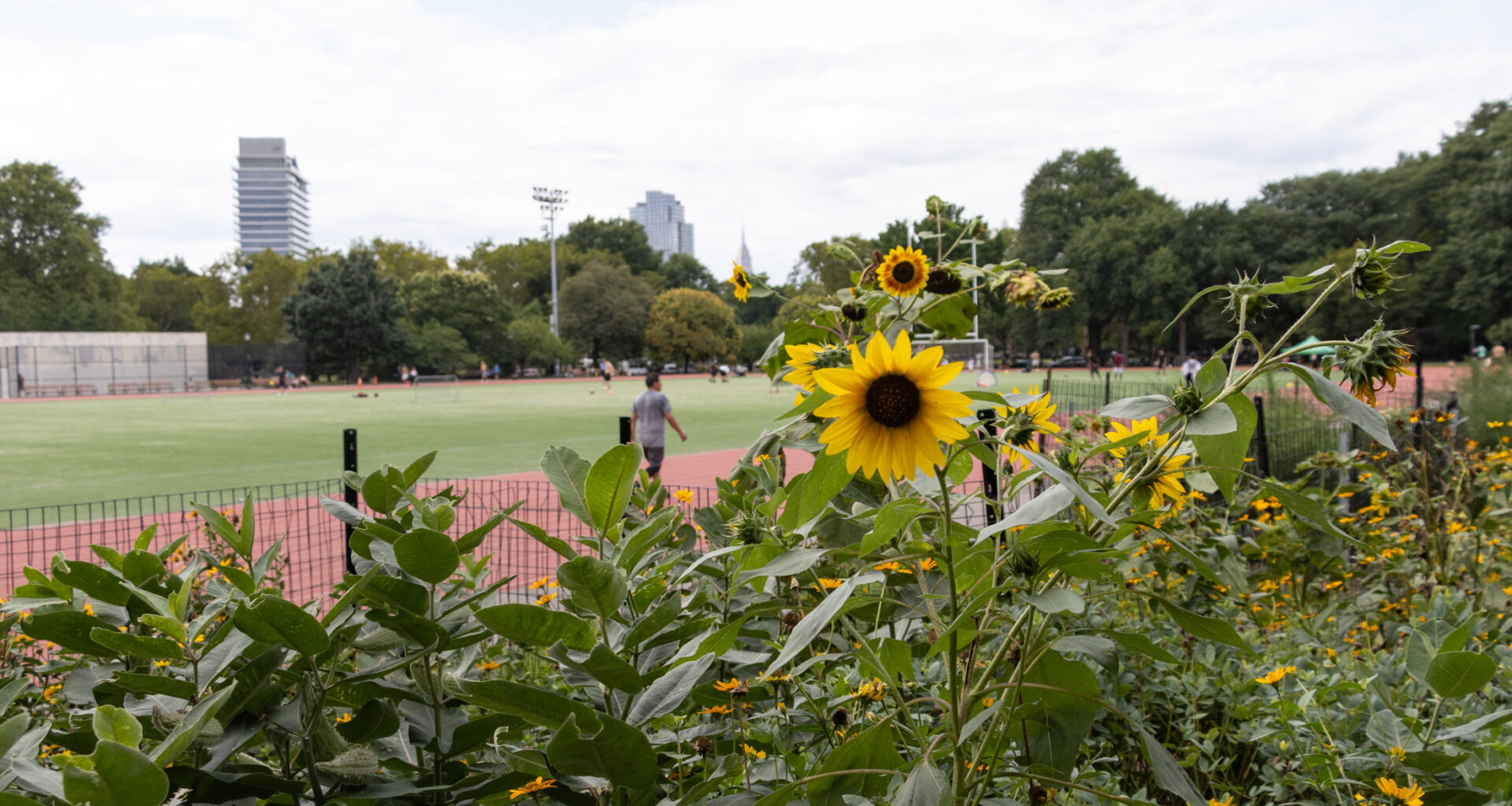

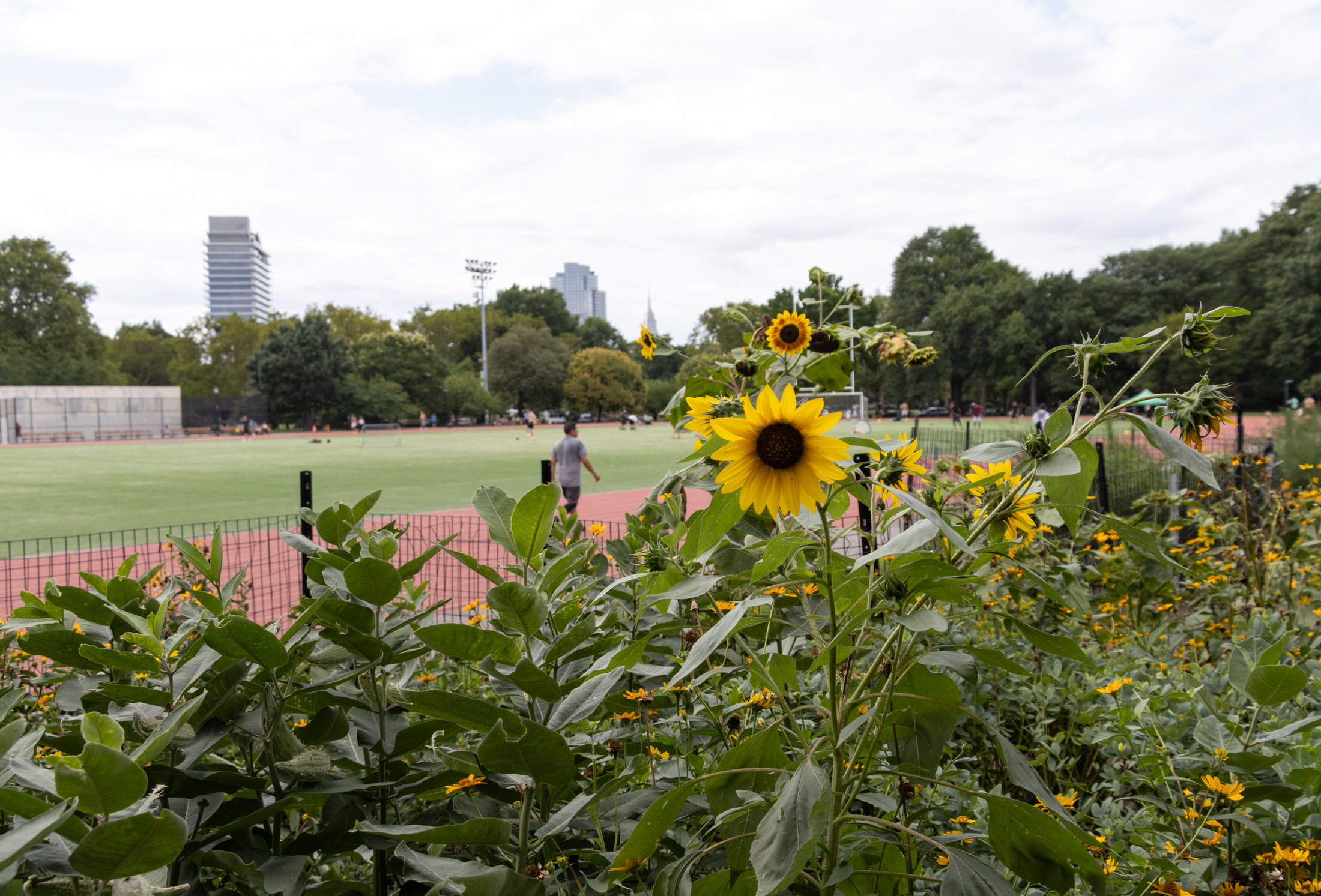
McCarren Park this summer. Photo by Susan De Vries
Landscape architects and engineers joined social reformers in the mid 19th century to advocate for parks and green space in American cities. The Industrial Revolution brought great wealth to factory owners and provided thousands of jobs to workers who crowded into urban areas from the countryside and abroad. Crowded and often substandard living conditions and polluted air and water were petri dishes for all manner of diseases. Advocates for public health saw public parks as necessary to ease both the physical and mental stresses of urban life.
One would think it would be obvious to all that parks were important, but that was not the case. Establishing parks would not be easy.
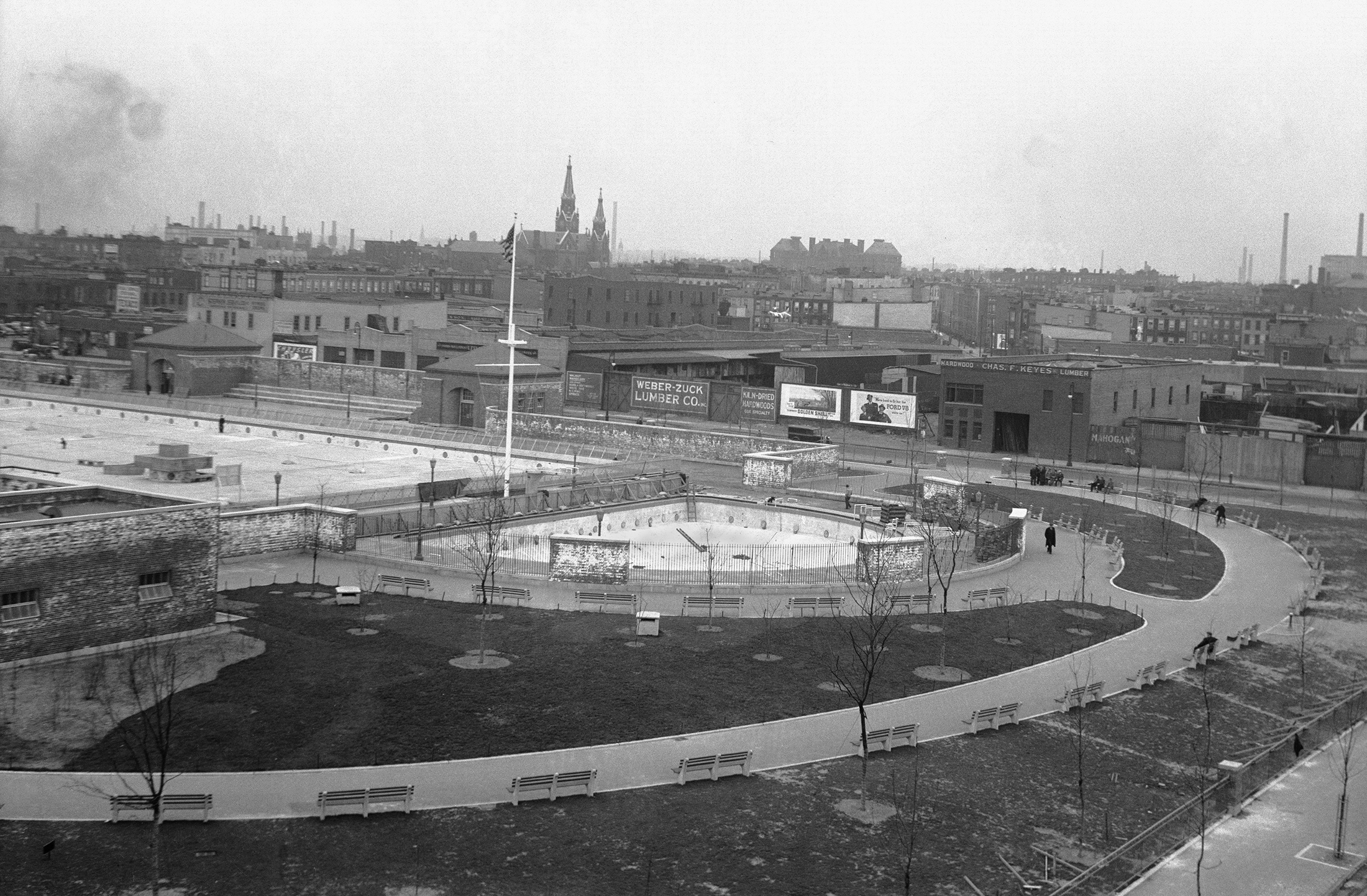 An aerial view of McCarren Park taken in April of 1937. Photo courtesy Municipal Archives, City of New York
Much was written about parks during the years leading up to the Civil War. Landscape planners such as Frederick Law Olmsted saw them as places where everyone, regardless of class or income, could enjoy beauty, find relaxation and fresh air and, for a time, escape from the harsh realities of urban life. Olmsted called parks the “lungs of the city.” One could smell the grass and flowers, watch children play, and just get away from it all for a few hours. Parks were event spaces, too, where someone could possibly enjoy a concert, watch a sporting event, or participate in a picnic or festival.
As universal as that all seems, this recommendation for parks was not universally lauded. Not everyone believed in public health. Some thought open land in cities should be developed and parks were a waste of space. Others liked gardens, nature, and the leisure of a park, but felt that it should only be for the upper classes, and making parks accessible to all would create social mixing that was dangerous and unnatural. Besides, working class and poor people should be working to better themselves, not walking or sitting around in a park. And then there were those who felt that parks attracted hoodlums, thieves, and bums, and were a gathering place for all sorts of undesirables. Why give them a publicly funded space to congregate?
Fortunately, public parks were created despite the naysayers.
Brooklyn began planning parks back when Brooklyn incorporated as a city in 1834. The city’s first park was City Park, established in 1836. It still exists today as Commodore Barry Park, near the Brooklyn Navy Yard. The second, much larger park was Washington Park, built on the site of old Fort Putnam, destroyed by the British during the Revolutionary War. It had been an informal green space for decades afterwards. Thanks in great part to the efforts of poet Walt Whitman, who was the editor of the Brooklyn Eagle at the time, the park was officially established as a city park in 1847. We know it now as Fort Greene Park.
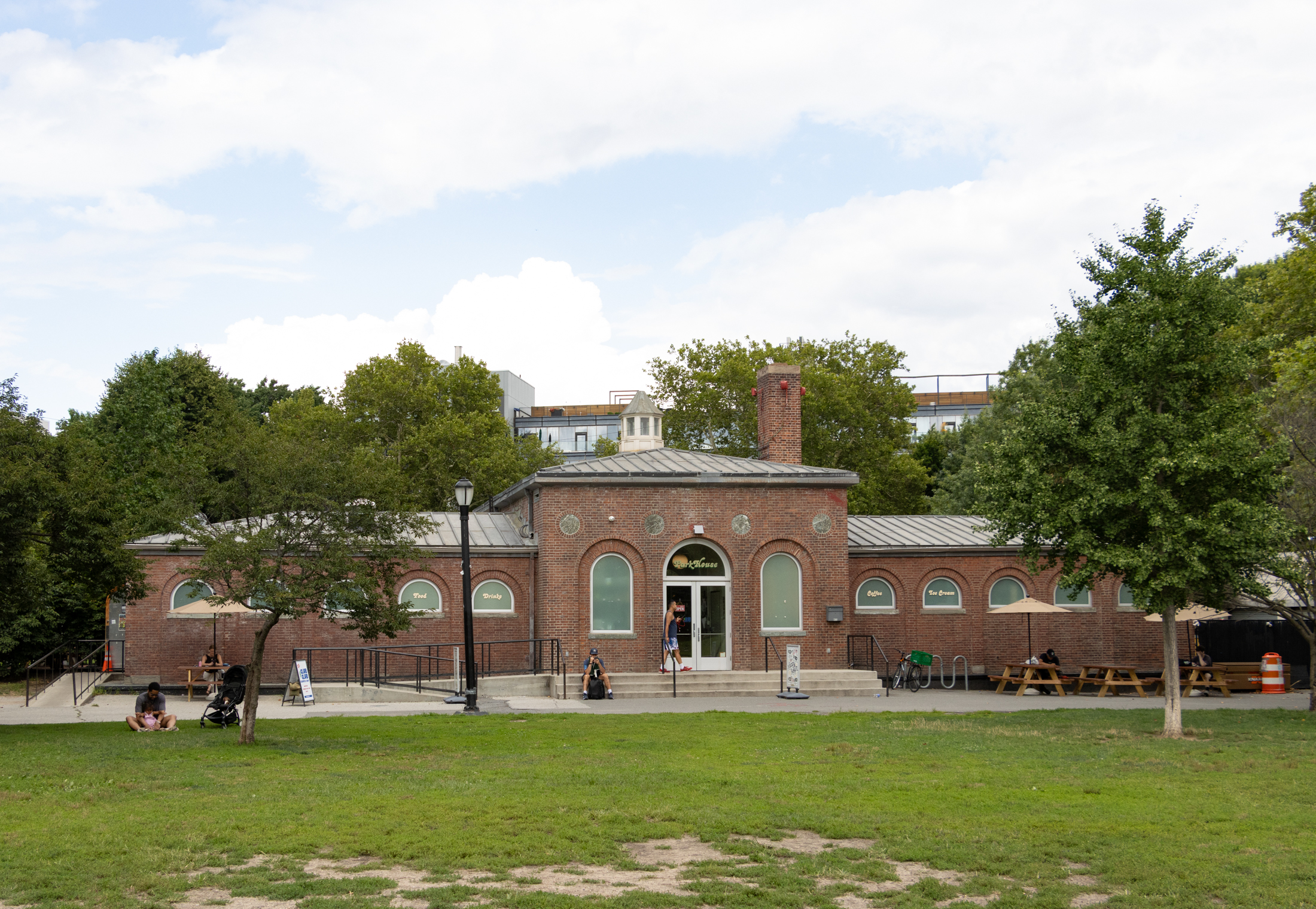 The Park House concession this summer. Photo by Susan De Vries
Several other small parks were created here and there in the mid 19th century, generally in developing middle and upper middle class neighborhoods, culminating in Olmsted and Vaux’s masterpiece, Prospect Park, which opened, still unfinished, in 1867. Other parks, some substantial, like Owl’s Head Park and Sunset Park, both in southern Brooklyn, would follow.
As great as those parks were for late 19th century Brooklynites, they were a drop in the bucket considering the size of the city and the need for more open space. The dense urban working class and working poor neighborhoods — those areas filled with what Walt Whitman called the “swarmingness of the population” — were clamoring for parks. Nowhere was the population denser and the need greater than in the adjoining areas of Williamsburg and Greenpoint.
Industry, Immigration, and the Need for a Park
The history of 19th and early 20th century Greenpoint and Williamsburg is one of industry. Williamsburg was home to a vast sugar refining conglomerate, as well as breweries, garment factories, printing companies, and factories producing household goods. Greenpoint’s industrial might dates back to the early 18th century, with the area famous for shipbuilding, glassmaking, pottery, and porcelain production, pencil manufacturing and — most environmentally detrimental to life and health — oil refining and related byproducts.
Much of Greenpoint was built on swampland. Bushwick Creek and its streams and salt marshes flowed from far inland to the shores of the East River. It was a rich area teeming with life that sustained the Native American tribes who called this part of Brooklyn home for centuries. After the Dutch “bought” the land in the mid-1600s, they began farming, the wealthiest using African slave labor.
By the 1830s, farming gave way to the street grid, roads, horse trolley lines, housing, and factories. Various industries found the East River and Bushwick and Newtown creeks to be excellent locations for factories large and small. The swampy Bushwick Creek area was gradually filled in, leaving only the Bushwick Inlet. All these industries needed workers, and workers needed places to live. The new land above the creek was developed with industry, roads, and residential buildings.
The first immigrant groups were the Irish and Germans who arrived in the 1840s and ‘50s. By the turn of the 20th century, Italians and Jewish and other immigrants from Russia, Poland, and smaller Eastern European countries were pouring into the neighborhoods of Manhattan’s Lower East Side and across the river into north Brooklyn and its new and old tenement neighborhoods. There they joined the Irish and Germans, Black folks, and others who were already there, creating in northern Brooklyn one of the highest population densities in the entire city. More Poles sought out Greenpoint in the early 20th century. If ever a section of Brooklyn needed some green space and park facilities, it was here.
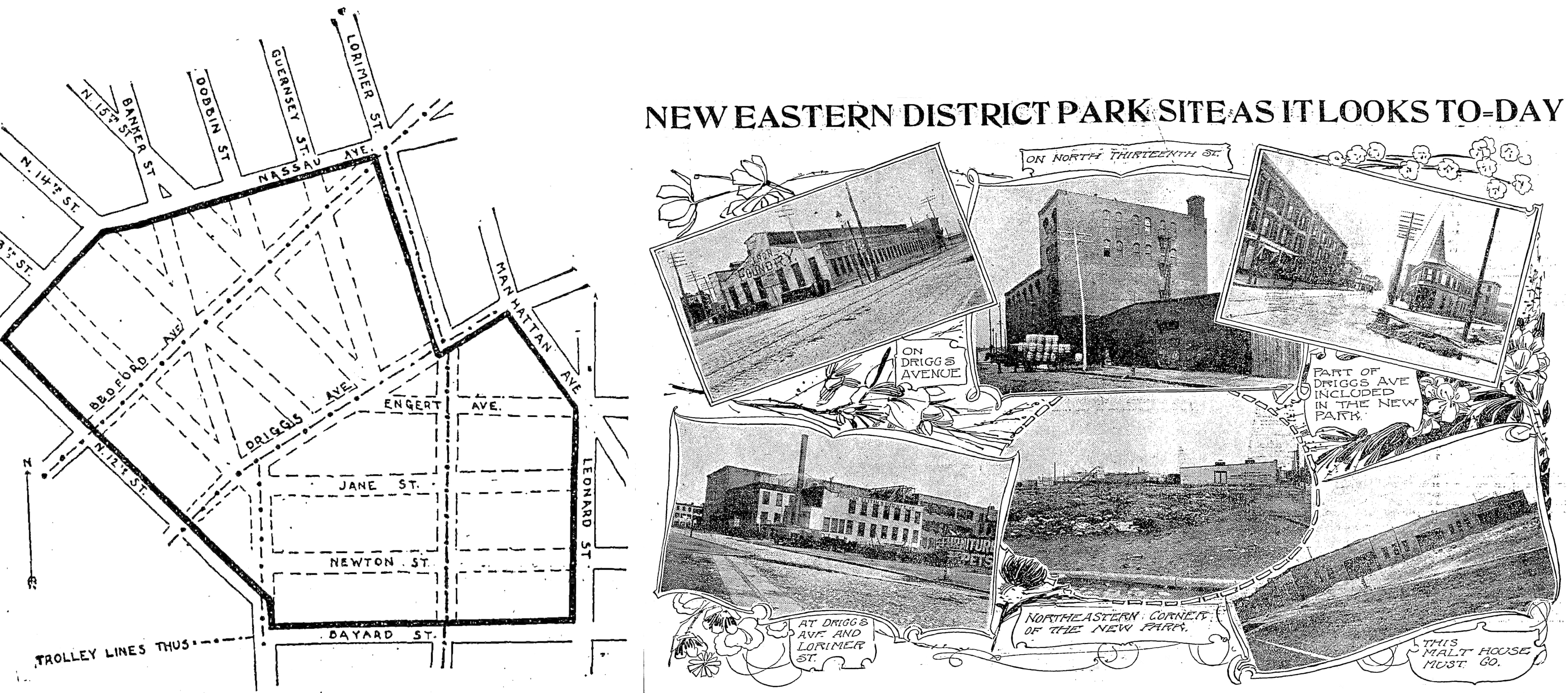 Left: A proposed map of the park published in 1902. Right: Buildings occupying the land in 1901. Images via Brooklyn Daily Eagle
News of a possible park began circulating in the late 1880s, but social reformers, politicians, and the public had long been advocating for the park. Several sites were proposed, with the Parks commissioners favoring a site that contained the now underground Bushwick Creek and marked the border between Williamsburg and Greenpoint.
The proposed polygon making up this site, as seen on a January 2, 1902 map in the Brooklyn Eagle shows the park’s borders as Bayard Street, North 12th Street, Nassau Avenue, Lorimer Street, Manhattan Avenue, and Leonard Street. Three trolley lines ran through it: the Bedford Avenue, Driggs Avenue, and Lorimer Street lines.
The city began buying up the land, which was far from unoccupied. There were large and small industrial buildings on most of the blocks as well as a few houses. The land probably would have had even more industry but yearly flooding and water issues kept away many manufacturers and property developers. Still, the city had to buy and remove chemical and varnish plants, an iron foundry, a malt manufacturer, and more. Also relocated was the Loof Company, the first American firm to construct carousels.
Because of the cross streets, the park was divided into four main sections, and each one was negotiated and purchased separately between 1903 and 1905. All in all, 36 acres were purchased. The major cross streets survived, but several smaller streets such as Jane Street were demapped and others truncated to allow for the park.
State Senator Patrick Henry McCarren Champions the Park
Of course, none of this came cheap. The funds needed to buy the properties and construct the park came from both the city and state. The powerful advocate for the park was State Senator Patrick Henry McCarren. It was said that he picked the site for the park himself.
McCarren was born in 1849 in Cambridge, Massachusetts, the son of Irish immigrants. His family moved to Brooklyn when he was a child, and he was educated in Brooklyn public schools. He started working at a young age, eager to be successful. One of his first jobs was as a cooper in a sugar refinery, and he later became an oil inspector, all in the Williamsburg and Greenpoint area.
He entered the world of Brooklyn’s Democratic machine when only 21. In 1882 he ran for New York State Assembly and won. His one-year term ended in 1883, after which he studied law and was admitted to the bar, though he never really practiced. He ran again in 1889, won, and ran for the State Senate a year later. He won again, and served from 1890 to 1893, and again from 1896 until his death in 1909.
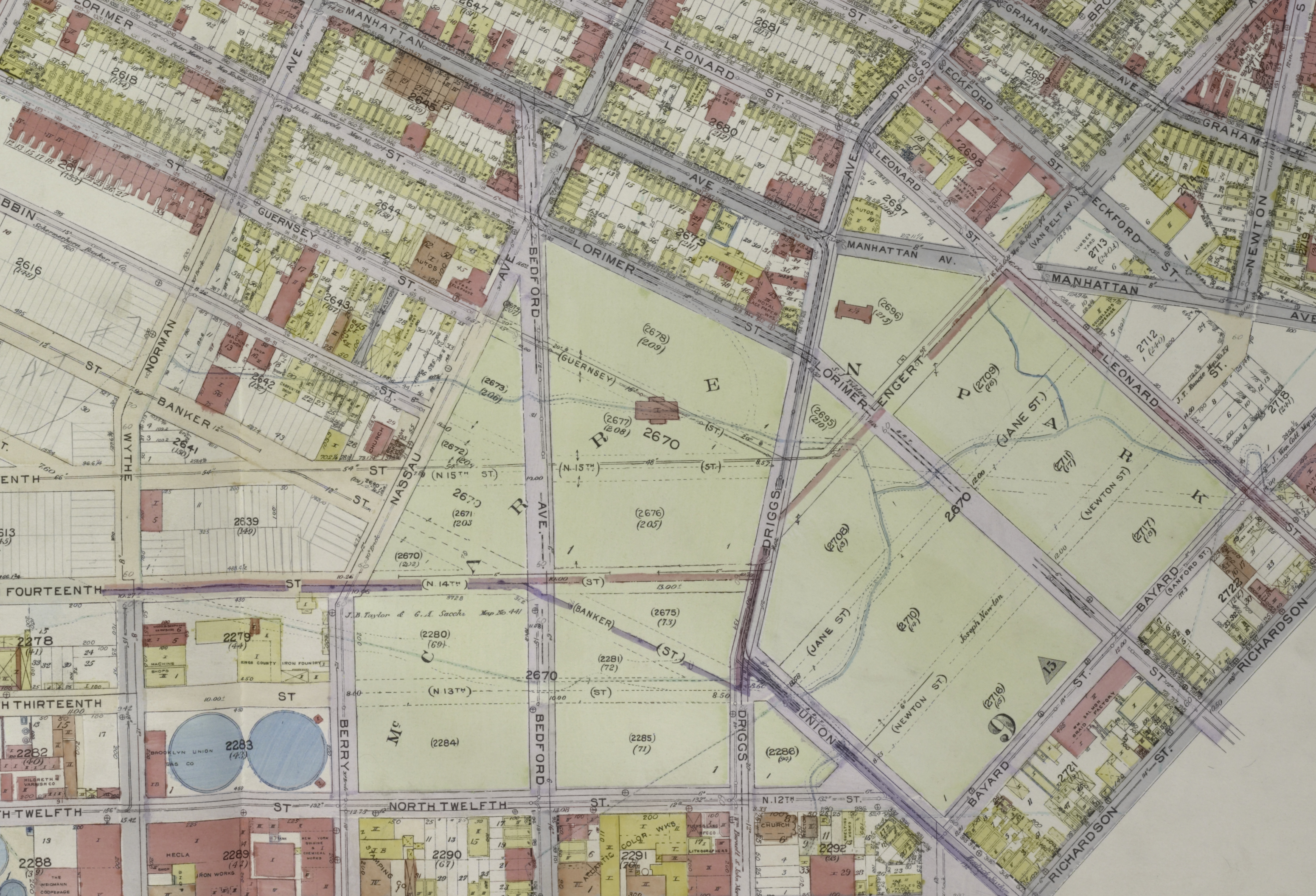 The park on a map of 1916. Map by E. Belcher Hyde Map Company via NYPL
As an elected official for northern Brooklyn, McCarren wielded a great deal of power and influence. It was said that he scorned Tammany Hall in Manhattan, the heart of political power and corruption, but that was because he didn’t need them. He built his own powerful machine base in Brooklyn and was responsible for many of the area’s public works projects, with his hands in on both the park and the new Williamsburg Bridge. By the time of his death in 1909, he was considered the undisputed Democratic Boss of Brooklyn. He was hailed by his constituents as the champion of the working class, but insiders knew he was also on the payroll of both Standard Oil and the sugar industry.
McCarren persuaded, cajoled, and strong-armed the state to pony up the $2 million it took to buy the land from owners and clear the site. The park was originally called Williamsburg Park, then it was named McCarren Park in honor of its patron. But public sites could not be named after those still holding office, so the name changed to Greenpoint Park and finally, in 1909, after McCarren’s death, the park was permanently named in his honor.
McCarren, the People’s Park
After all the land was finally acquired and cleared, which seemed to take forever, it was another year before the park opened, albeit mostly a grassy sward in the first few years. But there were two playgrounds with outdoor gymnastic equipment early on. One playground for boys was on the corner of Bedford and North 14th Street and one for girls at Manhattan and Driggs avenues. Heaven help the mother who had both boys and girls. Playing together was not seemly, and no doubt the facilities were very different as well.
Various groups couldn’t wait for the park, including local musical organizations who looked forward to summer concerts with orchestras and brass bands, singing groups, and soloists. In 1910, the newly renamed McCarren Park received more modern sports facilities. The city installed a quarter-mile track, a field that became an ice skating rink in winter, tennis courts, a dance platform, play equipment for small children, and fields for baseball, football, and soccer.
Social reformers working in the crowded surrounding areas established Brooklyn’s first children’s farm in 1914. Two hundred forty “little farmers” working in 120 separate plots grew beets, carrots, radishes, beans, onions, lettuce, and corn. The children were able to bring home this fresh produce. In the winter, the all-weather building on site was used as a social center for activities and programs by local clubs and church groups.
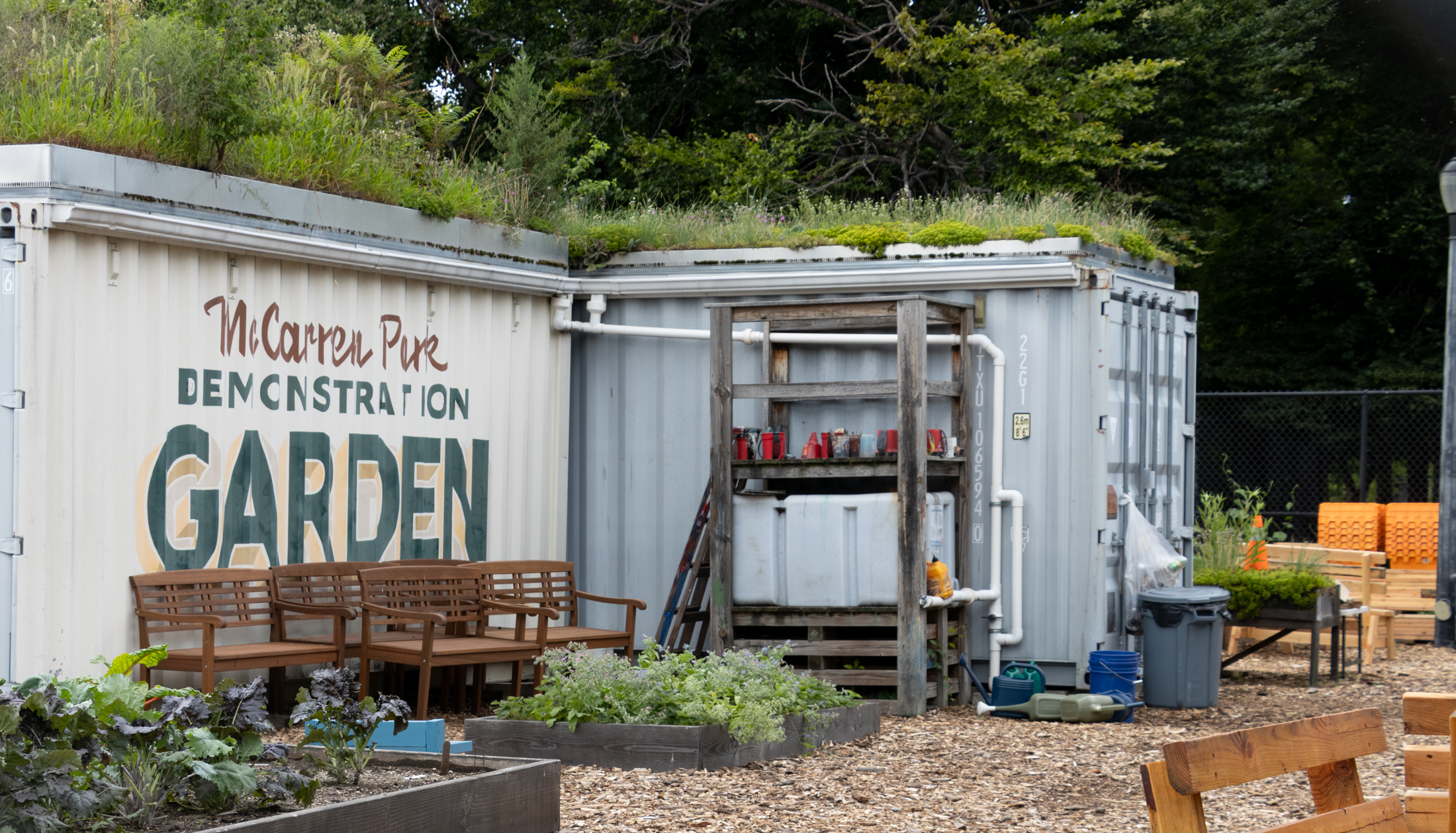 A demonstration garden, a project of North Brooklyn Mutual Aid and GrowNYC, in the park this summer. Photo by Susan De Vries
While McCarren Park was well used in the neighborhood, it didn’t achieve city and national attention until Robert Moses built one of his famous city swimming facilities there. While the Great Depression affected the entire nation, urban areas were not immune. Using funds available through the Federal Works Progress Administration (better known as the WPA), Parks Commissioner, city planner, and avid swimmer Robert Moses created 11 outdoor city pools in various low-income neighborhoods throughout the city. North Brooklyn had one of the highest unemployment rates in the city and was one of the most densely populated. McCarren Park would house the largest of Brooklyn’s four pools.
Newspaper articles announcing the pool began appearing in Brooklyn papers as early as 1930. The city had already started major construction in the park and opened a new playground in September 1934, funded by the WPA. The plans for the McCarren Play Center, with its bathhouse and large arched entryway on Lorimer Street and the separate one-story filter house and lifeguard station, were filed in August 1935. Work began with an opening expected for the next summer. That fall, the wading pool was completed and opened to the public with a large brick wall separating it from the main pool complex, still a work in progress.
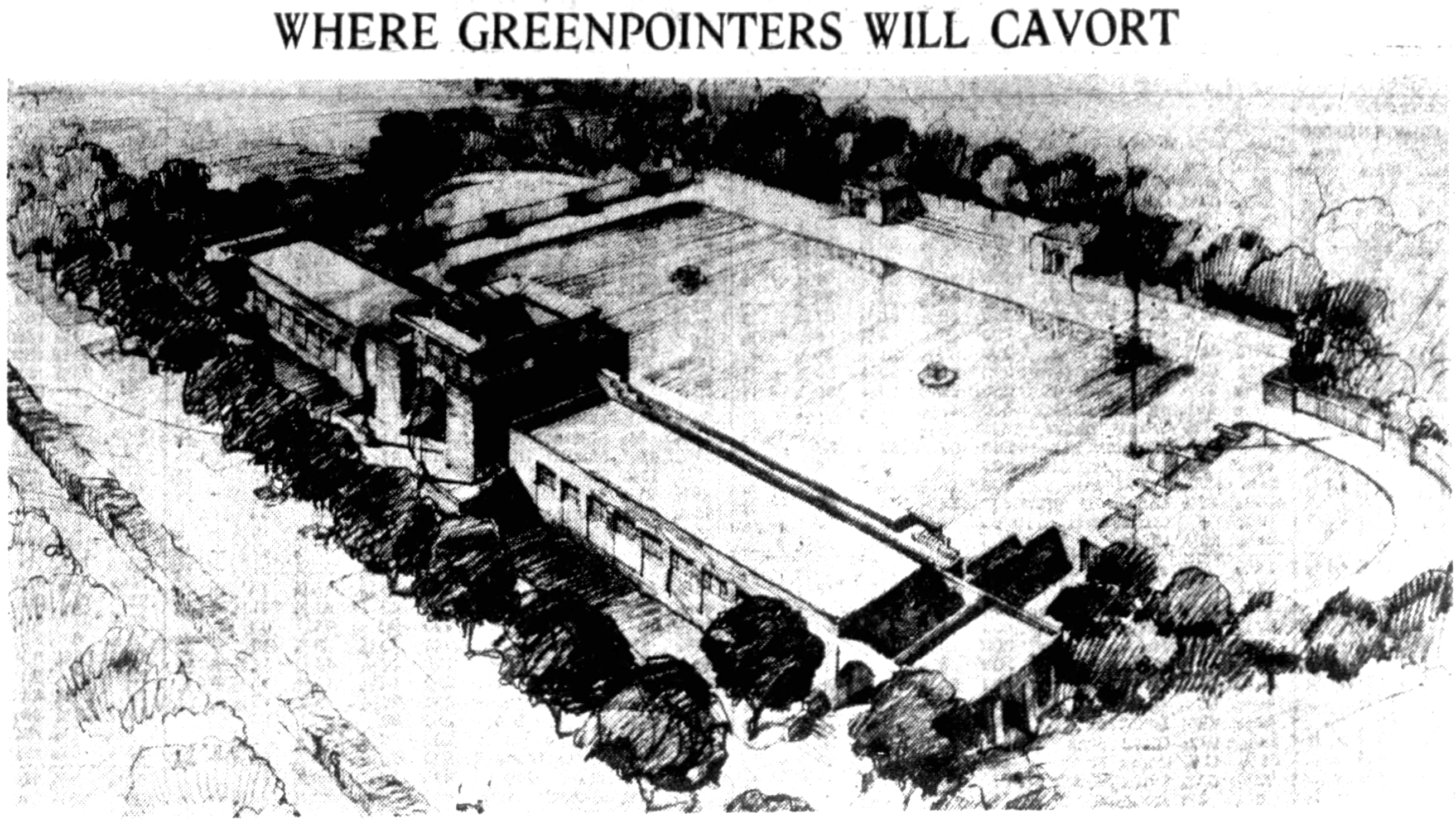 A sketch of the new pool published in 1936. Image via Brooklyn Times Union
The McCarren Park Pool and Recreation Center, along with its other city counterparts, was designed by Aymar Embury II and Gilmore D. Clarke, the Parks Department’s Consulting Architect and Consulting Landscape Architect, respectively. They were tasked with not only designing a large swimming pool, but an entire recreational facility, one that would house a bathhouse complex containing multipurpose locker and changing rooms, the mechanicals, and more. There was to be not just one large pool, but separate swimming, wading, and diving pools.
Wide concrete benches at the perimeter of the pools would provide spectator viewing, as well as sunbathing and allow for the movement of people. The main pool would have underwater lighting for night swimming, and parts of the pool were set up to allow regulation swimming competitions.
The Play Center comprised the bathhouse, and these were designed to be the architecture centerpiece of each project. The various pool complexes had to be built as inexpensively as possible, while not abandoning good design, pleasing aesthetics, and durable materials. The popular Art Moderne and Modern Classical styles, with their streamlined curvilinear lines, were seen as the best way to go. Modern technology was expanded to create systems that could heat, filter, and circulate the huge amounts of water needed. Special anti-bacterial and other cleaning systems were also installed.
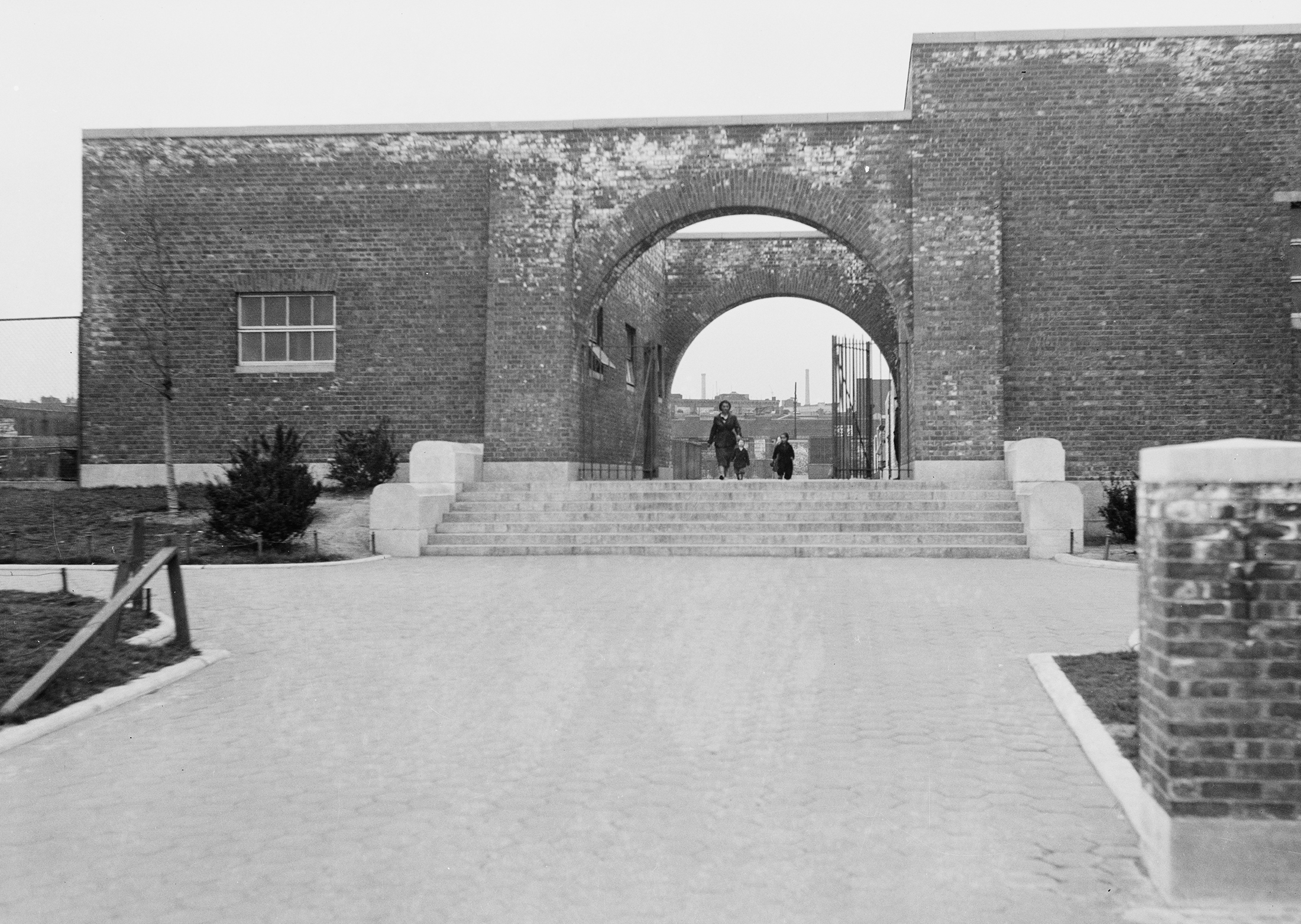 An arched entrance to the pool in April of 1937. Photo courtesy Municipal Archives, City of New York
The year of 1936 included an especially searing, hot summer, with temperatures breaking all summer records. It was also the “Summer of the Pool,” as 10 of the 11 new city pools opened, one per week for 10 weeks. The McCarren Pool opened with great fanfare on July 31st, 1936, the eighth of the 10 pools to open. Mayor Fiorello LaGuardia attended all the openings, along with Moses and the various local politicians and officials.
The mayor noted in his remarks that “no pool anywhere has been so much appreciated by the people as this one.” The new pool was a whopping 330 by 165 feet, the size of four Olympic swimming pools. As the celebrations continued and dusk approached, LaGuardia flipped the switch that turned on the underwater lights, to gasps of wonder from the crowd. More than 75,000 people showed up for the opening ceremonies, the largest public gathering of all 11 pools. The McCarren Pool and Play Center was going to be a huge success.
Until it wasn’t.
The 1970s are remembered in New York City as the decade where President Gerald Ford told the city to “Drop Dead,” as the infamous Daily News headline read. The city was in deep financial trouble. Manufacturing, which was the heart of the city’s pre-World War II economy, had been in steady decline since the 1950s, the factories and jobs going down South or overseas. Corporate New York was also leaving, lured by new headquarters in suburban areas. White flight to the suburbs left the city with reduced income and increasing needs for the remaining population.
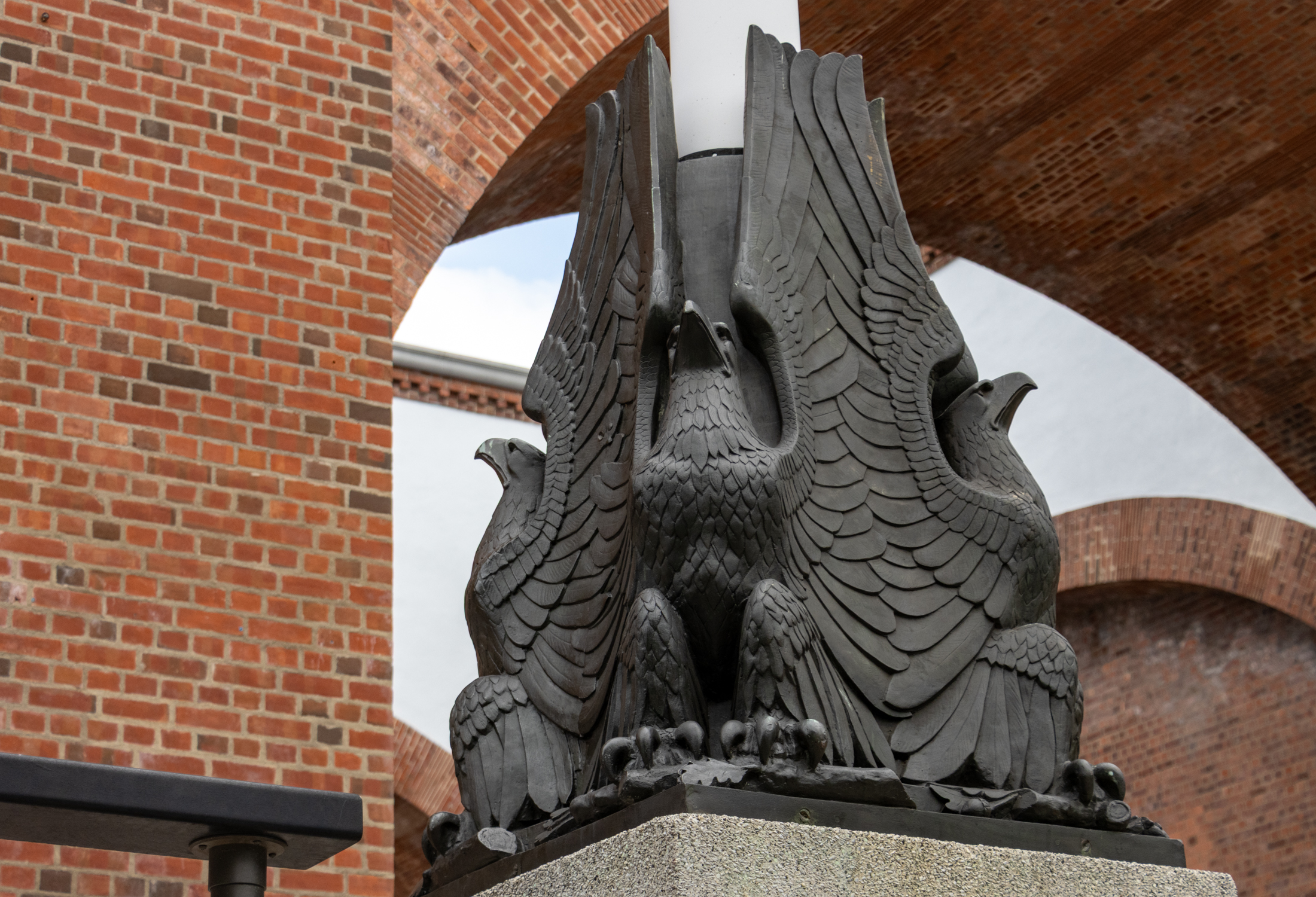 The flagpole outside the pool this summer. Photo by Susan De Vries
The city cut all kinds of services and employees. The Parks Department suffered more than most other departments. By 1981, Parks’ workforce numbered 2,900 people, mostly unskilled and temporary, compared to 30,000 staffers during the Moses years. Parks across the city were in bad shape. Pools, which cost much more than play equipment and ball fields to maintain, deteriorated rapidly.
In 1977, armed with some Federal funds, the Parks Department embarked on their first major project since the 1930s. A portion of that money was slated to go to the WPA pools, but the McCarren Pool rehab never took place. Instead, the pool complex continued to decline. Thousands of teenagers flocked to the pool while drug dealers and prostitutes did business out in the open.
Gangs began intimidating the lifeguards and swimmers, and reduced maintenance meant the pool was not cleaned very often and had candy wrappers and disposable diapers floating on the surface. Children were getting rashes after swimming and it got so bad that the city closed the Play Center and drained the pool at the end of the 1983 season. The McCarren Pool would be closed from 1984 until 2012.
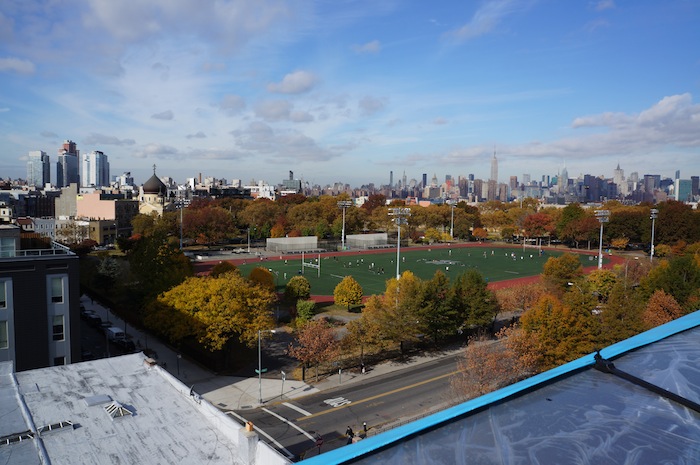 The park in the fall of 2013. Photo by Rebecca Baird-Remba
During those years, funding was provided to fix up the other WPA pools, but McCarren was left out. The facility was allowed to deteriorate even further. The roof leaked in the Play Center, causing structural damage. Bricks and stucco fell away from the arches and other parts of the buildings. The water filtration systems were outdated and falling apart. Vandals broke into the facility and stripped the buildings of anything sellable and wrote graffiti everywhere. Someone drove a car into the pool, and thieves tried to sell the large bronze eagles that flanked the stairs. Luckily, a Parks Department employee saw the eagles being wheeled down Houston Street, heading for an architectural salvage store, and was able to stop the sale.
In 2005, local choreographer Noemie LaFrance received permission to stage a large dance performance in the pool space. The city pitched in by stabilizing the bathhouse, cleaning up the site, getting rid of vegetation, painting over the graffiti, and other stopgap beautifications and precautions. The performance, titled “Agora,” ran from the middle of September to October 1, 2005 to great acclaim, with lots of publicity and press coverage. People became interested in the McCarren Pool again. The Play Center and Pool were landmarked by the city in 2007, and the Bloomberg administration allocated over $50 million to rehab and restore the facility.
 The McCarren Pool this month. Photo by Susan De Vries
In addition to most of its original features and amenities, the Play Center was kitted out with a new fitness center, community meeting room, and basketball court. The restored pool is slightly smaller than the original but still provides recreational fun for thousands of swimmers. The rehab with some new additions was designed by Marvel Designs. They added some new open air changing pavilions, a winter ice skating rink, and redesigned the interior locker rooms, among other things.
Their focus, like the original Embury design, was on the arched opening to the bathhouse. Embury referenced Rome’s Baths of Caracalla in his entrance and facade design, a feature that Marvel Architects embraced, declaring “everyone should experience the archway.” The graceful vaults and arched openings of the redesigned multi-story building are even more striking today. Thanks to city funding and community support, the new McCarren Play Center and Pool reopened its doors in the summer of 2012.
While it’s disconcerting to outsiders to have to cross the streets to access various parts of the park, for the residents of Greenpoint and Williamsburg, that’s a small price to pay to enjoy one of Brooklyn’s largest, most unique, and storied city parks. One with a massive outdoor public pool once again enjoyed by thousands of people looking to cool off and splash in the water. Patrick McCarren would have approved.
Related Stories
Email tips@brownstoner.com with further comments, questions or tips. Follow Brownstoner on X and Instagram, and like us on Facebook.