
This column originally appeared in the Looped In NYC newsletter. Sign up here.
Do you ever come downtown to the banks of the Hudson, look out at those skyscrapers across the river and wonder: What’s going on over there?
There’s only one person, aside from perhaps Jersey City Mayor James Solomon, that I felt could give me the answers I needed: Housing reporter David Brand.
If you remember David from his viral tour sharing his undying love of the Port Authority Bus Terminal, you know he’s also a New Jersey resident. And we’re not talking the Jersey of cul-de-sacs or shore houses or blueberry farms (though more on that later).
We’re talking about the stretch of New Jersey you can literally see from downtown Manhattan.
David was eager to give us a tour of his turf for the camera again and answer my burning questions.
JAMES: For a while now I’ve been taking the ferry home from Battery Park City, but there was one day recently where I was sitting by the water, waiting for my boat, and noticed that Jersey City is absolutely massive. It’s not Williamsburg or Long Island City, it’s not a few condos or a couple office towers, it’s like … Dallas.
Has it always been this way? Are those buildings full? Half-full? Commercial? Residential? What’s the deal with J.C.?
DAVID: Jersey City = YIMBY Dream World.
Back in the 1990s, after the decline of manufacturing led to big job losses, the city embraced new housing development.
Now, there’s a waterfront skyline that didn’t exist 30 years ago with offices, apartments and condos packed with people, often paying near-New York City prices. And the population has really boomed over the past decade — J.C. now has about 300,000 people and is on the verge of surpassing Newark as the Garden State’s biggest city.
JAMES: I remember you telling me you grew up in farm country in northwest New Jersey, and when you eventually moved to the proper New York City area, you didn’t necessarily envision being over there. What changed you?
DAVID: Growing up next to a farm in a tiny town not too far from the Delaware Water Gap, I always pictured myself living in The City … I just didn’t think that “the city” would be in Hudson County, NJ.
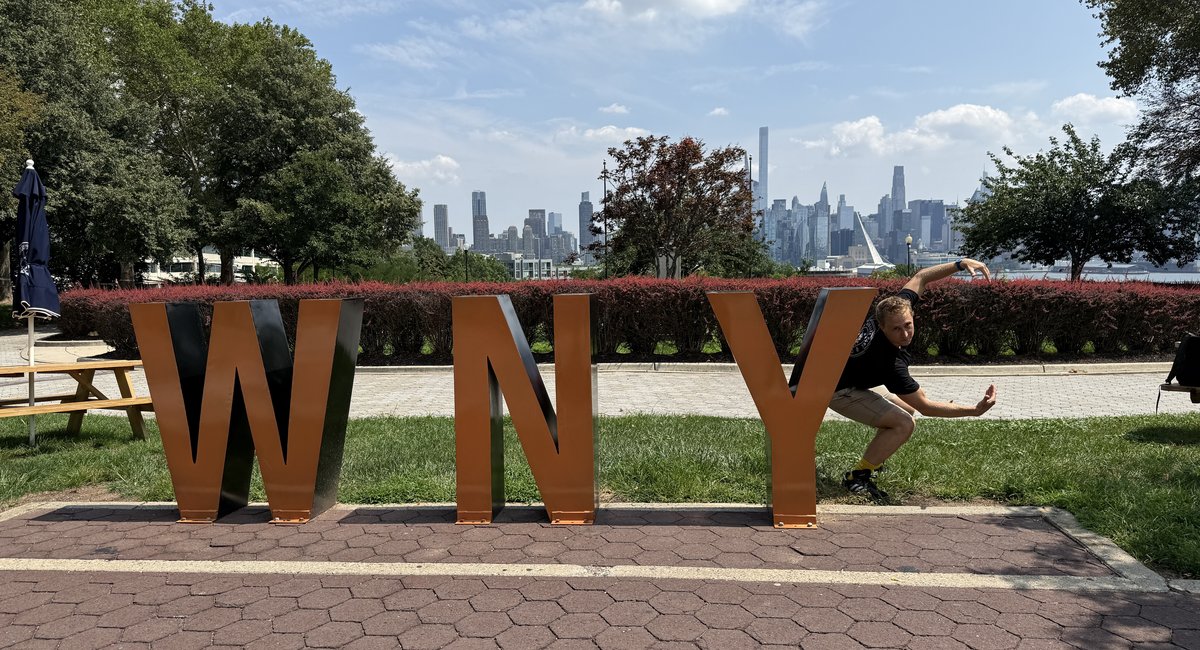
But after about a decade in Queens and Brooklyn, my wife and I began to explore the land two rivers away. We discovered really great, walkable, urban neighborhoods just north of the Lincoln Tunnel in towns like Weehawken, West New York, Union City and North Bergen.
JAMES: Is there something that surprised you when you moved over there that you think would surprise other people not familiar with the area?
DAVID: Well … there’s a West New York.
And four other cities just north of the Lincoln Tunnel with their own quirky names and layouts. North Bergen is actually south of Bergen County. Guttenberg is only two blocks wide. Then there’s Union City and Weehawken.
My take: None of these places have any business being separate towns and should be consolidated into one power-city of 200,000 people or so. Because you really can’t tell where one ends and the next begins — except that the color of the street signs change.
They have an energy, and they’re the most densely populated towns in the United States, all located a short bus ride into Manhattan – via my beloved Port Authority.
And hundreds of thousands of people crammed into one small area need great parks. We have some of those.
The jewel is James J. Braddock Park, also known as 80th Street or North Hudson County Park. It’s a big, beautiful greenspace with a recently renovated playground, a track that’s open to the public and a lake stocked with trout just across from the Upper West Side. There’s also a ton of grass where hundreds of people play soccer under the lights on weeknights.
Then there’s the food. Bergenline Avenue was named by the Star Ledger/NJ.com as the “Best Food Street” in New Jersey because of its hundreds of incredibly diverse offerings: pizza shops, Cuban coffee spots, Salvadoran pupuserias, Thai places, Doner, Peruvian restaurants, Mexican food.
JAMES: Say I’m not fortunate enough to have you as my tour guide: Shout out some spots! Tell me how to spend 12 hours along the Jersey side of the Hudson, David style.
DAVID: Great question: Here’s my 12-hour “New Yorker’s Guide to Hudson County.”
Take the ferry to Weehawken and then hike the metal switchback staircase up the Palisades cliff into the town (You can also travel up by bus). First stop: Charritos, a mountaintop chalet on Boulevard East and 48th St. with excellent Mexican food and sweeping views of Manhattan. Eat on the outdoor patio.
Next, keep walking, or take the bus, north to James Braddock Park to relax, visit the playground with kids, pose with the statue of The Cinderella Man himself, or take a walk around the lake. Pro tip: Each September, the park hosts the annual Hudson County fair with games and carnival rides.
Then, head to Bergenline Avenue for coffee, shopping and another bite to eat. I personally love all the soccer shops that dot the route.
After that, head back down south to Jersey City or Hoboken by bus, light rail or one of the $4 jitney-style shuttles that drive to JC (or take you right to Manhattan).
And finally, spend the afternoon and evening checking out the bars, restaurants and beautiful architecture around Washington Street in Hoboken or Grove Street in Jersey City. Hop on the PATH or board the ferry for a quick trip back to New York City.