
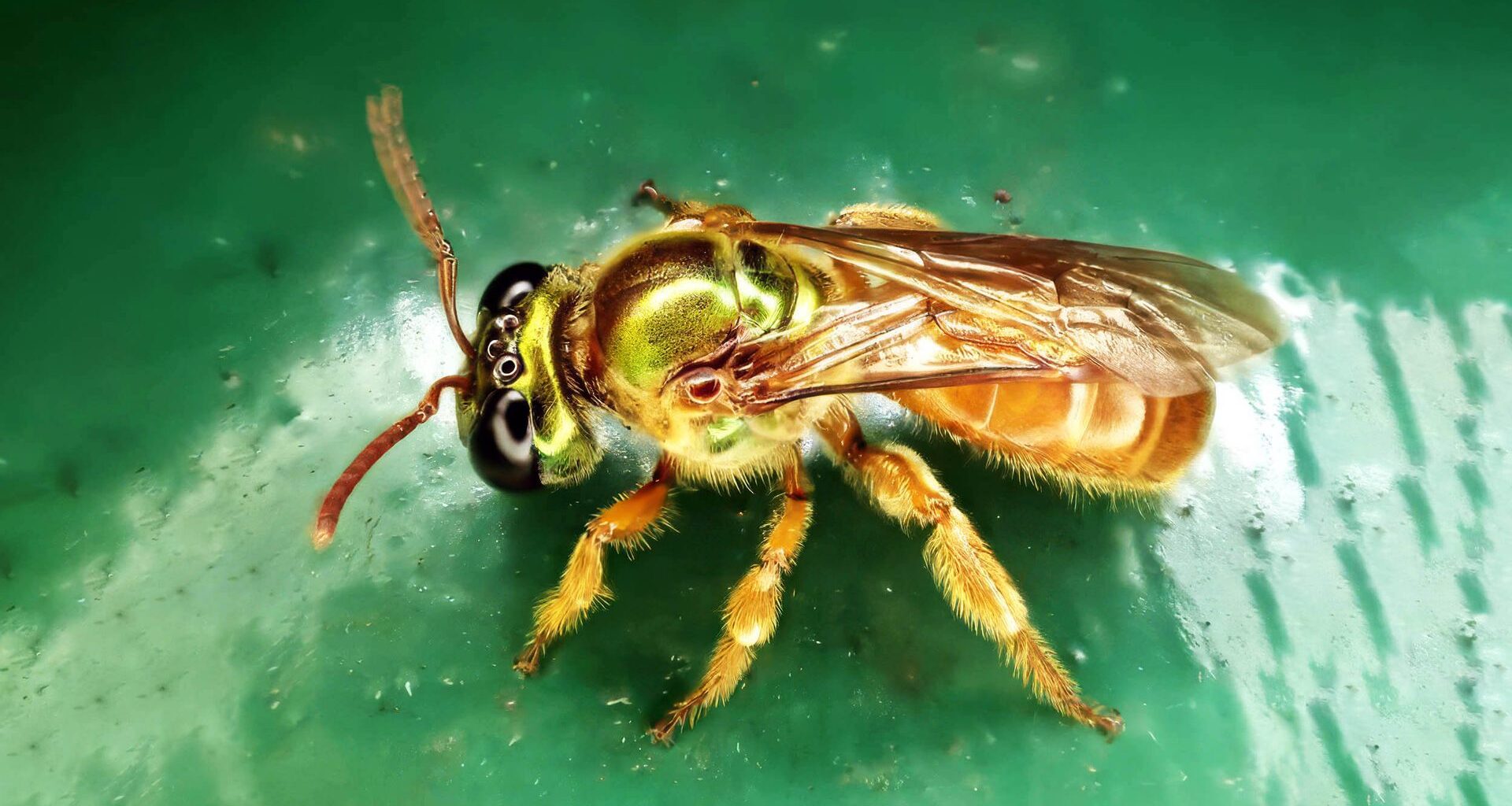
Daughters of queen bees were compelled to stay home to raise more offspring when their mother carried more of one particular waxy chemical.
A young sweat bee comes out of her brood cell into a nest her mother dug in dead wood. Two futures are open to her. She can stay and help raise more brothers and sisters, or she can fly off and start a nest of her own.
A new study found that daughters chose to stay home more often when their mother carried more of one particular waxy chemical.
Queens in ants and honeybees make chemicals that keep their workers from laying eggs. Nobody had found one of those queen pheromones in a bee that can live either alone or in a group.
Why stay home?
Callum Kingwell, a postdoctoral fellow at the Smithsonian Tropical Research Institute (STRI) and Princeton University, led the work.
Kingwell’s team set out 50 wooden nests low in the forest on Barro Colorado Island, in the Panama Canal. Over two later seasons they added 180 more.
A daughter who stays does not lay eggs of her own.
Ben Marcus is a science press secretary at the Smithsonian Institution. In an interview with Earth.com, he described what she gets in return.
“By staying in the nest in which she was born, daughters help their moms produce more offspring than they would be able to without her help,” Marcus said.
Those extra brothers and sisters share some of her genes, so helping raise them can still increase her genetic contribution to future generations.
Beads coated in queen wax
A bee is coated in waxy chemicals that keep her from drying out. Some are plain carbon chains. Others have a small branch part way along the chain, and chemists call those methylalkanes.
The team made copies of the branched wax and coated a glass bead with one queen’s worth. Then they set the bead in a tube with a wild bee and filmed her in the dark, since these bees fly at night.
Bees that touched the bead with their antennae backed away fast, and several tucked the abdomen up under the body. These are both behaviors shown by a worker when her queen comes near.
About half of the 30 bees tested did that. The three other chemicals did no better than plain solvent.
The wax does something slower too. The team rubbed extra wax onto live queens in their nests, five times over nine days, and gave other queens solvent alone.
Ten days later, the daughters of the wax-treated queens had less developed ovaries than the daughters of the others. Each group had 10 queen-and-daughter pairs.
The extra wax did nothing to the queens’ own ovaries. A chemical that drugged every bee would have slowed the queens too.
More queen wax, more eggs later
Before their young came out, the mothers who would end up with a helper carried no more wax than the mothers who stayed alone.
They started to differ only after grown daughters were in the nest. By day 10 the mothers with helpers had about twice as much wax.
In 47 nests where the first daughter stayed as a worker, the team counted every egg the mother laid until she stopped laying or the season ended.
The more wax a mother carried on her daughter’s first day out, the faster she laid eggs in the weeks that followed. Her wax 10 days later predicted the same thing.
A daughter meets her mother in the dark, days before those eggs exist. The amount of wax may give her an honest preview of what is coming.
Waxier queens kept their daughters
The team was able to follow how things turned out in 92 of the nests. In those, 84 percent of first daughters stayed as workers and about 10 percent left home.
Another 7 percent killed or drove out their mother and took the nest over.
The mothers whose daughters stayed carried more branched wax than the mothers whose daughters left.
Where daughters stayed, those mothers had already carried more of this wax when their offspring were still larvae, sealed inside their cells.
The team also removed the first daughter out of 17 nests. Those mothers then laid eggs at about the rate of a bee with no help at all. By the team’s estimate, helpers accounted for about half of everything a social nest produced.
Pollen pays for the signal
A signal is only worth reading if a weak queen cannot fake it. One of the raw materials for the branch in that wax is valine, an amino acid insects cannot make for themselves. Bees get it from pollen.
The team fed four bees sugar water mixed with valine made from heavier carbon atoms.
Four other bees got plain sugar water. The heavy carbon later showed up in the branch of the wax molecule on the first four.
Eggs need valine too. A queen who puts it into her signal has less left for her eggs.
That cost, the team said, may prevent a weak queen from advertising like a strong one.
Queens lived up to 18 months
Tracking the same bees for years turned up something else. Marcus told Earth.com that queens in social nests lived as long as a year and a half. Females that nested alone rarely lasted more than six months.
“For a sweat bee to reach such an old age was a bit of a surprise, especially considering the harsh environment of the tropical rainforest in which they live,” Marcus said.
Living in a group, he explained, appears to be associated with a longer life as well as more young.
An ant or a honeybee cannot choose to live alone. These sweat bees can.
Asked by Earth.com why that matters, Marcus said the solitary and social bees in this species live side by side. That lets researchers compare the two different lifestyles inside one gene pool and one forest.
“These flexible species may also serve as a kind of snapshot into the earliest stages of social evolution,” Marcus added.
“We are interested in the evolution of cooperation and, in this case, how sweat bees decide whether cooperation is worthwhile,” Kingwell said.
The daughters that left
Nine of those 92 daughters left home, and their mothers carried less wax on average. But the two groups overlapped, and a few daughters left mothers that had as much wax as the queens who kept their helpers.
Most of the study involved watching wild nests over several years, with a few small experiments run inside them. Extra wax on a queen slowed her daughters’ ovaries, but no one has tested whether extra wax will keep a daughter home.
These bees will not develop eggs in captivity, so every test had to run in nests out in the forest.
A weather station on the island has recorded rain and temperature since 1972, and other researchers track when the trees these bees feed from flower.
Marcus said records like those may help explain how conditions outside a nest change what the bees do inside it. The team’s next step is to match the environmental records against the years of accumulated nest data.
The full study was published in the journal Proceedings of the Royal Society B.
—–
Like what you read? Subscribe to our newsletter for engaging articles, exclusive content, and the latest updates.
Check us out on EarthSnap, a free app brought to you by Eric Ralls and Earth.com.
—–