
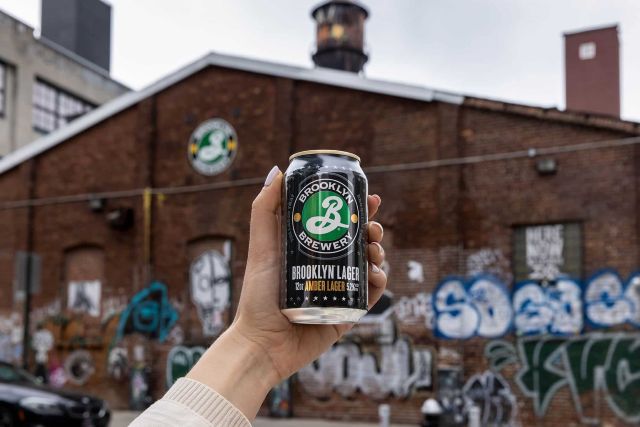
(Courtesy Brooklyn Brewery)
Some brewery taprooms are what they are, simply places to enjoy a beer. Others become part of the neighborhood.
Brooklyn Brewery’s longtime home at 79 North 11th Street in Williamsburg has unquestionably been part of the neighborhood.
After 30 years, the brewery is preparing to say goodbye to the industrial Williamsburg space that became one of New York City’s most recognizable craft beer destinations. The brewery will soon make the short move to a much larger new home at 1 Wythe Avenue, only four blocks away, but the departure still feels like the end of an era.
And what an era it has been.
Brooklyn Brewery traces its beginnings to Steve Hindy, a former Associated Press foreign correspondent who developed an interest in homebrewing while working in the Middle East, and his Park Slope neighbor Tom Potter, a banker who eventually agreed to join him in the beer business.
Brooklyn Lager arrived in 1988, at a time when attaching the word “Brooklyn” to a consumer product wasn’t necessarily considered clever marketing. The borough had yet to become the internationally fashionable brand it is today, and craft beer was still largely a curiosity to most American drinkers.
Hindy and Potter even handled distribution themselves in those early days, driving around New York trying to convince bars and retailers to take a chance on their unfamiliar beer. One of their first customers was Teddy’s Bar & Grill in Williamsburg, which was pouring Brooklyn Lager back when the neighborhood was a very different place.
The brewery also made an inspired decision early on when it turned to legendary graphic designer Milton Glaser, the man behind the “I ♥ NY” logo, to create its identity. His simple Brooklyn “B” would eventually become one of the most recognizable symbols in American craft beer.
Then came Garrett Oliver.
Oliver joined Brooklyn Brewery as brewmaster in 1994 after brewing at Manhattan Brewing Company and helped design the Williamsburg brewhouse that would become the brewery’s public face. The new facility officially opened in 1996 in a former matzo factory on North 11th Street, bringing beer production back to a borough that had once ranked among America’s great brewing centers, particularly in Brooklyn’s heavily German Bushwick brewing district.
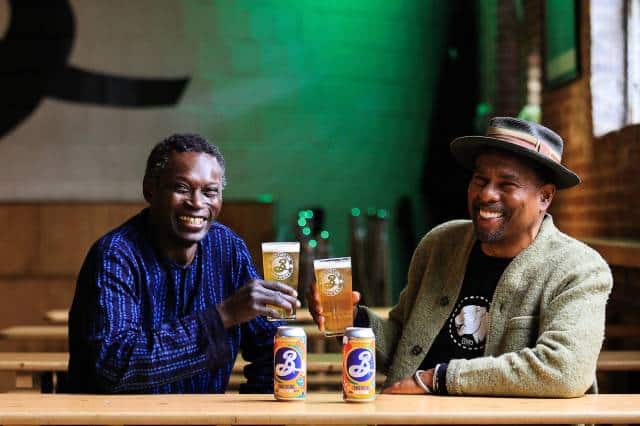
(Pierre Thiam / Yolélé and Garrett Oliver / Brooklyn Brewery)
Under Oliver, Brooklyn Brewery became considerably more adventurous. Brooklyn Black Chocolate Stout developed a cult following, East IPA helped establish the brewery beyond its flagship lager, and a steady stream of seasonal and experimental beers turned the Williamsburg brewery into one of the most creative production facilities on the East Coast. Oliver would eventually become one of the most influential brewers of his generation, as well as the first brewer to receive a James Beard Award.
But the building itself was always part of the attraction.
The Brooklyn Brewery tasting room never felt overly polished, but that was part of its charm. It was big, industrial, loud and unmistakably Williamsburg, particularly during the neighborhood’s transformation in the late 1990s and early 2000s.
Back then, Williamsburg was becoming a magnet for artists, musicians, designers and young people willing to live in former industrial spaces across the East River from Manhattan. Warehouses became lofts. Abandoned storefronts became bars and galleries. Bedford Avenue became a cultural destination.
And Brooklyn Brewery was right there.
Friday night taproom hangs became a Williamsburg ritual. Long communal tables filled with locals and visitors exploring the neighborhood. Brooklyn Brewery’s tours introduced countless New Yorkers and visitors to American craft beer. Artist pop-ups, concerts, food events and beer releases added to its vibe.
As Williamsburg evolved from gritty industrial waterfront neighborhood to one of the most expensive and fashionable addresses in New York City, Brooklyn Brewery somehow kept its connection to the neighborhood’s earlier incarnation. The streets outside changed dramatically. Luxury apartments arrived. Hotels appeared. Restaurants came and went. Real estate prices exploded. And the iconic brewery with that familiar Brooklyn “B” kept doing its thing.
Now Brooklyn Brewery is changing along with Williamsburg.
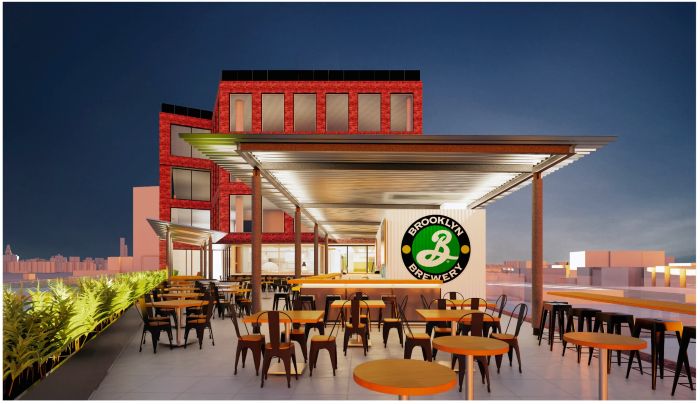
(Courtesy Brooklyn Brewery)
Its new 1 Wythe Avenue location will be nearly four times the capacity of the current space and considerably more ambitious. Plans call for expanded brewing facilities devoted to small-batch and experimental beers, a full kitchen and pizza program developed with Fornino founder Michael Ayoub, a broader bar program, brewery tours, guided tastings and significantly more room for events. A soft opening is planned for late summer, followed by a grand opening in the fall.
So, Brooklyn Brewery isn’t really leaving Williamsburg. It’s growing into the Williamsburg that exists today.
And there’s a bittersweet truth to that.
Brooklyn Brewery arrived at a time when not a lot of New Yorkers knew what craft beer was and Williamsburg certainly wasn’t shorthand for cool. Thirty years later, Brooklyn is an international brand, Williamsburg is a global destination and Brooklyn Lager is sold around the world.
The brewery helped sell Brooklyn to the world before the world decided Brooklyn beer was worth buying.
So while 1 Wythe Avenue promises to be bigger, slicker and capable of doing things the old brewery simply couldn’t accommodate, replacing three decades of memories won’t be quite so easy.
For generations of New York beer drinkers, 79 North 11th Street wasn’t just where Brooklyn Brewery made beer.
It was part of what made Williamsburg feel like Williamsburg.
###