
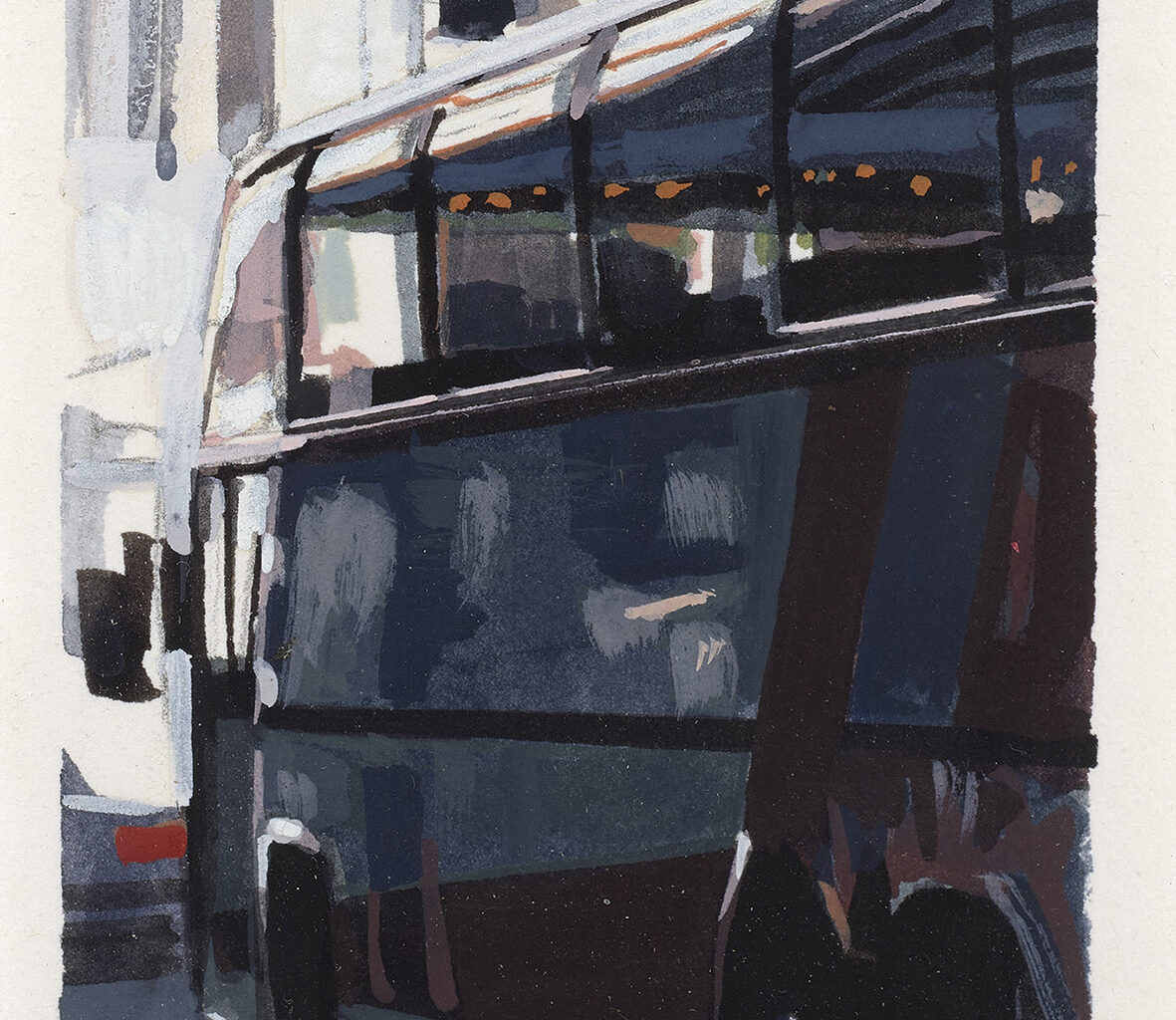
The critical reception of photorealism as reactionary or populist was not without basis: its popularity, technical virtuosity, and apparent return to accessible subjects could be understood as a retreat from modernism’s critical advances. Yet this judgment often obscured the problem its strongest works addressed. It rested on the modernist assumption that illusionism and self-reflexivity were mutually exclusive—that representing the appearance of the real necessarily meant abandoning the critical concerns through which modernism had defined painting’s imperatives. For Estes, those very operations became a means of re-entering modernism’s unresolved problems. His paintings do not simply revive an exhausted pictorial tradition; rather, within a culture increasingly organized by photographic and commercial reproduction, they return painting to the conditions by which the real becomes pictorially available.
The connection between abstraction and mimesis in Estes’s paintings is not one of opposition. His paintings insist on the recognizable—storefronts, streets, glass, cars, reflected bodies—but these things do not form a single, continuous reality. Estes does not introduce abstraction into representation; he reveals the abstraction through which representation is constituted. Photographic information is selected, geometrized, fragmented, and recomposed until it appears as a coherent image of things. Window mullions, awnings, façades, signs, shadows, and mirrored fragments become grids, bands, hard edges, and dislocated planes. One recognizes a street scene, yet its coherence is continually interrupted: interior and exterior occupy the same surface; several viewpoints coexist; reflection reverses or fractures space. This mimesis is therefore not imitation but construction—a representation of the photographic image built through perception and constituted by abstraction.
The same relation emerges in the water/landscape paintings, whose near-abstraction is inversely related to the geometry and fracture of the urban works. Water becomes a reflective surface of distorted, dispersed, and doubled images. Estes does not require skyscrapers to produce this doubling; he finds it in water disturbed by a boat’s wake or broken by its current. More crucially, water provides a referent for painterly marks disguised as disturbance. It is the one element in these works that resembles the painterly, yet it is rendered through the same procedures used to depict glass and chrome.
My Camera Is My Sketchbook demonstrates the reflexivity of Estes’s paintings. What survives of the real are small discontinuities—compositional seams, inversions, displaced reflections, and wakes—that disclose the mediated conditions the paintings seem to suppress. Estes makes visible not the world itself, but the operations by which the world becomes legible.