
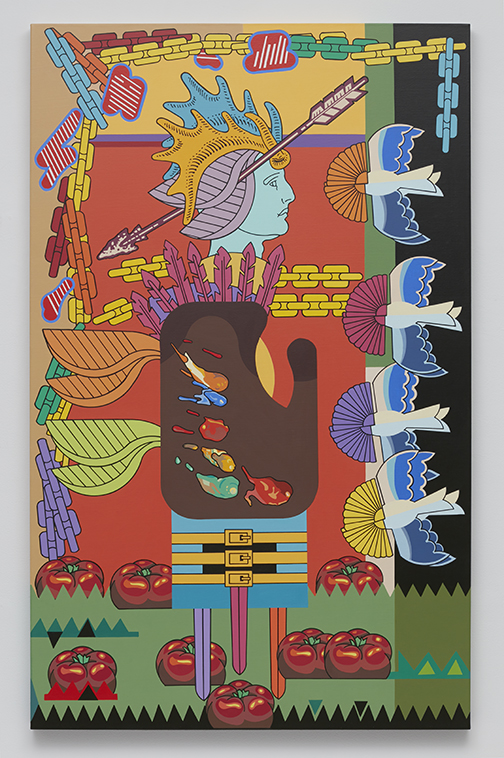
The Mermaid’s Revenge
Tibor de Nagy Gallery
June 12–July 31, 2026
New York
Asked once if his poems contained hidden meanings, John Ashbery said they didn’t for the simple reason that “somebody might find out what they were and then the poems would no longer be mysterious.” It’s easy to believe that Trevor Winkfield’s paintings, bristling with precisely rendered, deeply enigmatic visual detritus, are riddled with hidden meanings. Like ancient hieroglyphs or comic book rebuses or tarot cards, Winkfield’s paintings cry out for deciphering. This exhibition of paintings from 1991–2001 offered viewers countless opportunities to spelunk themselves into the artist’s distinctive, phantasmagoric iconography, while also inviting us to ponder some fundamental questions about painting.
Most of the work in the show belongs to two series, one depicting exemplars of various vocations, another titled “Voyage.” Also included is a painting titled Self Portrait (2001). Oddly (dare I say, mysteriously), the exhibition’s title, The Mermaid’s Revenge, derives its name from a 1993 painting not on view. The protagonist in The Student (1999) is, as Winkfield’s figures nearly always are, an amalgam of human and non-human attributes. This one sports a recognizable head, hands, and feet (in disparate colors and scales), while strange geometric objects serve as the torso and legs. The result is a kind of heraldic cyborg. Surrounding the student figure are several lightbulbs, a wooden chair, a yellow lyre, some chain-linked poles, and an alpine scene framed in a window. The background consists of interlocking, solid-color rectangles, which could be read as some kind of modernist interior but, more plausibly, as geometric abstraction. As always, the paint has been applied in the flattest, most neutral manner. At first glance, Winkfield’s imagery also reads as flat, but quickly one begins to notice the nods to illusionistic space: judicious use of shadows and, in the lightbulbs, the reflections of windows which introduce three-dimensionality into the picture. However, the overall sense of the composition as totally flat still lingers. The fact that the artist begins with a collage is probably a factor in this effect, but it’s also because Winkfield avails himself within each painting of various styles of illusionism. No single light source is implied. Each depicted object follows its own rules of representation. Winkfield also seems to delight in having his motifs interfere with one another. Notice, in this canvas, how the mountain view cuts off one of the lightbulbs in contradiction of any spatial logic. Something similar happens with the poles and the stylized waves in the painting’s lower left corner. Clearly, the disparate imagery and decisive slicing owe much to a collage aesthetic. It comes as no great surprise to learn that Winkfield admires Kurt Schwitters, and that a visit to Schwitters’s Merz Barn in England’s Lake District as a teenager was crucial for him.
In a 2010 interview with Miles Champion, Winkfield shared his appreciation of how Sassetta “often used … people as commas and quotation marks across his chromatic planes, and if they got in the way of an architectural element—a column, say—he’d allow it to ruthlessly cut through a body. The band of pink—the abstraction—took precedence.” (His appreciation of Sassetta’s formal complexity is something he shares with the late Shirley Jaffe, also represented by Tibor de Nagy and a fan of the great Sienese painter.) Speaking of “chromatic planes,” Winkfield consistently lets the block of color in his backgrounds wrap around the sides of the painting, while every depicted object or motif is abruptly snipped off (an aspect of the work that is usually lost in reproduction). Yet despite his tendency to privilege shape over subject, we can’t say of Winkfield’s work that “it’s all just about formal relationships.” Despite his admiration for Sassetta’s “ruthless” compositions, he is a painter of narratives; the myriad associations (and disassociations) among the things he depicts affect how we look at his paintings, how we think and see our way around them. In other words, the denotations and connotations of his imagery matter just as much as their purely visual function.