
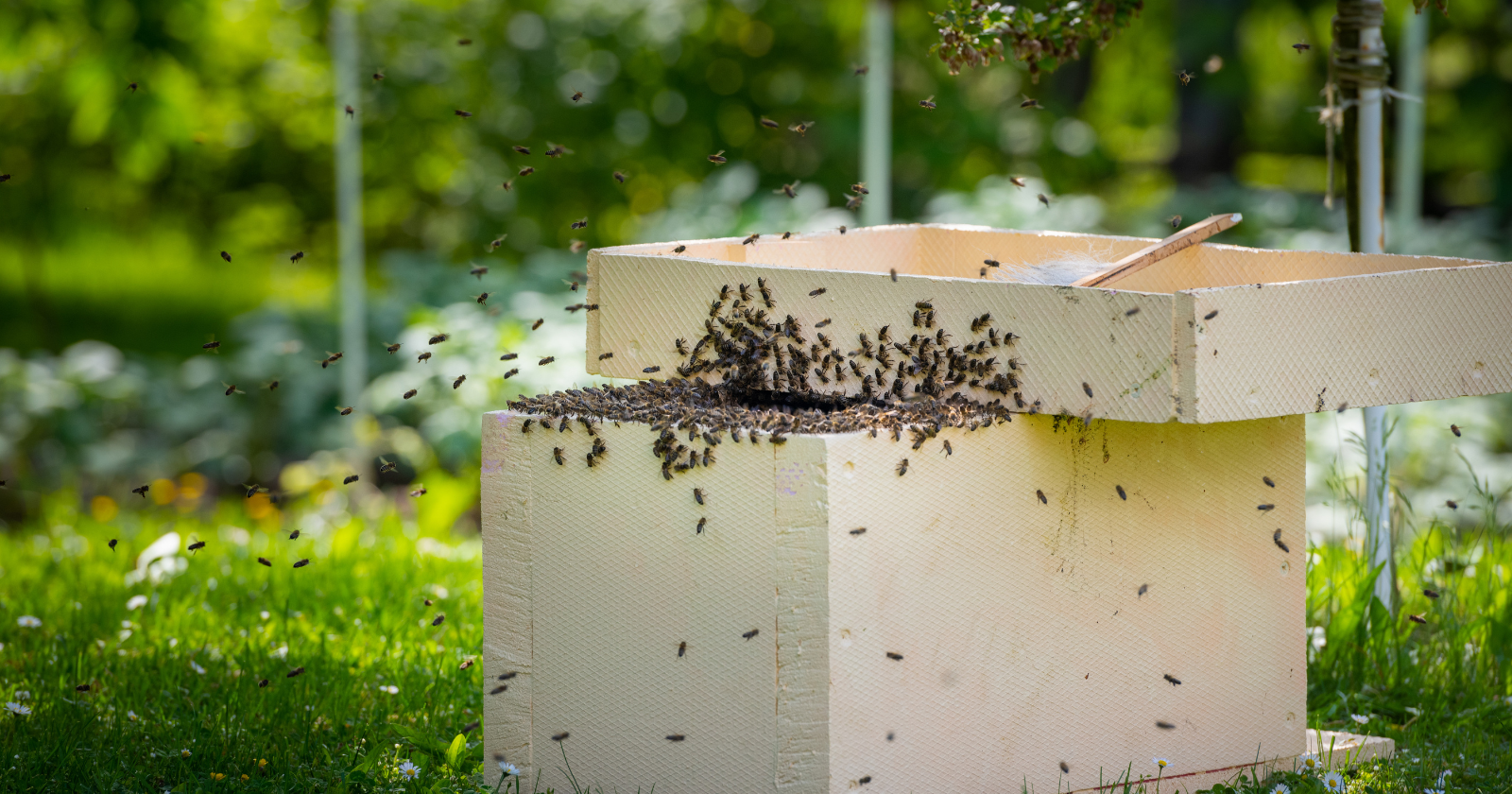
In the spring of 2022, Rachel Fordyce, a technician in Cornell University’s entomology lab, had been parking for free at Ithaca’s East Hill Plaza and cutting through nearby East Lawn Cemetery on her walk to campus, a detail later recounted in Cornell’s alumni magazine. She’d noticed the ground was covered in small, dark bees, thousands of them, moving in and out of tiny holes in the bare soil between the headstones. Rather than walk past it again, she scooped some into a jar and brought them to her supervisor.
That jar became the starting point for a study published in April in the journal Apidologie, led by Steve Hoge under Cornell entomology professor Bryan Danforth. What began as one technician’s curiosity turned into an effort to count an entire underground population, and the number the team eventually arrived at was startling: roughly 5.5 million individual bees living beneath a single 1.5-acre section of the cemetery, more than three times the population of Manhattan.
The bee doing the digging
The species responsible is Andrena regularis, known as the regular mining bee, a small, solitary, ground-nesting bee rather than the hive-building, colony-organised kind most people picture when they hear the word “bee.” Solitary bees like this one don’t build a shared nest or answer to a queen; each female digs and provisions her own burrow, though ground-nesters of this kind often nest in dense aggregations when the soil conditions are right, which is exactly what East Lawn Cemetery’s undisturbed, well-drained, largely unmown ground turned out to offer.
To estimate the population, Hoge and Danforth’s team didn’t attempt to count individual bees directly, which would be close to impossible across an area that size. Instead, between late March and mid-May of 2023, they set out emergence traps, small mesh tents staked over patches of ground with a funnel at the top, designed to catch bees as they emerged from their burrows and flew upward. The traps caught 3,251 individual insects across 16 species of bees, flies, and beetles over that stretch, with Andrena regularis as the dominant species, and by measuring the density of A. regularis emergences per square metre and extrapolating that figure across the roughly 6,000 square metres of the surveyed section, the team arrived at their 5.5 million estimate for that species alone.
Why a cemetery, of all places
Cemeteries turn out to be closer to ideal mining-bee habitat than most working or residential land nearby. East Lawn, founded in 1878, has never been ploughed, developed, or heavily chemically treated, and much of its ground is left undisturbed between burials, mowed but not tilled. For a bee that needs bare or thinly vegetated soil it can dig into without disturbance for the several weeks its larvae take to develop underground, that combination of age, continuity and light-touch maintenance is unusually rare in a landscape otherwise dominated by lawns, pavement and turned soil.
It’s a pattern that has shown up in other studies of urban and suburban insect life: places that look unremarkable to people, like a cemetery, a road verge, or an old churchyard, often turn out to be doing outsized ecological work simply because nobody has gotten around to disturbing them. East Lawn wasn’t set aside as habitat. It became habitat because it was left alone.
Coverage of the study, including a writeup in Smithsonian Magazine, quoted Sean Brady, an entomologist at the Smithsonian’s National Museum of Natural History who wasn’t involved in the research, on just how rare this scale of finding is: he knew of several studies estimating bee-nest aggregations in the hundreds of thousands, but only one other, besides this one, estimating a nest aggregation in the millions.. The pattern researchers are converging on is that continuity of land use, meaning decades or centuries without the ground being dug up, paved, or intensively replanted, may matter more to ground-nesting bees than the specific type of green space involved. A cemetery, a fallow field, and an old estate lawn can all function the same way for a bee that just needs undisturbed dirt.
What that many bees are actually doing
Regular mining bees are active fliers in early spring, precisely the window when many fruit trees, understorey shrubs, and early wildflowers are blooming and in need of pollination before most social bee colonies have built up their numbers for the season. A population in the millions, concentrated in one place, represents a meaningful amount of that early pollination work being done by a single, easily overlooked species in a patch of ground most passersby would not think to look at twice.
Danforth was direct about what a discovery like this implies for how such sites get treated going forward. “These populations are huge, and they need protection,” he said, according to Cornell’s own account of the study. “If we don’t preserve nest sites, and someone paves over them, we could lose in an instant 5.5 million bees that are important pollinators.” The vulnerability he’s describing isn’t abstract: a population this size exists because the ground has gone undisturbed for well over a century, and there’s nothing structurally protecting it from a single decision to regrade, pave, or intensively landscape the site.
What the number can and can’t tell us
The 5.5 million figure is an extrapolation from a sample rather than a literal headcount, and the researchers treat it accordingly. It rests on the assumption that bee density in the trapped plots represents the wider surveyed area — reasonable, given how the plots were distributed, but still an assumption. And it’s a snapshot of one nesting season: whether the population holds steady from year to year would take repeated surveys over several seasons to establish with any confidence.
None of that undercuts the finding’s basic significance. Whether the true figure is closer to 3 million or 8 million — the full range the researchers reported — this is one of the largest documented aggregations of a single wild bee species recorded anywhere, sitting beneath ground that thousands of people walk past every week without a second look. Fordyce still parks at East Hill Plaza. She still cuts through the cemetery. What has changed is that she now knows roughly what’s underfoot.