
Zurbarán
The National Gallery
May 2–August 23, 2026
London
A couple of rooms into Zurbarán, a new monographic exhibition dedicated to the Spanish Baroque master (b. 1598; d. 1664) on view at the National Gallery in London, the visitor is met with a series of saints.
The left-hand corner of the gallery is dominated by images of Saint Francis, humbly-clad and set against a dark background. The right wall, by contrast, is filled with depictions of virgin saints dressed in heavy brocades and the finest contemporaneous fashion. Devoid of any distinct psychology, these latter paintings appear to function mostly as a vehicle for Zurbarán’s virtuosic ability to render every pleat and fold of fabric. Indeed, not long after these works were painted, they drew the ire of Jesuit theologian Bernardino de Villegas, who wasn’t far off the mark when he said, “in their apparel and adornments they do not seem to be saints of the heavens, but ladies of the world.”
In Zurbarán’s time, Seville was caught between powerful forces. Transatlantic trade had made it Europe’s richest city, the gateway to the Americas, and yet, at the same time, it remained firmly in the thrall of the Catholic Counter-Reformation and religious orders who—following the Council of Trent’s decree on images—sought to harness the worldly art of painting as a tool to inspire otherworldly devotion.
What makes Zurbarán’s art compelling is the co-presence of these two distinct, almost mutually exclusive impulses. Here, sacred and profane don’t exactly exist side by side; rather, the latter is used as the manifestation of the former, a means to intensify its spiritual truth. That’s why, even when Zurbarán’s subject matter seems symptomatic of a retrograde theology very much at odds with more contemporary secular sensibilities, we can’t help but be enthralled by the way the painter renders it.
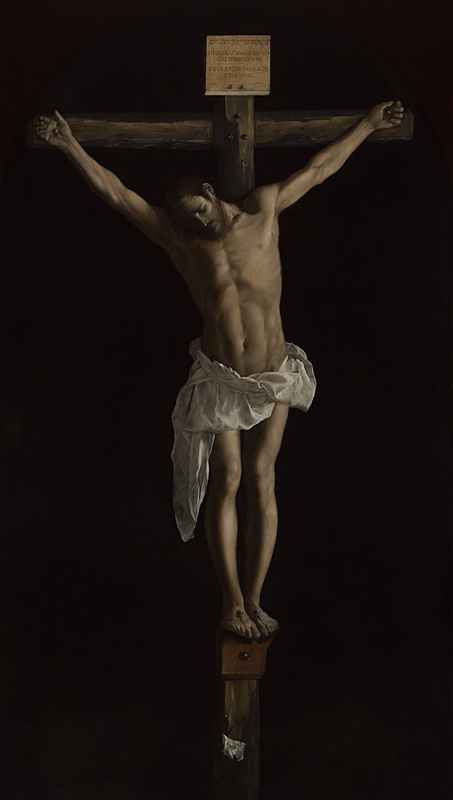
For a case in point, look no further than the exhibition’s first gallery, and the first of Zurbarán’s many crucifixions. The Crucifixion (1627) is flanked on opposite sides of the room by The Apparition of Saint Peter to Saint Peter Nolasco (1629) and Saint Serapion (1628), both of which similarly communicate holiness by contaminating it with elements of all-too-human pathos. Similarly, the crucifixion between them depicts Jesus not as an abstract entity, but as a man of flesh and blood exquisitely staged against a pitch-black background, his muscles tensed by the suffering he is experiencing. Widely considered Zurbarán’s early masterpiece, this painting caused a stir when it was first shown—hidden behind a grille in the dimly lit monastery of San Pablo el Real, it was often mistaken by visitors for a sculpture—and its reception, in part, led to Zurbarán being invited to relocate from his native Extremadura to Seville.
Although they don’t follow a strict chronological order, the three galleries that follow capture Seville at its apogee—commissions were coming thick and fast. The first of these rooms is dedicated to works which Zurbarán realized for different religious orders. Three pictures included here are being displayed together for the first time in 175 years, but belonged originally to a monumental altarpiece painted for a monastery in Jerez de la Frontera, near Cádiz. The second room reunites single-figure pictures of saints produced for both religious orders and private patrons, while the third brings together religious scenes such as the Immaculate Conception and the Crucifixion, both motifs Zurbarán would be asked to depict time and again throughout his career (fifteen and twelve times respectively, to be precise.)