
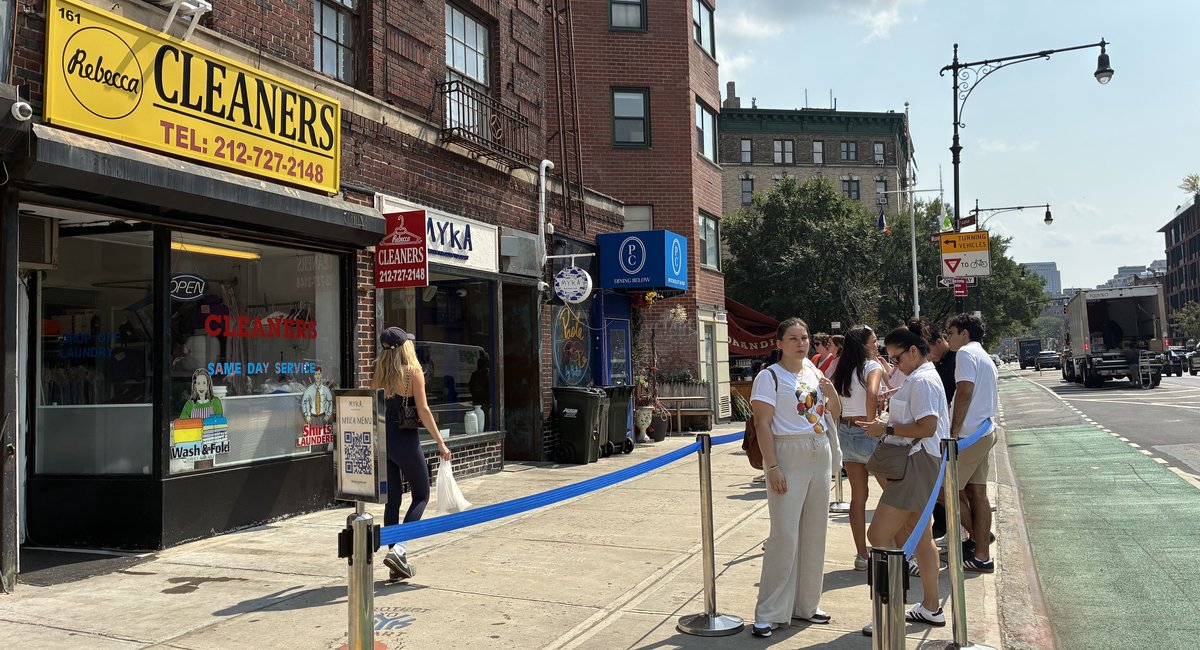
On a sweltering Thursday afternoon earlier this month, I stood in line for frozen yogurt to see what all the fuss was about. I counted 13 people waiting in front of me outside the West Village location of Myka, a frozen yogurt chain originally from Madrid.
A friend later informed me that this was an astonishingly short queue to encounter at the TikTok-famous spot. On weekends, the line wraps all the way around the block.
This wasn’t the first time I had waited for frozen yogurt. I came of age during its heyday in the 2010s. My peers and I frequented the self-serve shop Red Mango, walking around our Midwestern suburb with technicolor desserts piled high. It became a ritual for us.
Trends are cyclical, so it only makes sense that frozen yogurt, which faded in popularity before descending into relative oblivion during the pandemic, would eventually return. But this time it’s more of a production.
People aren’t waiting outside Red Mango or 16 Handles for a simple swirl of cookies-and-cream. They’re queuing between velvet ropes for Myka or Mimi’s or Madison Fare, adorably named places across Manhattan that sell some of the most luxurious frozen yogurt you’ll ever set your sights on — or open your wallets for.
At Myka, $12.15 gets you the special: a regular portion of yogurt topped with ground pistachios, bitter orange compote, a drizzle of floral honey and the fruitiest of olive oils (Spanish or Greek, your choice).
Sure, it’s enticing. But is it worth the high price and ridiculous wait? I needed to find out.
Coming in three, four times a week
There were multiple people in line that day wearing Alo Yoga athleisure, which I imagine to be the uniform of clean eaters stopping for a treat while running errands around town. They were joined by European tourists in backpacks and large hats. A pair of edgily dressed friends standing behind me had just swung by a storefront for the luxury brand Chrome Hearts, judging by the shopping bags in their hands. The frozen yogurt managed to bring us all together.
Myka has been a major attraction from the start, according to entrepreneur Javier Ezquerro, who co-founded the shop with his wife, pastry chef Natalia Morales, in 2023. At their first location, a roughly 200 square foot space in Madrid, “We had tremendous success, just by word of mouth,” he said. “A week or two after opening, we had lines outside our door.”
At Myka in the West Village, $12.15 gets you the special: a regular portion of yogurt topped with ground pistachios, bitter orange compote, a drizzle of floral honey and the fruitiest of olive oils (Spanish or Greek, your choice).
Sonia Rao / Gothamist
Myka has since expanded to 54 stores across Europe, the Americas and the Middle East, per Ezquerro. He expects that number to grow to 75 by the end of the year, and up to 200 by the end of 2027.
“We have so many people that build it into their routine,” he continued. “They’re coming three, four times a week to our shops. We don’t see it slowing anytime soon.”
This detail made me pause. Three, four times? For a place with waits that can stretch to an hour? New Yorkers are more willing than most to wait in line — just walk by a Radio Bakery location for proof — but would they sacrifice that much time each week?
Well, maybe. Because Myka isn’t the only frozen yogurt place to boast regulars, Jenny Ammirati, the co-founder of Culture in Park Slope, sees many of the same customers week after week. She and her husband, Gino Ammirati, opened their shop during the last froyo craze in 2011. They have a second spot in the West Village, a few blocks from Myka. Both locations offer a few yogurt flavors and a wide variety of toppings.
“It can be like a simple black dress to put your topping choices on,” Ammirati said.
While Park Slope tends to be calmer, the lines outside Culture in the West Village are comparable to the queues that form outside Myka — as in, they’re also ludicrously long. While I stood outside Myka on that hot and sticky afternoon, I traced the curious gazes of a few passersby. As their eyes darted from the line to the shop signage and back, they seemed to understand what was going on, but couldn’t quite grasp why.
A “yogurt-first mentality”
I was right there with them until I spooned the yogurts into my mouth. The plain flavors at Culture and Myka are each smooth and lightly sweetened. The tang dances across your taste buds. These are treats that don’t leave you feeling sick or weighed down. I topped my Culture yogurt with mango and strawberries to preserve its fresh edge.
The owners of Culture in Park Slope opened their shop during the last froyo craze in 2011.
Sonia Rao / Gothamist
Ammirati credits this quality to her shop’s “yogurt-first mentality,” which the public has increasingly embraced as Americans eat more of the fermented dairy product for its probiotics and protein. Both Culture and Myka use Greek yogurt as their base, with Culture sourcing its milk from Hudson Valley Fresh. Myka mixes in kefir, which supplies extra gut benefits. Their recipes are carefully crafted for people who actually want to taste the yogurt in their frozen dessert, rather than mask the flavor with saccharine add-ons (as I was guilty of doing in my youth).
Some frozen yogurt resembles soft-serve in flavor, which Ammirati said is probably due to those places cutting corners by adding milk to their yogurt bases. (If this sounds good to you, it probably makes more sense to just go out for fancy soft-serve instead; the dessert has piggybacked off frozen yogurt’s renewed popularity. You might find it worth waiting in line to try innovative flavors such as heirloom tomato or sweet corn at Lisbonata in Crown Heights.)
“It’s really labor-intensive” to make Greek yogurt from scratch, Ammirati said. Which helps explain some of these prices. Culture charges between $6 and $10 for yogurt before toppings, which doesn’t feel unreasonable when you consider the quality of what you’re consuming. (I would say the same for Myka, but with its baseline price comparable to some workday lunches, that one might be more of a destination for special occasions.)
“Yogurt-first” doesn’t mean devoid of fun. The most surprising discovery I made on my truth-seeking mission came from Sofreh Cafe, a Persian bakery and coffee shop in Park Slope.
Frozen yogurts from Sofreh Cafe, a Persian bakery and coffee shop in Park Slope.
Sonia Rao / Gothamist
Chef Nasim Alikhani met the demand for frozen yogurt by adapting a traditional ice cream dessert from her nearby restaurant, Sofreh. She introduced a rosewater saffron yogurt to the cafe this past June. This flavor is a constant, but Alikhani intends to always have a second flavor on rotation that can be swirled in. When I visited earlier this summer, it was a sour cherry.
“We Persians like sour things,” Alikhani said. “We really do. Our food has a lot of citrus and a lot of acid.” It also favors pistachios, which Sofreh Cafe offers as a topping.
In just two months, the yogurt has attracted a passionate community following. Alikhani said she introduced a strawberry flavor to please the small children of Park Slope, who might have found the sour cherry a bit too tart, but plans to introduce a pomegranate next. “And then sometime at the end of summer — fig leaves,” she added.
I wondered aloud whether she would find herself continuing the experiment into the fall. Will the frozen yogurt demand dwindle once the temperatures drop and the novelty fades? Or will the lines continue to stretch around the block year-round, as was the case when Birdie’s opened in January or the West Village’s Myka in April?
“I mean, New Yorkers are quite comfortable eating something frozen in the middle of minus-10 [temperatures],” Alikhani said. “So I guess so.”