
It’s lunchtime and an office worker sweetly offers her hungry coworker a salad.
“Thanks,” he says, before spiraling into paranoia, “for trying to give me poison!”
The farcical Instagram video, created by Brooklyn-based comedian Ena Da and musician and social media consultant Louis Fischer, has racked up more than 15,000 likes and captures the salad panic that has gripped New York City this summer amid a surge in cyclosporiasis cases. The severe form of food poisoning is caused by a tiny parasite that can be transmitted through fresh fruits and vegetables.
The fear is easy to understand: Cyclosporiasis can cause weeks of gastrointestinal symptoms, including explosive diarrhea, according to the U.S. Centers for Disease Control and Prevention. It has sickened thousands across the country this summer, with more than 800 cases reported in New York state and more than 500 in the five boroughs since the beginning of May.
The number of lab-confirmed cases of cyclosporiasis in the city has been trending down since mid-July, according to city data. But weeks after the uptick in cyclosporiasis cases was first reported, New York City and state health officials said they still don’t know which foods are to blame — even as outbreaks in other states have been tied to iceberg lettuce from Taylor Farms de Mexico that has since been recalled.
Amid the uncertainty, some New Yorkers are eating fruit and veggies as usual this summer, while others say they are taking various approaches to avoid getting sick. Some New Yorkers who spoke to Gothamist said they were trying to buy local produce at farmers’ markets instead of going to the grocery store, cooking their vegetables instead of eating them raw, or eating more frozen vegetables instead of buying fresh ones. Some said they are avoiding lettuce, specifically.
Food safety and public health experts differ on how much New Yorkers should change their habits, based on the available information.
“ I haven’t been changing my diet and I don’t know that you should change yours,” Dr. James McDonald, the state health commissioner, told Gothamist.
McDonald reiterated the guidance the city and state health departments have been offering since last month. He recommended washing fruits and vegetables thoroughly, although experts say that doesn’t completely remove the risk of cyclosporiasis. And he said those who are really concerned can cook produce to kill the parasite.
McDonald didn’t have a clear answer on how New Yorkers would know when the increased risk of catching cyclosporiasis had passed.
“ I think it’s always good to keep an eye out on case counts,” McDonald said. “But on the other hand, I think it’s always good to wash your fruits and vegetables thoroughly.”
But other food safety experts said they were taking more precautions.
“I am avoiding raw vegetables right now, which is disappointing because it’s the height of the summer harvest,” said Carolyn Dmitri, a professor of food studies and director of the graduate food studies program at NYU’s Steinhardt School of Culture, Education and Human Development.
Dmitri said she was scrubbing, peeling and cooking her produce and avoiding packaged salads that have been chopped, instead opting for greens sold whole and unwashed, since “water is one way to spread pathogens.”
Are we still avoiding salad?
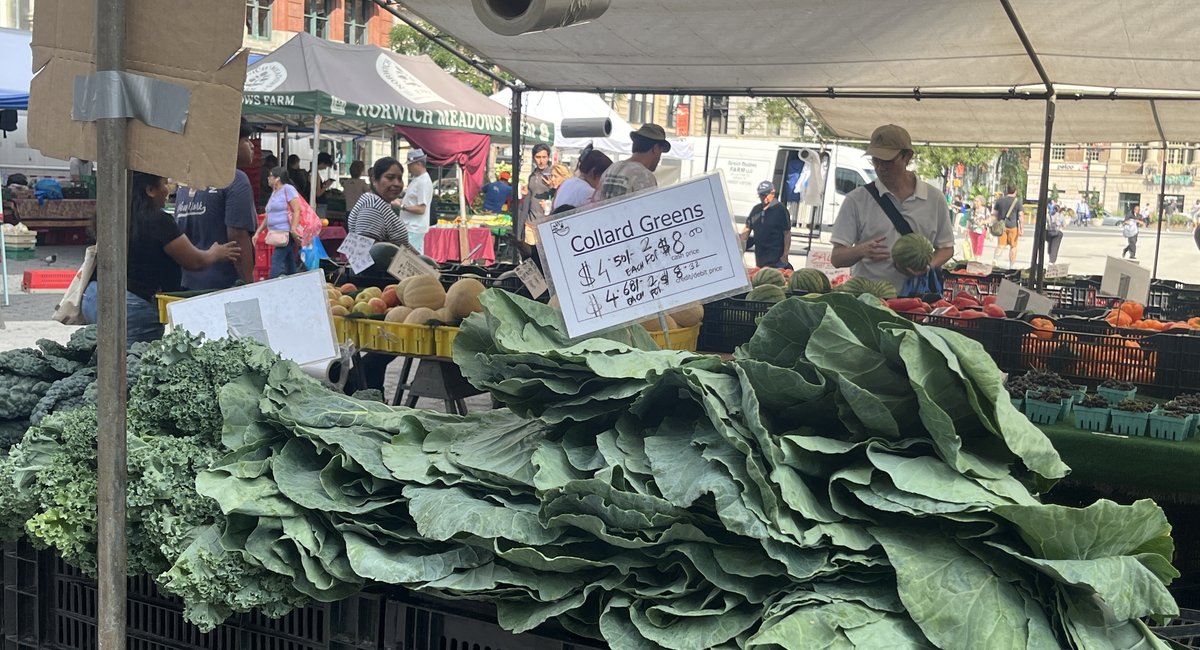
New Yorkers walking through the Union Square Greenmarket on a recent afternoon had differing attitudes toward food safety amid the cyclosporiasis surge.
Joanne Sandler, 75, said she was eating fruits and vegetables but avoiding leafy greens — “even my favorite, arugula.”
Her friend, Jacqui Starkey, 84, said she is thinking more about the safety of the food supply — but it hasn’t stopped her from eating fruits and vegetables as usual.
Several shoppers at the market said they felt safer eating local produce than buying it at a grocery store.
Marc Phillips, a co-owner of Phillips Farms in New Jersey, which sells produce at the Union Square Greenmarket and other greenmarkets across the city, said lettuce sales at his stands were up about 10% to 15% amid the outbreak, but other types of produce weren’t affected.
“This is what I call the flight to safety,” Phillips said. “Any time something bad happens in the food supply, our sales go up.”
Public health experts who spoke to Gothamist said local produce isn’t immune to foodborne illness — but if there is an issue, it’s less likely to be widespread.
“If you know the farm, if you’ve bought produce from them before and you trust them, I think that’s a good sign,” said Lew Ziska, a professor of environmental health at Columbia University’s Mailman School of Public Health.
Fruits and vegetables are more likely to become contaminated with cyclosporiasis outside of the United States, said Dana Mordue, associate professor of pathology, microbiology and immunology at New York Medical College.
She said this summer she is eating more fruits and vegetables she can peel and avoiding most lettuce because it has a natural coating Cyclospora can embed into — although she said she feels more confident eating locally grown varieties.
Fischer, the co-creator of the Instagram video about the outbreak, said he stopped eating fresh vegetables early last month, swapping them out for frozen or cooked veggies.
“ I was like, ‘Oh my God, if I have to poop for the next month and take time off [of work], I don’t know how I’d be able to feel good about myself,’” Fischer said. He added that the COVID pandemic had primed him to take public health alerts seriously.
But Da, his collaborator, said she’s less fearful.
“From my perspective, there’s not that much preventing getting sick from food, except safe handling,” Da said.
The pair got the idea for their video when Da, who volunteers at the Fourth Street Food Co-op in Manhattan, suggested Fischer would be safer eating local produce.
“ I kind of accused her of trying to poison me,” Fischer said, clarifying that he was kidding.
Earlier this week, Fisher said his friends convinced him to break his rule and have a salad.
“If I get Cyclospora, I’m gonna be so mad at everyone, I swear to God,” Fischer said.
Will New Yorkers get any answers?
In Michigan, where cyclosporiasis sickened nearly 13,000 people this summer and killed two, health officials declared earlier this month that residents could go back to eating salad greens as usual, as long as they continued to avoid recalled products.
But it’s unclear whether New York will get concrete answers about the source of the cyclosporiasis cases this summer, or an indication of when things can return to normal.
New York always has a certain number of cyclosporiasis cases every year and they tend to tick up in the summer, according to city and state health officials. But this year, there were about three times as many as usual in the city by mid-July, the city health department said at the time.
New York was not on the list of states that Taylor Farms recalled lettuce from last month, although the U.S. Food and Drug Administration said Tuesday that lettuce could have made its way here anyway.
Only a handful of the cyclosporiasis cases in New York have been linked to the Taylor Farms lettuce and all were acquired while traveling out of state, city and state health officials said.
The city and state health departments say they are still investigating the source — or sources — of this summer’s cyclosporiasis surge.
To trace cases in the five boroughs, city health workers call people who have gotten sick and ask them about what they have eaten, the city health department said.
If an ordinary restaurant or grocery store pops up, city workers visit the location, inspect sanitary conditions, and try to gather more information about common ingredients or suppliers. That information is then provided to the CDC, so federal officials can compare it with information on clusters in other jurisdictions, the city health department said.
Part of why a cyclosporiasis outbreak can be “such a vexing puzzle to solve” is because it can take up to two weeks for symptoms to show up and people may not remember what they ate that long ago, said McDonald.
This approach can help health officials identify the source of a cyclosporiasis cluster, such as the one the city health department linked to cilantro earlier this year.