
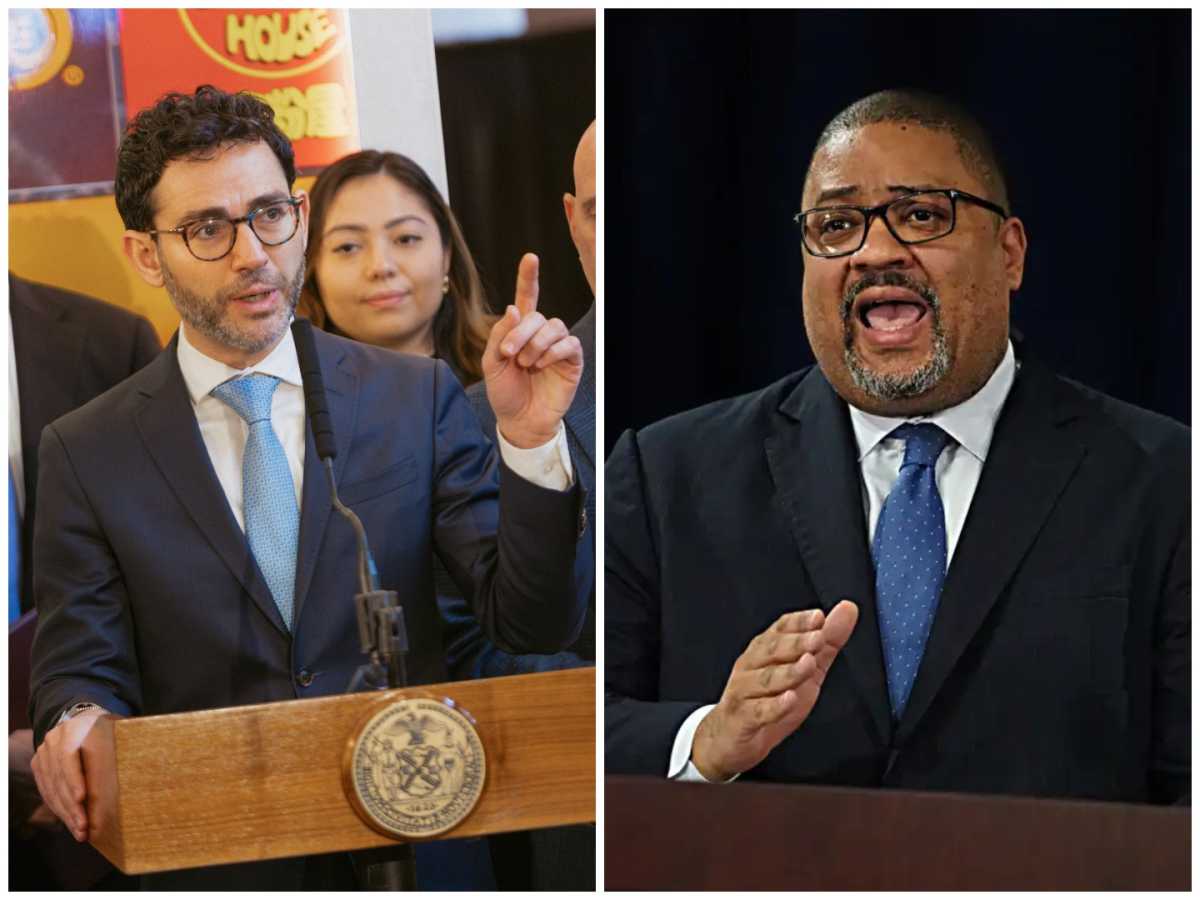
The Manhattan District Attorney and the city’s labor watchdog announced that they would join formally forces on Thursday — an initiative they hope will crack down on wage theft, housing and immigration violations.
Manhattan DA Alvin Bragg and Department of Consumer and Worker Protection Commissioner Samuel Levine signed a memorandum of understanding this week in which they agreed to start sharing information, data, and strategy on how to combat unscrupulous employers, landlords and other bad actors.
“We are sending a message to companies that want to steal people’s wages, that want to exploit immigrants, that want to harass tenants, that they not only could face civil prosecution, but that they could face criminal prosecution,” Levin said. “And my hope, of course, is that that actually deters and reduces exploitation.”
Though the lion’s share of what the District Attorney’s office prosecutes is criminal cases involving violent crime, Bragg has made strides in the area of labor enforcement. He created a worker protection unit after he entered office in 2022, and drew attention to a construction task force that handles wage theft violations.
Levine told amNew York that the collaboration follows a model he had pioneered in Washington D.C. with the Federal Trade Commission’s Bureau of Consumer Protection, in which he expanded the agency’s criminal liaison so that he could refer more cases for criminal prosecution. Levine said that his idea to partner up had been received enthusiastically by the Manhattan DA’s office, and that he hoped other boroughs would follow suit.
For wage theft cases, whether a case ends up attracting criminal enforcement on top of civil penalties boils down to the scale – either length of time or number of employees – or whether there was intimidation or retaliation, Bragg said.
“They’re complimentary pieces of the enforcement puzzle,” Bragg said. “We get allegations of wrongdoing that are disturbing and problematic and illegal but don’t rise to the level of a criminal case… To have a way to facilitate referrals and streamline information — to reduce silos in government is very important.”
If an employer flat-out refuses to pay a freelance worker, for instance, civil penalties can act as one form of deterrent but a criminal investigation can make the consequences more severe.
“It’s really important that especially with these fly-by-night operations where you get a civil judgment and they just don’t pay it — sometimes the only way to deter that kind of practice is through a criminal enforcement where people can actually face jail time,” Levine said.
On the flip side, Levine added, the DCWP plays a key role in ensuring that exploited workers or tenants actually get their money back.
Beyond labor enforcement, the two agencies will also share data over housing violated — DCWP enforces rental fees like the ban on broker fees. Levine said that when he and his staff attended some of the rental rip-off hearings, they heard not just about normal abuses like junk fees but egregious criminal conduct like landlords demanding sex from their tenants — a clear instance in which criminal enforcement is warranted.
In instances where the violations run the gamut of both civil and criminal violations, victims can now go to either the DA’s office or DCWP and let their staff sort out what the proper course of action should be.
“Put the burden on us to figure out how to serve the public rather than the burden on people going through really difficult moments in their lives,” Levine said.
Bragg said that the other strategic benefit will be for the agencies to compare data on violations involving workers, tenants or immigrant fraud scams, to get a clearer picture of their frequency and extent. That way, they can raise public awareness before these infractions get to the level of enforcement.
“We certainly want to hold people accountable, but we also want to educate the public and have a deterrent effect from the work,” Bragg said.