
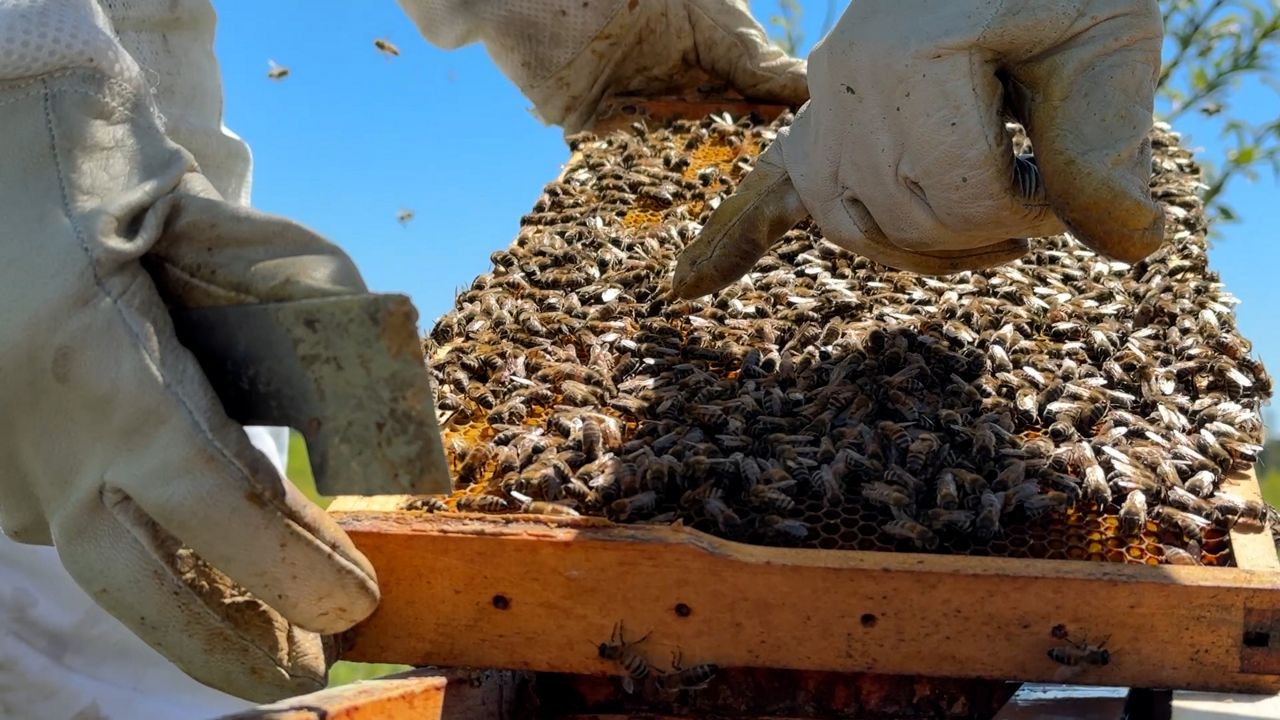
EAST CONCORD, N.Y. — They’re the little critters that keep our food supply running: bees. Sometimes, they need a little help getting to their next stop in life.
“We just give them a little bit of smoke to let them know we’re here,” said Amy Barkley, the owner of Snowy Brook Farm, as she approached a beehive.
All but two of the hives on Barkley’s farm came from swarms.
“A bee swarm is when the bees have built up enough population in their home colony where they say, ‘OK, we are strong enough; it’s now time to spread our genetics somewhere else,’ ” Barkley explained. “Then half of the hive … they’ll go off and find a new hive.”
With warming temperatures, swarm season started earlier this spring, but the cold swings left a lot of them a bit discombobulated. They gathered in trees and hard-to-get places, but also picnic tables, fences and grills.
“It puts people at risk. It puts the bees at risk,” said Sandra Larsen, the owner of The Eclectic Patch. “So while we would love nature to do their thing, sometimes there’s just not enough space.”
Larsen is the second half of the duo, taking those swarms and bringing them to safety.
“She has the science end covered and me as a more spiritual person, like I just genuinely felt for them,” said Larsen.
It’s not all easy going.
“Multiple eggs per cell,” pointed out Barkley, looking at one of the swarms she saved.
Multiple eggs per cell isn’t a good sign, because it could indicate the absence of a queen.
“Hold on. Is that a drone? Is that a new queen?” questioned Larsen, pointing out one bee.
Lack of a queen could mean death for the hive. So if one hive might be struggling, creative engineering comes into play. Larsen and Barkley took healthy bee eggs from one hive and transferred them to the hive with the questionable queen, in the hopes that it would bolster their numbers.
“Adopt the babies,” said Barkley to the hive.
“Please adopt the babies,” added Larsen.
They’re saving the bees with an eye to business, too.
“The bees at my place … they’re local,” said Larsen. “Every single queen that I have swarmed from some place in Western New York, and now they’re living on the eclectic patch.
“Winter comes two weeks earlier. Spring comes two weeks later. So we need to have bees that have acclimated to this exact environment in order to thrive,” added Barkley.
They got dozens of calls each during the spring swarm season. There can be a second one in August and September.
“I think of the swarm that I caught in Hamburg, and there were literally no bees left behind,” said Larsen. “There’s a little bit of, I wouldn’t say pride, but it warms your heart knowing, like, ‘wow, OK, they’re going to be OK,’ you know.”
Their tip: If you see a swarm, leave it be or call in the pros.
“I think it’s like anything else. Just be prepared,” said Larsen.
You can reach out to your local beekeepers association or cooperative extension office for information on finding one of those professionals.