
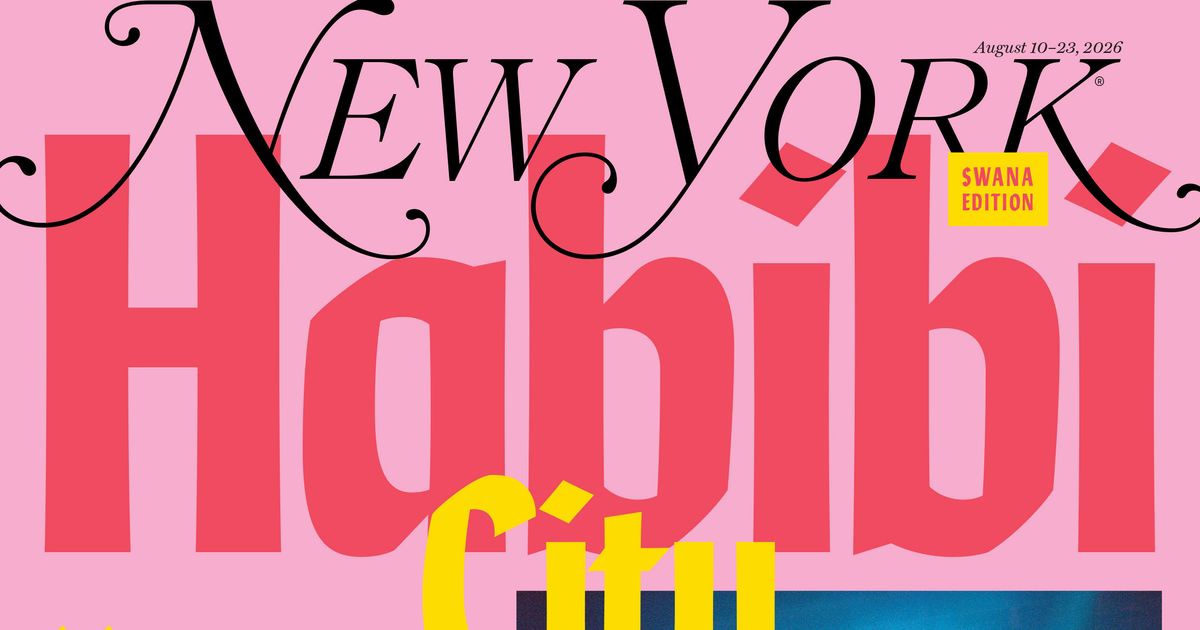
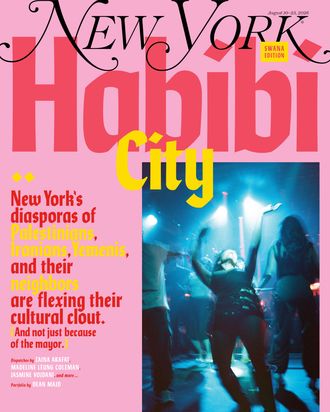
The magazine’s most recent issue was devoted to a series of articles exploring the rise of the city’s SWANA — Southwest Asia and North Africa — scene. The feature prompted a strong reaction, from celebration to condemnation, across social media, newsletters, and local and international news outlets. Copies of the issue sold out online, and multiple city newsstands placed reorders; at the same time, some longtime readers canceled their subscriptions in protest of material they found antisemitic.
The Washington Post columnist Shadi Hamid called Zaina Arafat’s introductory essay “a wonderful piece on how NYC met its Muslim moment,” and the Lebanon-based L’Orient–Le Jour wrote that the issue “symbolizes the emergence of a new era” and argued that the “most striking symbol of this media breakthrough is the cover, entrusted for the first time to a Palestinian artist and photographer, Dean Majd.” One commenter, a Palestinian American raised on the Upper East Side, wrote, “honestly never thought I’d see the day NYMag put the word ‘Palestine’ on its cover without a giant, de-humanizing asterisk underneath it” and thanked the magazine for making the “American diaspora population feel a little more seen.” Reem Farhat of the News Movement praised the issue as “historic” but wrote that “the question now is whether … this ‘soft power’ in the form of cultural clout will mean less bombs dropping overseas.” “The answer is obviously: no,” the journalist Dalia Al-Dujaili responded. “Most people can agree that having more SWANA businesses is an enjoyable development … To force this connection in the narrative of this issue is unfounded.”
The series reported from within a community that explicitly defines itself as pro-Palestinian, and the magazine’s decision not to include other perspectives struck some readers as unbalanced, antagonistic, or an act of Jewish erasure. On Substack, Matthew Nouriel wrote that the series’ “diversity is curated inside an ideological framework: Israelis can appear, as long as the ones we are shown have denounced Zionism. I can’t think of anything more pitiful or pathetic than Jews or Israelis being granted acceptance by repudiating the actual decolonial national liberation movement of their own people.” “Every Jew is described as anti-Zionist, an Arab Jew, or as someone’s non-Zionist partner,” wrote Eli Kowaz in his newsletter, The Middle Ground. “To be a Jew in Habibi City, you have to answer the Israel question the ‘right way.’ ” Mark Horowitz, a former editor at the magazine, said he was saddened that the feature “couldn’t find a way to celebrate one part of the city without also denigrating and erasing another.”
Arafat, a Palestinian American writer and professor, wrote in her essay (“Soft Power”) that members of the SWANA community “still face xenophobia, Islamophobia, and Zionism—along with the repercussions of speaking out against them”; many readers critiqued the choice to include the term Zionism in this sentence. In a letter to the magazine, Kenyon College political philosopher Fred Baumann asked, “How is the presence of Jews (and non-Jews) who want to see the Jews of Israel survive and the Jews of the diaspora have a place to go to, when as Jew-hate revives yet again, a threat? What is so scary about that, that it has to be ‘faced?’ ” Others were upset that while October 7, 2023, was referenced multiple times in the series, the authors never directly addressed the massacre that occurred in Israel that day.
The controversy around the issue was covered widely in other publications. The New York Post ran multiple articles about it, headlining one “New York Magazine’s evil ‘Habibi City’ cover sends a message: Jews aren’t welcome in Mamdani’s NYC.” The online magazine Tablet called the issue “absurd,” while National Review accused the magazine of turning “its back on the city’s Jews.” For The Free Press, Liel Leibovitz wrote, “If all you care about is your native culture, if you wish to fill every moment of your day with swell SWANA sensations, why not, ya know, go back to SWANA?” and argued that “everyone else should fight like hell to make sure New York never becomes Habibi City.”
The reaction was, to some readers, itself Islamophobic. The media-watchdog group FAIR argued, “These nonsensical responses to a straightforward piece of cultural reporting are a testament to what Arabs, Persians and other groups are up against in the press.” “It’s sad to see certain pro-Israel voices treat culture as zero-sum. It seems that their opposition is to the very idea of a Muslim or Arab public presence in NYC,” Hamid, the Washington Post columnist, wrote. He added, “Of course Muslim spaces are going to be critical of Zionism. Why wouldn’t they be?” Jasmine El-Gamal argued that “the meltdown” over the “series is very telling, and underscores just how much some people want us, as SW Asian/Middle Eastern/North African communities who make up the beautiful melting pot that is America, to exist quietly, invisibly, obediently … We’re proud of our cultures, and we’re proud to be American, and both of those statements can be true at the same time, habibi.”
Some objected to the magazine’s use of the term genocide to describe Israel’s actions in Gaza. Close readers will recognize that this was not a decision specific to this series. This past fall, after an extensive review of genocide scholarship and interviews with multiple experts in the field of genocide studies, the magazine’s editors decided the term was an accurate description of the atrocities in Gaza, that accusations of antisemitic intent were in fact obfuscating an overwhelming scholarly consensus, and that its use would be allowed in our pages.
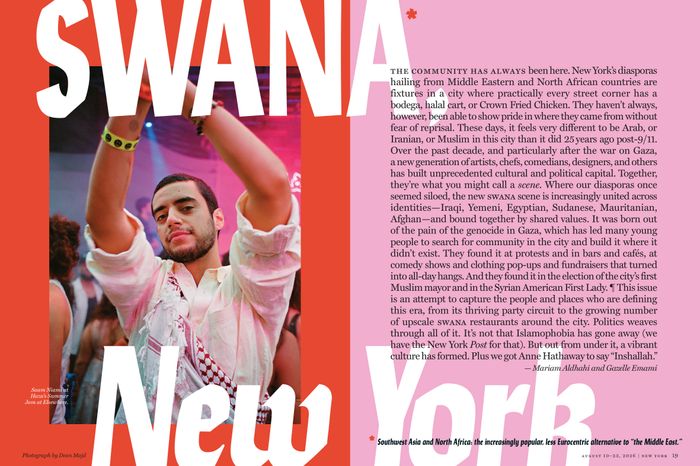
Photo: New York Magazine
As part of the series, Madeline Leung Coleman wrote about the SWANA restaurant scene — and the fissures that exist within it (“When Eating Out Is Political”). Journalist Peter Sterne called the report a “really fascinating story about the cultural and political implications of NYC’s ‘Middle Eastern’ dining scene” and praised it for “presenting Arab, especially Palestinian, New Yorkers as protagonists in their own story.” But numerous critics took issue with its embedded argument that Israeli restaurants were appropriating other cultures’ cuisines. In a Substack essay, “New York Magazine Erased My Family From the Middle East,” Hen Mazzig wrote, “To pretend that a people don’t have food is a way to dehumanize them. No nation lacks cuisine. Deprive Jews and Israelis of a culture, and you deprive us of our humanity.” Helen Rosner of The New Yorker, though, called it “an incredibly insightful, intelligent piece” and encouraged critics to read it more closely: “Not only is this article genuinely one of the most rigorous, elegant pieces of gastronomical culture writing I’ve ever read … it gives deep consideration to Jewish & Israeli culinary culture.”
In writing about the restaurant Ayat, Leung Coleman described its menu as
“a cheerful tourist-style map in which the land mass currently called Israel is titled ‘Discover Palestine.’ ” While she calls Ayat’s stance “combative,” many readers were offended by this line, which to them suggested the magazine itself was adopting the restaurant’s perspective. On Instagram, the Jewish comic Eitan Levine wrote, “The whole thing made it seem like Palestinian culture cannot exist unless Israeli and Jewish culture are wiped off the map.” Writing for the Forward, Rob Eshman argued that articles like it are part of the reason “Israeli restaurants are increasingly labeling themselves as Middle Eastern or Levantine”: “Israeli restaurants aren’t Med-washing their names because they’re reckoning or apologetic. They’re hiding because the violence against them is getting worse.” In its reporting on the controversy, Haaretz noted that “Israeli chefs in New York voiced concern about the article, but preferred to keep a low profile and not inflame the debate further. The feeling among them is that the piece could hurt restaurants identified as Israeli—yet alongside the worry there is also hope that the uproar will actually draw Israel’s supporters to them, and there are still plenty of those in New York.”
Elsewhere in the issue, Emi Nietfeld reported on the custody fight between a Chinese man and the Florida woman who carried his triplets (“Who Gets to Raise These Babies?”). For many, the article raised concerns about the lack of regulation around surrogacy in the United States. The feminist writer Jill Filipovic said, “I don’t think surrogacy should be illegal but it should be very very very tightly regulated and stuff like this should not happen.” Attorney Dilan Esper added, “I am not sure transnational surrogacy should necessarily be legal at all in the US. The argument for surrogacy is that American couples desperately want children of their own. But selling American kids to foreign (authoritarian!) countries isn’t good!” Overwhelmingly, readers asked us to keep covering the story: “I came here to say one thing,” commenter joyouss wrote. “Please, please, please continue writing about this. We want to know how this story progresses and the fate of these precious babies.”
Send correspondence to comments@nymag.com. Or go to nymag.com to respond to individual stories.
Thank you for subscribing and supporting our journalism.
If you prefer to read in print, you can also find this article in the August 24, 2026, issue of
New York Magazine.
Want more stories like this one? Subscribe now
to support our journalism and get unlimited access to our coverage.
If you prefer to read in print, you can also find this article in the August 24, 2026, issue of
New York Magazine.