
Mayor Zohran Mamdani has said that the city is exploring “every single avenue” it has to address persistent flooding after parts of Brooklyn and Queens were impacted by serious flooding on two occasions last week.
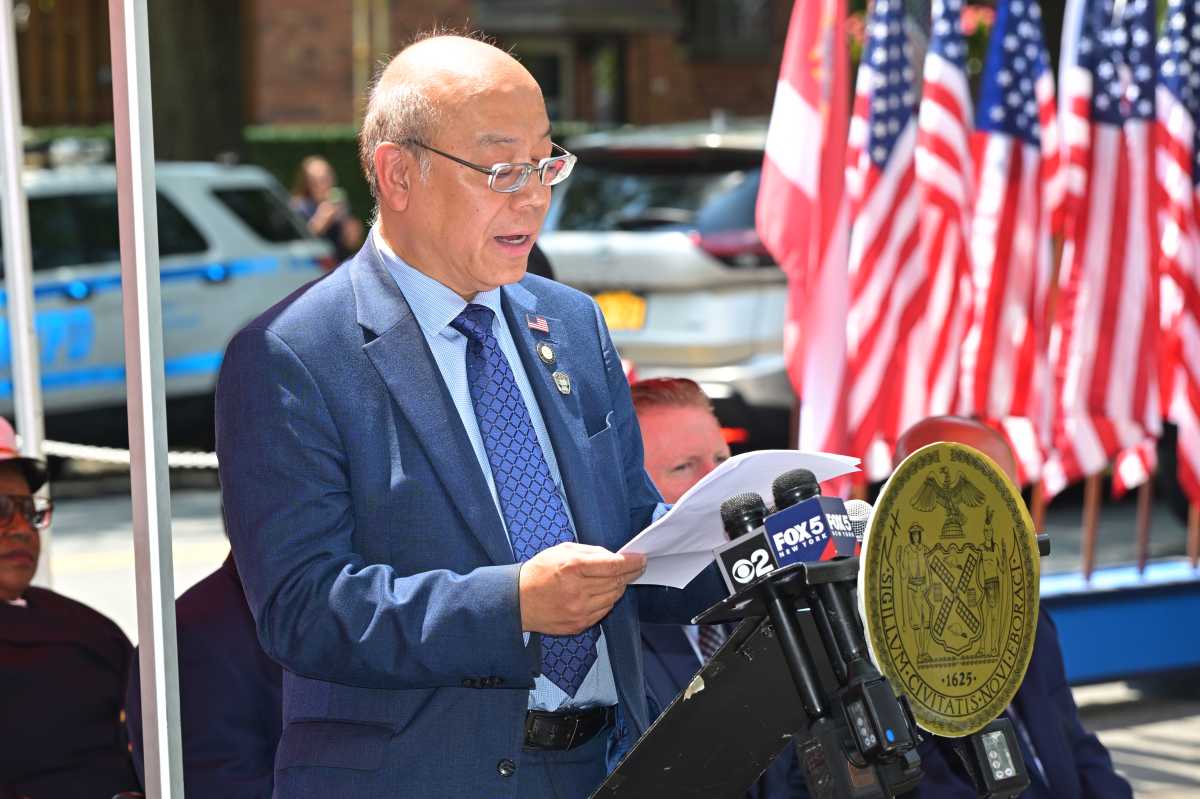
Mamdani’s statement comes after Council Member Phil Wong wrote to the mayor demanding that City Hall take immediate action to address flooding across Queens, noting that Council District 30 was hit by serious flooding twice last week and at least four times in August.
In a lengthy letter to the mayor, Wong called on Mamdani to redirect hundreds of millions of dollars of city funds to the Department of Environmental Protection to help fund more frequent catch basin and sewer cleaning, additional drainage and retention infrastructure, and assistance for homeowners within flood-prone communities.
Responding to separate questions from reporters at an event in Glendale on Aug. 24, Mamdani said the city’s sewage system was built to cope with the rainfall of a century ago, adding that climate change has significantly increased the rainfall that the city is not withstanding. The mayor said the sewage system would need to be completely overhauled in order to cope with the current levels of rainfall in the city.
However, he said the city would “not sit on our hands” while the sewage system is overhauled, stating that City Hall is exploring a number of methods to mitigate flooding, including the installation of cloudburst technology, the use of permeable pavements and floodable parks among other methods.
Deputy Mayor of Operations Julia Kerson, meanwhile, said the city is investing $100 million in modernizing catch basins as well as investing in initiatives like rain gardens and cloudburst programs. Kerson also noted that the city has announced a $2.8 billion initiative to overhaul the sewage system in southeast Queens to deal with chronic flooding in the area.
Wong, however, accused Mamdani of implementing “damage control” after flooding had caused damage in neighborhoods across the borough rather than proactively acting to prevent major incidents.
“Catch basins need to be cleaned on a real, reliable schedule, not simply after a storm,” Wong wrote. “We need more of them installed where the infrastructure cannot handle the volume of water.”
He also called for more underground retention tanks so that excess water has “somewhere to go” other than people’s basements.
Wong further called on the mayor to ensure that the Department of Transportation “gets serious about enforcement,” claiming that utility companies frequently dig up and repave sidewalks with “too little oversight.”
“Too often, they fail to restore grass strips and other green spaces that existed before the work and simply pave over the entire stretch instead,” Wong wrote. “That eliminates permeable surfaces that can help absorb stormwater.”
Wong said he has confidence in DEP Commissioner Lisa Garcia but called on Mamdani to “empower her” by giving her the resources she needs by redirecting funds from other initiatives to flood mitigation.
Those initiatives, which are policies that Wong has opposed, include $260 million for the Office of Community Safety and $53 million for the Office of Mass Engagement, which aims to transform how New Yorkers participate in city government.
“Redirect money from offices that are not providing essential services,” Wong wrote. “Put those dollars toward the infrastructure New Yorkers actually depend on.”