
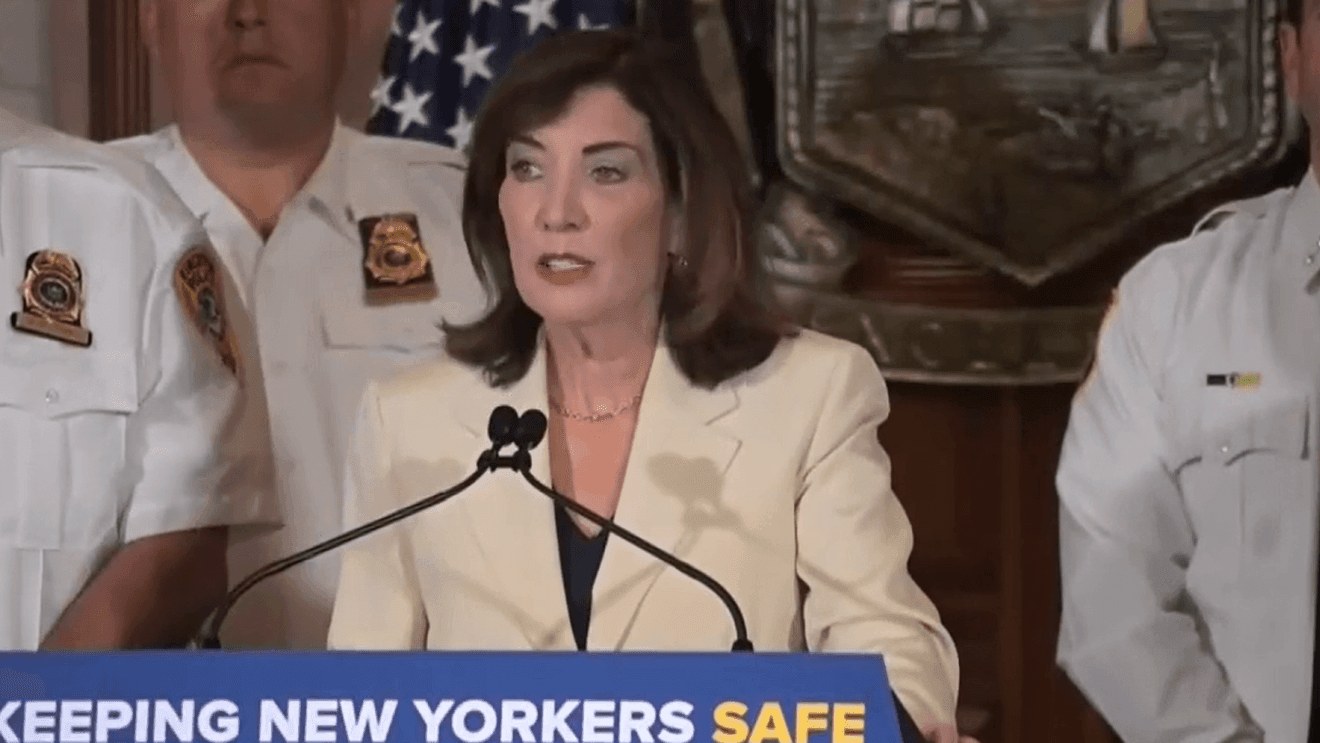
ALBANY, NY — New York’s ban on agreements that allow local law enforcement agencies to assist with federal civil immigration enforcement took effect Tuesday, Aug. 25, setting up a fight with the two counties that still participate in the partnerships.
The law, known as the Local Cops, Local Crimes Act, bars local governments and law enforcement agencies from entering into 287(g) agreements with U.S. Immigration and Customs Enforcement, or similar arrangements that use local resources to detain people for federal immigration violations. Gov. Kathy Hochul said the measure is intended to keep local police and sheriff’s departments focused on public safety in their own communities rather than federal immigration enforcement.
Hochul made clear she expects law enforcement agencies statewide to follow the new law and said the state is prepared to fight back if counties do not comply.
“And to those suing us, those trying to block the implementation of this law, try before and failed, our law has been already upheld by courts,” Hochul said. “But if you’re trying it again, I say bring it on.”
The Local Cops, Local Crimes Act was signed into law in May as part of Hochul’s broader package of immigration-related protections. The package also limits the use of face coverings by government officers while interacting with the public, creates a path for New Yorkers to sue government officials over alleged constitutional-rights violations and sets protections involving sensitive locations and immigrant students.
The law took effect Monday morning, less than two months after the U.S. Department of Justice filed a complaint against the state. The DOJ argues state-level bans on 287(g) agreements and agent masking restrictions amount to unconstitutional interference with ICE’s work.
“Courts have already spoken,” Hochul said. “But I’m confident we’ll win again. In the meantime, we expect all agencies and the confines of the great state of New York to comply.”
Section 287(g) of the federal Immigration and Nationality Act allows ICE to delegate certain immigration enforcement duties to local officers or employees. Supporters of New York’s new law argue those partnerships can damage trust between law enforcement and immigrant communities, making people less likely to report crimes or seek help.
State officials say 53 of New York’s 62 counties have never had a 287(g) agreement with ICE. Out of the 62 counties statewide, only Rensselaer and Broome counties still participate in 287(g) agreements.
Attorney General Letitia James last month notified 12 local law enforcement agencies with 287(g) agreements that they were required to end those arrangements by Aug. 25.
The DOJ has sought to block parts of the state’s immigration laws. A federal court denied the department’s request for a preliminary injunction involving the 287(g) ban, allowing the provision to take effect.
In Albany, Police Chief Brendan Cox said overall crime has dropped by 7%, partly because local officers are not required to do ICE’s job.
“This isn’t about refusing to cooperate on criminal matters. We will continue to work with our federal partners on serious criminal activity with a nexus to public safety. It’s about keeping our local officers focused on local crime and maintaining the community-based trust that keeps us safer,” Cox said.
Hochul said the issue extends beyond New York, arguing the way immigration enforcement is carried out affects public safety nationwide.
“We saw it on the streets of Minneapolis with Renee Good and Alex Pretty were killed in cold blood,” Hochul said. “And where a five-year-old boy was detained with his blue bunny head on. His Spiderman bag still has it back. We saw it in our own state, Mr. Shah Alam, a blind man who couldn’t speak English, was left to freeze to death by border agents in Buffalo. And we’re still seeing it.”
Both Hochul and Cox also referenced last week’s foiled terror plot and said local and state police worked with the FBI and the Joint Terrorism Task Force to ensure officers stayed safe.
New Yorkers who witness federal enforcement activity can report it through the New York attorney general’s federal actions portal. The attorney general’s office also has a hotline for reports involving possible violations of state civil immigration-enforcement laws: 1-800-771-7755.
RELATED: Rensselaer County challenges New York’s ban on 287(g) immigration agreements