
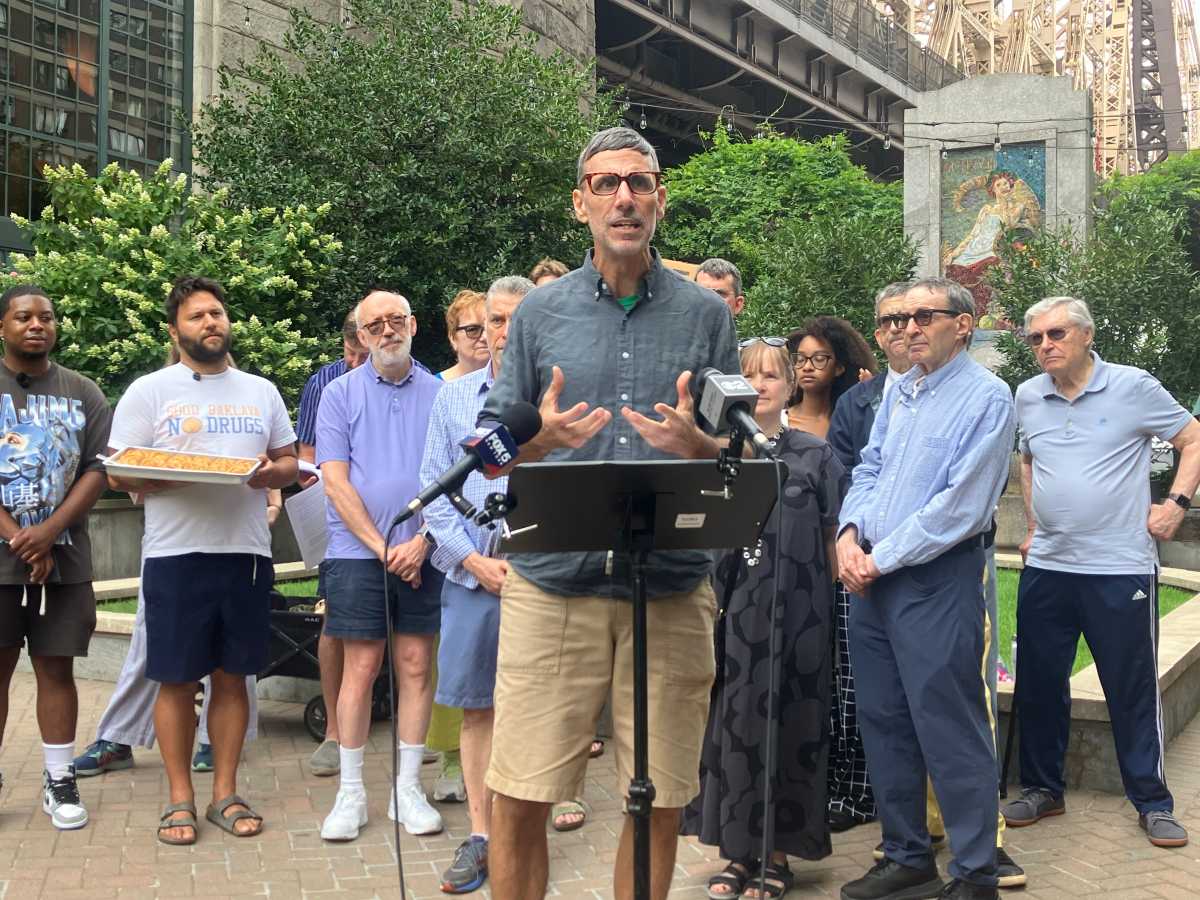
A high-end event venue has “taken over” a Midtown East public plaza, illegally denying people access to the space via barricades, no trespassing signs, security guards and an “agreement” with the local NYPD precinct, alleges a new class action suit.
Luxury event and wedding venue Guastavino’s has illegally made the public plaza under the Queensboro Bridge near East 59th Street and 1st Avenue its own, alleges a group of people who say they’ve been denied access to the space consistently for years and documented NYPD officers kicking them out on Instagram.
“This case is about the brazen and illegal seizure of public space by a high-end private event company and a commercial real estate developer who, on a daily or near-daily basis, evict the general public from a public plaza in Midtown Manhattan,” states the suit. “The city, rather than enforcing the terms of the original deal on behalf of the public, actively participates in the illegal scheme by falsely claiming the space is private property and, upon request of the companies, evicting members of the public, arresting them, and charging them with trespassing.”
The lawsuit filers seek damages for all members of the public who have been kicked out of or denied access to the space.
Guastavino’s is not only kicking the public out of the city-owned plaza, the suit alleges, but also profiting from it — selling the use of it and an “illusion of exclusivity” to clients who sometimes pay up to $300,000 to hold events in the pricey event hall.
The suit, filed Monday, asks for an accounting of all the money the private space has made off using the public space over the years, and for those funds to be placed into a court-approved restoration fund dedicated to the preservation of public space in Midtown East.
The venue has advertised the public space as its “private garden” on its website, which the suit alleges has allowed Guastavino’s to charge more for events. It also recently accepted payment for a high-profile film shoot in the space. The venue has never obtained a city permit for use of the outdoor space for those events, the suit alleges, a requirement when operating in public spaces.
In response to a request for comment on the suit, Guastavino’s said it “acknowledges that this is a public plaza,” and is working with the city to “come up with a path forward.” City Hall and the NYPD — both of whom were named in the suit —did not respond to requests for comment.
City Council Speaker Julie Menin’s office, however, told amNewYork that city agencies investigated the matter at her request, an action which resulted in the removal of “incorrect signage” that indicated the plaza was private Tuesday morning. New signage clearly indicating the space is public will be installed, Menin said.
“Public spaces belong to all New Yorkers and must remain accessible for everyone to enjoy,” said Menin, whose district includes the contested public space. She said she became aware of the issue through constituents and the attention the controversy over the space has garnered on social media.
Midtown East public plaza suit may impact usage across NYC
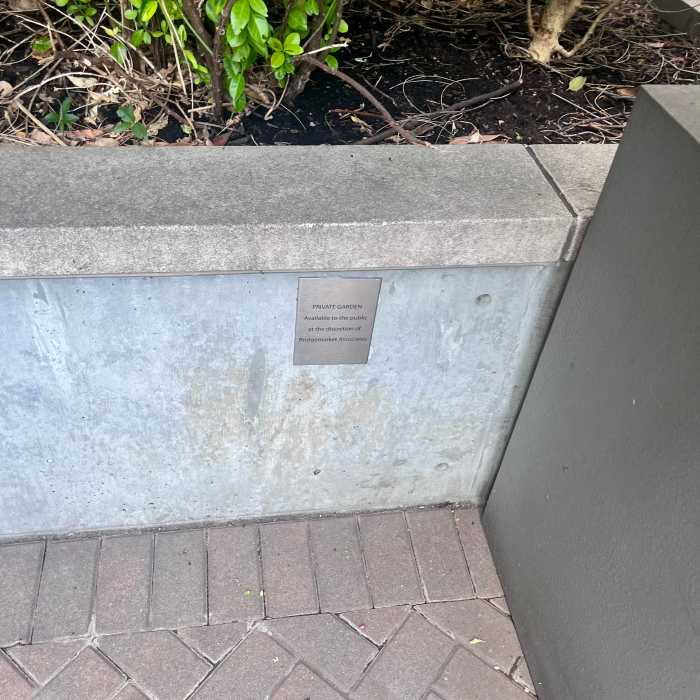 Since-removed signage incorrectly stating the plaza was private.
Other council members whose district neighbors the plaza and includes contested public spaces said their offices and the city’s legislature were considering ways to beef up enforcement against private businesses that were taking advantage of, misusing or unjustly keeping the public out of adjacent public spaces or of privately owned public spaces, colloquially known as POPS.
Brice Peyre, a spokesperson for Council Member Virginia Maloney, whose district neighbors the 59th Street public space, said her office and the Council have been getting calls from residents complaining about private businesses taking advantage of public spaces and POPS, which had spurred Maloney to turn her focus to the issue.
“We would love to see enforcement of the actual regulations as they exist right now,” Peyre said. “Where are the teeth? Do we need to put in more enforcement measures, like financial penalties, stepped-up penalties, other forms of more enforcement? We’re just starting to dig into that.”
“There is a need to keep an eye on it as far as security and to make sure it doesn’t become overrun,” he added. “It’s a balancing act there, but I’m sure that we can work with local precincts and private building owners to make this work for everyone. Because the way it’s going now, it’s becoming a free giveaway to corporate interests, and it’s just not right. We need to reclaim our public spaces.”
There is clear documentation that this has been a city-owned plot of land and a public space for decades. The leases private businesses signed with the city cited in the suit clearly require that the space remain public.
Additionally, the 59th Street space includes a large fountain in the back, donated by the Municipal Art Society of New York, with an inscription denoting the plaza as public.
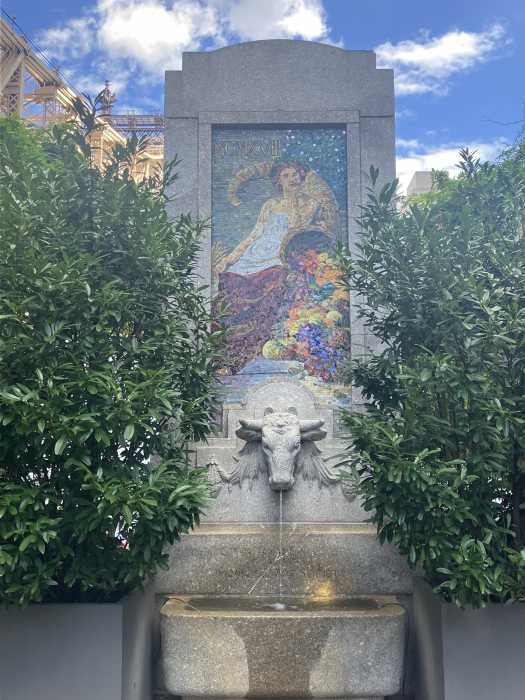 Donated fountain in the public space.
Sean Basinski, a lead plaintiff on the suit, said he started coming to the space regularly to lift weights and get fresh air during the height of the COVID-19 pandemic. He’s been told to leave without adequate reasoning and has been arrested for trespassing when simply sitting in the public space and taking photos (that case was dismissed a few months ago).
He’s since heard from dozens of neighbors that they’ve been kicked out or incorrectly told the space’s not public by private security or NYPD officers, including a woman who sat down to rest in the space with her father who was undergoing chemotherapy treatment. Being kicked out of the space was one of her last memories with her father before he died, she told Basinski.
“This has happened here for, we think, 20 years,” said Basinski, a former attorney for the Street Vendor Project. “People are sick of getting told they can’t be there. They tell us it’s private space, but it’s public space.”
Basinski and other members of the neighboring community emphasized the importance of public space in the area, which historically hasn’t had much green space.
Iskander Khan, a 21-year-old who grew up in the area, said he’s always been upset by security and police making him feel like he’s unable to use the public space.
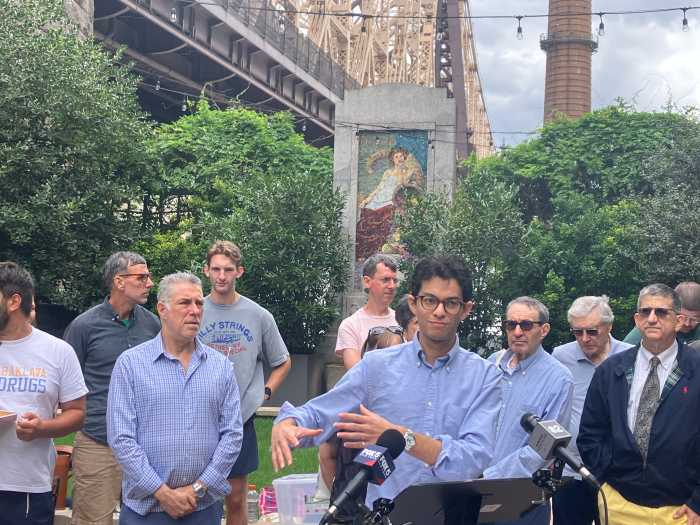 Khan speaks to reporters in the public space.
“I remember as a kid finding this and thinking it was the perfect little oasis,” Khan said. “I also remember getting kicked out …by security. That was a long time ago. In the years since, it’s never quite felt like a public open space. I’ve always felt like I’m trespassing, and that’s partially because there’s no public space sign.”
“This neighborhood doesn’t have that many nice, green, sort of peaceful places to sit and think for a while,” Khan continued. “I think it’s really important to get clarity on the situation and … get a public space sign so that residents feel comfortable hanging out here.”