
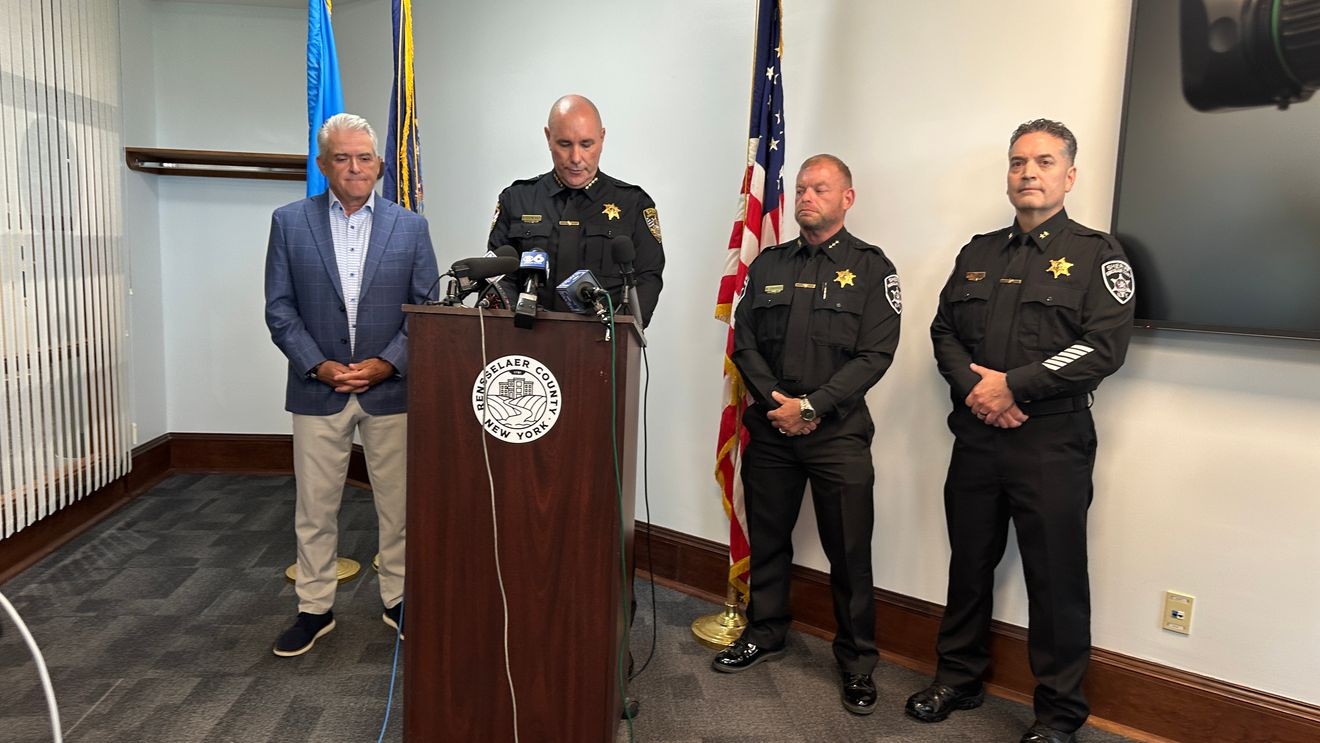
Rensselaer County leaders say they are taking New York State to federal court as a new law banning agreements between local law enforcement agencies and federal immigration authorities took effect Tuesday.
Rensselaer County Executive Steve McLaughlin and Sheriff Kyle Bourgault pushed back against the new law, arguing the county’s participation in U.S. Immigration and Customs Enforcement’s 287(g) program is different from the type of local immigration enforcement Gov. Kathy Hochul says the ban is intended to stop.
When CBS6’s Briana Supardi asked whether the county intends to comply with the new law, McLaughlin responded, “I’ll see you in court, governor. That’s my answer to that question for everybody.”
McLaughlin said a federal lawsuit challenging the state’s action was being filed in the Northern District of New York.
The federal 287(g) program allows ICE to delegate certain immigration enforcement functions to trained state and local law enforcement officers.
Rensselaer County has participated in the program since 2018. Bourgault said the sheriff’s office operates under what is known as the “jail enforcement model,” meaning its participation occurs inside the county jail and involves people who have already been arrested, brought into custody, and charged.
“Our deputies are not out driving around looking for undocumented immigrants,” Bourgault said. “They are not conducting immigration checkpoints. They are not making immigration-related traffic stops.”
Under the county’s model, trained staff can access federal immigration information for individuals already in the jail. County leaders argue that distinction is critical to understanding their opposition to the statewide ban.
Bourgault said nine people have been identified and removed through the process since the county joined the program in 2018. He cited one case involving a person from Ireland who Bourgault said had committed a rape there before being identified through the program and ultimately turned over to ICE.
MORE: Rensselaer County exec, sheriff face backlash for defying NY immigration law
Hochul, however, made clear Tuesday that the state’s prohibition on 287(g) agreements does not mean New York law enforcement agencies will stop cooperating with ICE when it comes to criminal matters.
“We’ve worked hard to drive down crime to record lows, and that includes working with ICE to track down and apprehend criminals,” Hochul said.
She later added, “Local police will assist ICE only if a real crime has been committed.”
McLaughlin seized on that statement, arguing it supports Rensselaer County’s position.
“That’s the point,” McLaughlin said. “A real crime has been committed. They are in our jail for a real crime. All we are doing at that point is, again, running them through a database.”
The dispute centers on where the state draws the line between permissible cooperation with federal immigration authorities in criminal cases and local participation in federal immigration enforcement through a formal 287(g) agreement.
The governor says New York will still work with ICE to ensure criminals are deported after they’re convicted and serve their time.
The process in New York is going to play out. They’re already arrested. They’re already in law enforcement custody. I don’t — if you’re inferring that you don’t think law enforcement can handle an individual in that situation, I would say you’re wrong. You don’t need to call ICE in that case. They can notify, but they do not need ICE involved, because I want that person prosecuted.
“If the facts bear out and a jury agrees they should be convicted and do time. You can notify ICE because ICE will pick them up at the end of that term. That’s the involvement with ICE,” said Hochul.
“I want them gone when they’re done serving their time, and those who think you should ship them out immediately, where is the justice for the victims?,” she added.
Bourgault argues the county’s jail enforcement model does not involve deputies searching communities for people based on their immigration status. He said the program is instead a public safety tool used after someone has already entered the criminal justice system.
“This isn’t just about 287(g),” Bourgault said. “This is about tools being taken away from law enforcement to safely protect the people they are closest to.”
McLaughlin said the county believes the state is failing to account for differences among the various ways local agencies can participate in the federal program.
“You can’t just throw a blanket over everything,” he said. “You say no 287(g)s — there are nuances here to what we are doing.”