
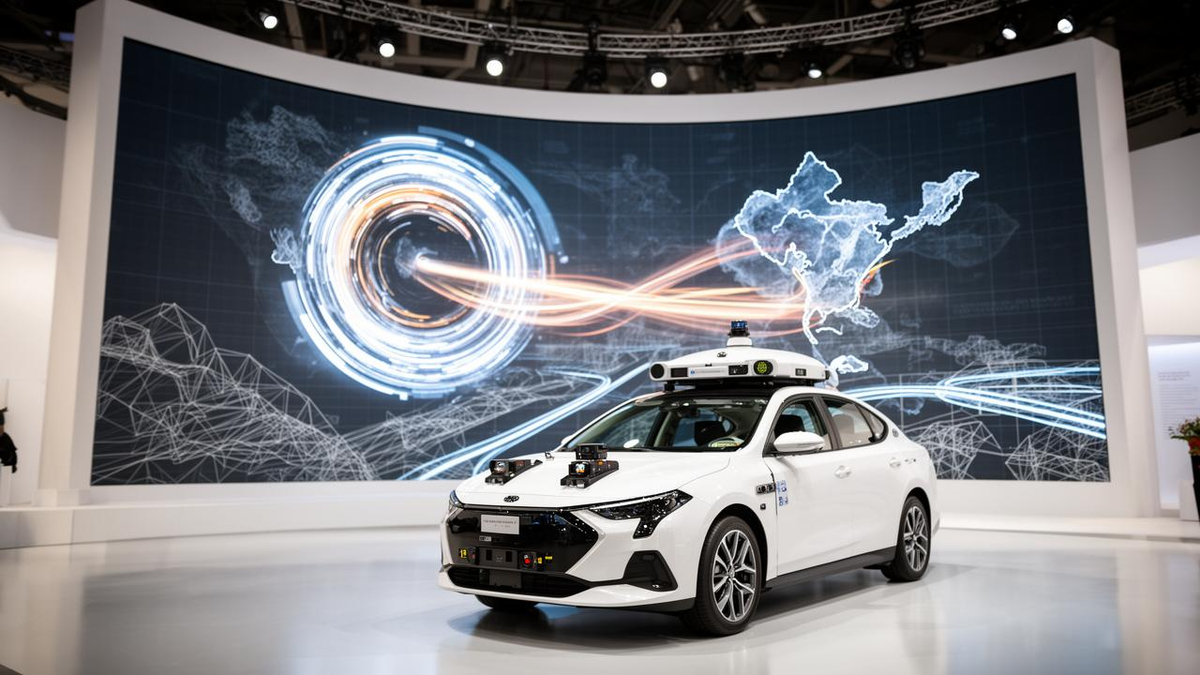
Hyundai Motor is positioning its “Data Flywheel” as the core of its autonomous driving competitiveness, unveiling a 24-hour data processing system connecting South Korea and the United States. With autonomous driving technology moving beyond the development stage into an era where actual customers experience its performance, the strategy is to compete on data quality and utilization speed rather than sheer volume.
Lee Kyung-min, senior vice president at Hyundai Motor’s Autonomous Driving Development Center, said in a keynote address at the 2026 Autonomous Mobility Expo (AME) held at COEX in Seoul’s Gangnam district on August 26: “The autonomous driving industry has now entered a stage where actual customers experience performance, moving beyond technology development.” He defined this point as the “Manhattan Moment”—drawing a parallel to how the Manhattan Project, the U.S. nuclear weapons development program during World War II, changed the course of the war, suggesting autonomous driving technology has reached a tipping point that will reshape the automotive market.
He cited the fact that 12 out of 20 new vehicles in China now come standard with Level 2 or higher autonomous driving features, with 3 of those at Level 2++ capability. Whether using end-to-end (E2E) models or vision-language-action (VLA) models, the methodology has largely been settled, and customers can now directly verify autonomous driving performance.
The differentiating factor is shifting from which model a company developed to how much data it can secure and how efficiently it can leverage that data for training. “Even assuming you can obtain data from more than 7 million vehicles, the approach of indiscriminately pulling in and processing all of that data is inefficient,” Lee noted. As data volume grows, storage and GPU costs escalate sharply, making the “curation” process of selecting high-quality data actually needed for the model critically important.
Hyundai Motor’s Data Flywheel goes beyond simple collection and training to include 3D reconstruction and closed-loop simulation. If real-world data captures a pedestrian jaywalking at an intersection, the company reconstructs it in a 3D environment and then adds various conditions—rain, snow, nighttime—and changes in pedestrian counts to validate model performance. While repeatedly experiencing every hazardous situation on actual roads is limited by time and cost, converting a single case into a virtual environment can generate countless variations.
Safety validation is another critical pillar. Newly trained models are not immediately deployed to vehicles. Instead, closed-loop simulation allows the model to directly control the vehicle, with physics simulation generating the next scenario and feeding it back into the model in an iterative process. Each deployment validates thousands to tens of thousands of scenarios, followed by real-vehicle testing. Multiple layers of safeguards are also applied: guardrails against control output anomalies, separate safety mechanisms to reduce risk just before a collision, and the “Minimum Risk Maneuver (MRM)” that moves the vehicle to a minimal risk state.
What particularly sets Hyundai Motor apart is its data operations approach. Lee described this as “Follow the Sun.” During daytime hours in South Korea, data is collected and problems are analyzed; during South Korea’s nighttime, work is handed off to the United States where the sun is up. U.S. engineers receive unresolved problems from South Korea through a global queue, process them, and collect additional data. South Korea and the U.S. effectively operate as a single global engineering organization, enabling continuous problem detection, resolution, and model improvement.
“The structure allows problems to be collected 24 hours a day and resolved 24 hours a day,” he said, emphasizing that the “Root Cause” analysis stage—identifying the cause after an issue arises—is the key factor determining the speed of the entire cycle. While problem detection and solution implementation can be largely automated, accurately analyzing root causes requires the experience and judgment of skilled engineers. Hyundai Motor operates an internal “Issue Triage Center” to manage this, tracking problem resolution status through dashboards.
Hyundai Motor Group previously announced it would strengthen its flywheel structure by establishing a “Data Union” system connecting data across Hyundai Motor, Kia, 42dot, and Motional. Park Min-woo, head of Hyundai Motor and Kia’s Advanced Vehicle Platform (AVP) division, also emphasized in June that data acquisition, utilization, and product transition speed are the core of autonomous driving competition.
As flywheel efficiency improves, costs associated with accidents, insurance, and operations can be reduced, creating another virtuous cycle leading to lower service prices, expanded usage, and increased data. This effect could be amplified in robotaxis where drivers are eliminated. It goes beyond simply lowering operating costs—accumulated driving data can reduce accident probability and optimize routes and fleet operations.
Changes are also expected in vehicle purchase criteria. Until now, consumers have selected vehicles based on hardware-centric factors such as design, performance, safety, and convenience features. Going forward, the level of Data Flywheel applied and the experience it delivers could become purchase criteria as well. Competition dynamics among automakers may also shift. While collaboration has traditionally centered on manufacturing—joint parts development or hardware purchasing—there is potential for “data alliances” to expand, focused on sharing driving data and advancing AI models. This outlook stems from the assessment that individual automakers face inherent limitations in securing data alone, given that data volume and training efficiency directly translate to competitive advantage.