
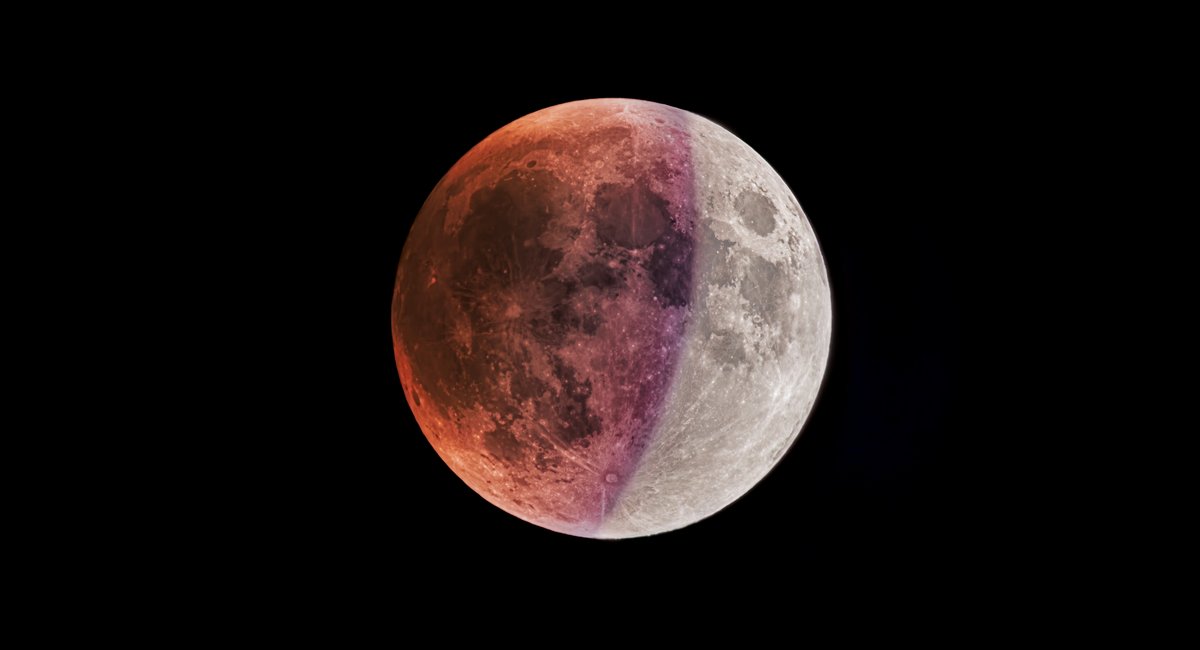
New Yorkers could get a chance to see a rare lunar eclipse — if the weather cooperates.
Thursday’s forecast calls for a rainy day, followed by an eclipse that will block out about 96% of the moon just after midnight. According to the National Weather Service, there’s a chance of thunderstorms during the day and possible flooding with up to half an inch of precipitation. As of Wednesday morning, it’s a toss-up if the storms will extend into the evening, marring views of the eclipse. The next one of this magnitude won’t come until June 26, 2029.
“I’m an eternal optimist and I’m going to be up at midnight anyway, so I will poke my head out,” said Bart Fried of the American Astronomical Society.
Even if it’s cloudy and rainy, it’s still possible to see the moon, especially on Long Island, where the weather is predicted to be more favorable.
There’s a good chance New Yorkers who stay up late will be rewarded with a view of the lunar eclipse near its climax.
“You’ll definitely notice that this full moon doesn’t look right, especially because it’ll be high up in the sky and have that reddish-orange color,” Fried said. “It’s going to look interesting and unusual.”
The Earth’s outer shadow will begin to dim the moon at 9:23 p.m. About an hour later Earth’s dark umbral shadow will begin to cover the moon’s face. The eclipse will be over around 2 a.m.
No special eyewear or binoculars are required. Just find the moon, which will be in the southeastern portion of the sky as the eclipse begins. That evening, the moon will be in the constellation Aquarius. Saturn will appear as a very bright point of light shining next to the moon.
Parks are ideal spots for taking in the eclipse, but most spots in the city should work.
“Any place with a clear view of the moon will do,” said Kat Troche, NASA solar system ambassador.
The lunar eclipse coincides with the August full moon, which is called the Sturgeon Moon. According to the Old Farmer’s Almanac, the name is tied to a Native American belief that sturgeon were easiest to catch in the Great Lakes and Lake Champlain during the late summer.
“Sturgeon is a big, ugly fish that’s like a living fossil,” Fried said. “They’re like Frankenstein fish. They’re not very good-looking, and a lot of it is basically like swimming cartilage. And this is the time of year you’ll see them.”
Lunar eclipses always happen about two weeks after solar eclipses. On Aug. 12, New York City had a nearly 10% solar eclipse, when the moon covered part of the sun.
“Solar eclipses and lunar eclipses chase each other because of the positioning of the Earth and the moon,” said Jackie Faherty, astrophysicist at the American Museum of Natural History.