
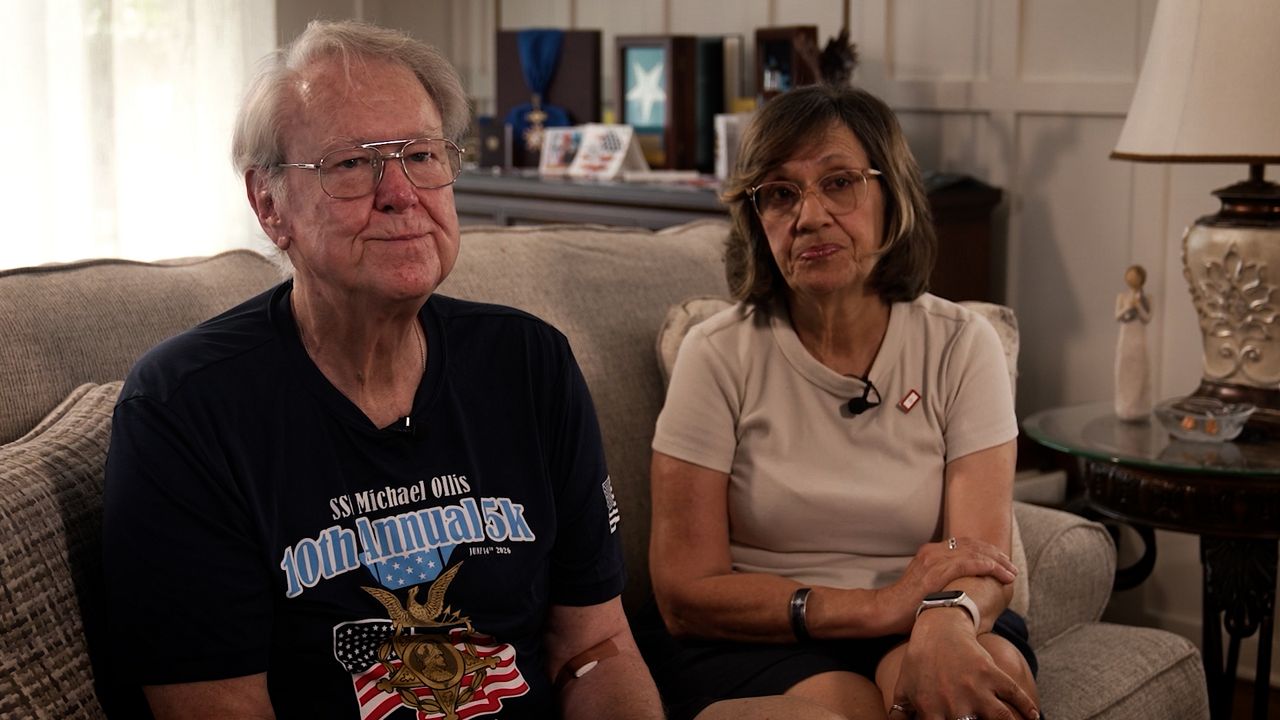
For nearly 13 years, the street where Robert and Linda Ollis live have been lined with American flags. At the end of their street is a memorial, one that has been carefully maintained just as long. In the middle is a photo of a young man, smiling, in an Army uniform.
It’s their son, Staff Sgt. Michael Ollis.
They said most of his life, Michael wanted to join the military, like Robert, who served in Vietnam.
“He would go up and take my jungle fatigues, roll up the sleeves and go out in the yard playing ambush his sisters,” Robert said in an interview with NY1 this summer.
But that desire to serve really started accelerating on Sept. 11, 2001.
He may have been in middle school, but Robert and Linda said 9/11 impacted their young son. They know this because later on, they saw he wrote about it in his journal.
That commitment did not wane. He joined the ROTC at his high school and at 17, he signed paperwork to join the Army.
“I was always scared for him. So it didn’t matter if he was, even if his stories were happy or and then maybe got darker, I just always thought, ‘This is dark,'” Linda said.
Some of Robert’s friends told him he needed to sit Michael down before he ever deployed.
“I brushed people off like that, and. I couldn’t. I didn’t know what Iraq was like. I didn’t know what Afghanistan was like,” he said.
Michael deployed to war zones three times. The first tour was in Iraq from 2008-2009.
The second deployment was in Afghanistan from 2010-2011.
It was during that stint that something happened.
The Ollises said Michael was there when six U.S. soldiers were killed and many more were wounded when a suicide bomber rammed into a new outpost in southern Afghanistan.
He told them when he came home that he tried to save them after the explosion but it was too late.
Robert remembers the change he saw in his son.
“He just wasn’t the happy-go-lucky kid that used to run around the neighborhood,” he said.
And then, Michael told him something that stuck with him.
“He insisted and kept saying it over and over again. ‘I am responsible for these guys, for this squad, and I’m going to make sure that they are going to get home alive,'” Robert recalled.
But the person missing from that promise: himself.
“He wasn’t worried about Michael,” Robert explained. “He was worried about them.”
Michael’s third deployment began in January 2013 – again to Afghanistan.
It would be nine months, as opposed to the standard 13, Linda said.
“Always in the back of my mind, though, I always, it was thought, it could be the last time I’m saying goodbye to him,” she said.
Robert remembers the goodbye clearly.
“We kissed goodbye and I just sat there. And he took his gear, and he went in to the building and I sat outside,” he said. “I sat there for the longest time, and I cried, and I didn’t know why, but I knew something was not right.”
In late August, Robert and Linda were on vacation in London, when they got a call from one of their daughters in the middle of the night.
Their neighbor called her to get in touch with her parents. Two soldiers had been at their home on Staten Island, ringing the doorbell.
Robert knew that wasn’t good.
Then she said the soldiers had left a number for them to call.
So he did, and he spoke to a sergeant.
“He said, ‘Sir, tomorrow morning at 7 a.m., an officer from the Pentagon, from the embassy, will be there,'” Robert recalled.
And at 7 a.m. that morning, he received a knock at the door.
“They gave us the speech about the president being proud and thankful and stuff like that, and said, ‘Your son was killed,'” he said.
But then, they said something else.
“You know, your son died a hero,” Robert said.
He assumed they said that to everyone. But soldier after soldier told him and Linda the same thing.
“You know the story,” he remembers one asking him. “And I said, ‘No, we had no idea.’ So he started filling us in a little bit,” he said.
And that’s when they heard for the first time: Michael Ollis sacrificed himself to save another soldier. Someone he had never met: Karol Cierpica, a lieutenant in the Polish army.
“I tried reading the incident report. I’ve read some of it,” Linda said. “It’s very difficult to read for me.”
On August 28, the Polish base where Michael had been was attacked. He told the other soldiers in his unit to move to bunkers for protection, while he went into the building to search for anyone else inside, according to the military.
He found Cierpica inside. They didn’t speak each other’s language. So Michael started motioning to him.
“He pointed to his eyes and patted his back,” Robert said. “Meaning, ‘I have your back.'”
Cierpica was injured in the constant stream of gunfire.
“With complete disregard for his own safety, [Michael] positioned himself between the insurgent and the Polish officer, who was wounded and unable to walk,” the report from the military reads. “[Michael] fired on the insurgent and incapacitated him, but as he approached, the insurgent’s suicide vest detonated, mortally wounding [Michael].”
“I think we were in shock when we first heard it, but then when we heard the story of what had happened, I think the shock started to wear off,” Linda said. “And we were like, ‘This is Michael.'”
 
In November 2013, the Ollises were invited to the Polish Consulate in Manhattan. There, they met Cierpica.
“So here comes Lt. Cierpica. Nervous,” Robert recalled. “Doesn’t know how we’re going to react towards him. We come and we’re just close. I grab a hold of him and hug him. I kissed him on his cheek and I said, ‘Thank you for your service.'”
Michael has been awarded several medals for his sacrifice. But it was this winter, more than 12 years after he died, the Ollises got a call from President Donald Trump.
“Your son is going to get the highest honor that you can have,” Trump said on the call, recorded by the Ollis family. “There’s no higher honor than the Congressional Medal of Honor.”
“I kept saying, ‘This is surreal,'” Robert told NY1. “This is nothing like we ever, ever expected in our lifetime.”
In March, Michael Ollis received the Medal of Honor.
“Today, my commitment and greatest gift is to cultivate the memory of the true heroic act of courage I witnessed performed by your beloved son, Michael,” Cierpica said at the ceremony.
Cierpica named one of his children Michael, in honor of the man who saved his life.
 
“We just wish that Michael was the one to receive it,” Linda said. “And not us.”
Robert said Michael would tell him he’s the most patriotic person he knows. But Robert said it was really the other way around.
“Every time I spoke with him, when I hung up, I would say, ‘I love you. You’re number one. You are always number one. You are my son,'” he said. “‘And I’m proud of you.'”