
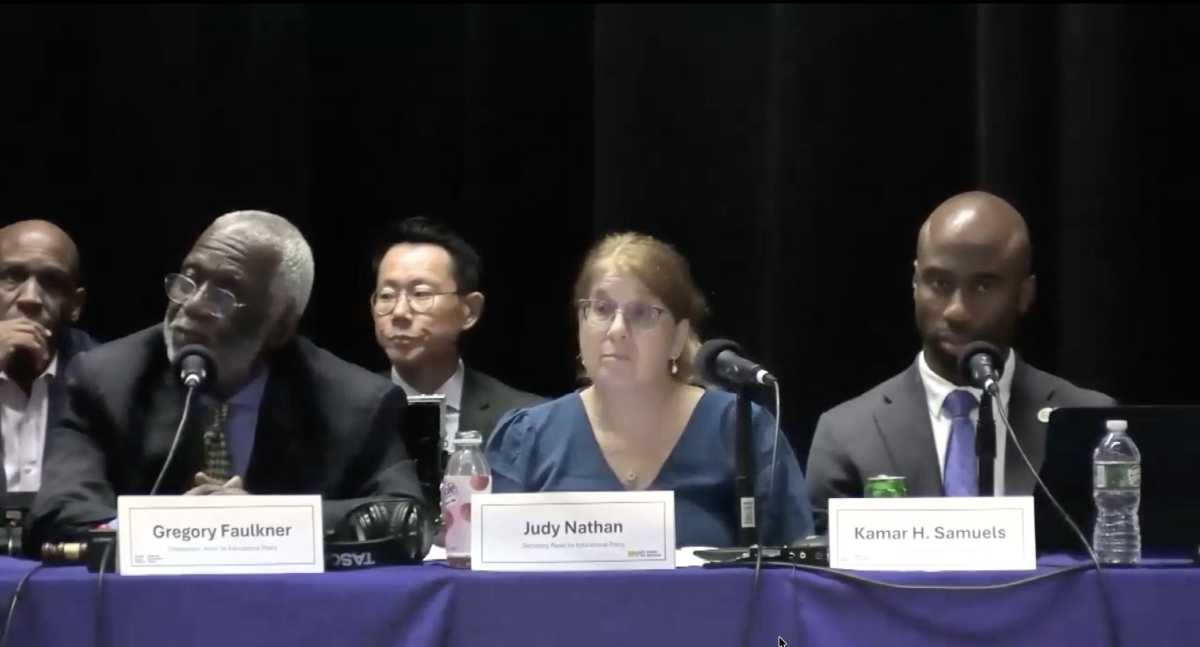
Tensions continued to grow Wednesday during the final Panel on Education Policy (PEP) meeting ahead of the 2026-2027 school year in September regarding the use of ed tech and AI in NYC Public Schools (NYCPS) .
Parents and educators demanded answers from NYC Department of Education officials regarding ed tech policy, and again called for a two-year moratorium on AI usage in classrooms.
Schools Chancellor Kamar Samuels said little at the Aug. 26 meeting to indicate whether NYCPS would institute an AI moratorium or issue comprehensive guidance ahead of the start of classes on Sept. 10. Parents, educators and advocates emphasized how imperative it was to have a plan in place before students began classes.
A literal chorus of voices testified in front of the panel singing original lyrics opposing the use of AI in schools to the tune of the Village People’s “YMCA.”
“We’re here to say we want NO MORE AI
We’re here to say we want NO MORE AI
It will burn everything
Make our water dirty
There’s no need to let this happen”
The panel and Samuels were entertained at a minimum.
“That must have been the most convincing testimony I’ve heard,” Samuels said.
Levity aside, those concerned about the use of AI in the classroom echoed messages they’ve voiced for months leading up to the school year — namely a lack of research showing that ed tech and AI improves critical thinking and student outcomes, data security and transparency issues, and the threat of data centers to NYC’s sustainability goals.
One woman, identified as Crystal, emphasized how difficult it would be to get up to speed with new guidelines issued so close to the start of a new school year.
“We are two weeks away from school starting, and we do not have a clear AI policy,” she said. “This does not give schools any time to properly review the policy, ask questions [and] educate staff.”
The DOE has not provided amNewYork with comment on its updated AI policies.
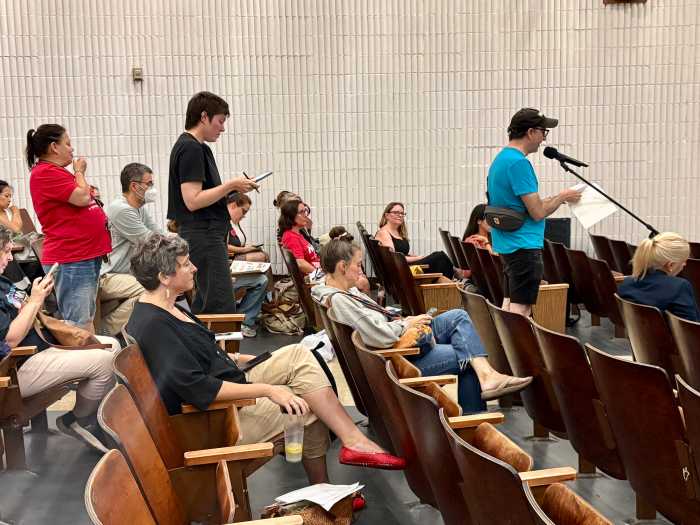 Speakers waited in line to comment both on contracts to be approved and for open thoughts, many waiting for a period of three hours to speak both about contracts with big tech companies and on the lack of DOE’s comprehensive AI policy just two weeks ahead of the new school year. Photo by Sadie Brown
The Department of Education (DOE) initially issued guidelines in March that fell flat; critics found the policy to be too general across the educational spectrum, lacking specific measures by grade, and clear accountability efforts.
The agency publicly acknowledged its misstep and vowed a more thorough and comprehensive playbook, but it blew past its self-imposed deadlines to so. At a City Council hearing in June, agency reps said that it would not commit to a timeline.
Parents and educators’ patience was also wearing thin at Wednesday’s PEP meeting.
Aixa Rodriguez carried a sign reading “Libraries are the only data centers that NYCPS should fund!” She was frustrated that the DOE was asking to approve more on tech contracts than physical textbooks.
“We’ve been saying this for a long time, get back to the basics, stop spending money where it doesn’t belong, because libraries are the only data centers that we should fund,” she said.
FOCUS Act aims to regulate tech and AI in classrooms
Meanwhile, State Sen. Andrew Gounardes (D-Brooklyn) introduced legislation on Aug. 21 proposing regulations on technology in education on everything from screen time to AI in classrooms to data privacy and contract transparency.
He told amNewYork the Fostering Optimal Classroom Use of Screens (FOCUS) Act was developed by partnering with parents, educators and stakeholders to map out a vision of a school experience that centered kids over technology. As the parent of a child entering Kindergarten this year, Gounardes said he was especially sensitive to the discourse around the lack of guardrails around AI, screen time and data privacy in schools.
“ It was kind of like a growing crescendo over the last couple of years, but certainly over the last couple of months I would say it’s gotten particularly loud,” he said.
Under the bill, schools would give families the “right to analog learning”; require schools to prioritize assignments that can be completed without screens whenever possible; and prevent school-issued devices from having social media, chatbots and a list of other distracting or demonstrably harmful features.
The bill also focuses on transparency by requiring all ed tech companies to register with the State Attorney General before being able to do business with school districts in the state. NYCPS parents have reported to amNewYork that they have been unable to get a clear picture from the DOE about what specific apps or technology their student is using, even though filing Freedom of Information Law (FOIL) requests.
Back to basics?
Fourth grade educator Martina Meijer said that for her and many teachers in her school, relying less on technology-based tools is benefiting their students. Meijer said that she and her fellow educators chose to use technology and standard curriculum as guidelines, but felt empowered as educators to make the best choices for their students, including leaning more towards analog methods like books over screens.
“ Even though we’re repeatedly on the same grade and we’re working with the same material and the same standards, we never present the material the same way because the children are different in front of us,” Meijer said. “The current events are different, the references are different, the songs are different, and the memes are different and the jokes are different.”
She said they’ve seen consistent positive returns, with the recent ELA scores at her school exceeding the citywide average by 10 points and math scores by an even greater margin.
“It’s about seeing the joy that the children bring, seeing their brilliance, and tapping into that,” she said. “And there’s no way an AI chatbot can do that. There’s no way that a scripted curriculum can do that, because it was written by people who have far less teaching experience than I do.”
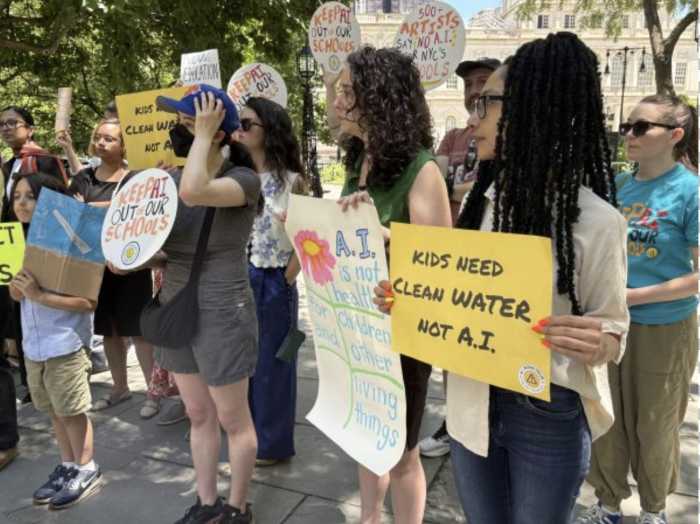 Parents, educators, lawmakers and advocates are concerned about the rush to incorporate technology, especially AI into NYC’s learning spaces and are calling on the city to hit pause and return to more analog methods until stricter guardrails can be put in place. Photo by Sadie Brown
Local lawmakers have also been supportive of leaning into more traditional methods of teaching before relying heavily on tech and AI.
City Council Member Eric Dinowitz (D-Bronx), chair of the Council’s Education Committee, told amNewYork that young New Yorkers can benefit the most from foundational learning techniques and advocated for strong legislation like the Gounardes’ FOCUS Act to protect students and preserve education.
“Our youngest students learn best through hands-on instruction and real engagement with their teachers,” Dinowitz said. “We need enforceable guardrails on classroom screen time. New York City spends billions of dollars each year on technology contracts with little accountability, and this legislation takes a strong stance against the wild proliferation of screens and tech in our schools with little evidence it benefits kids”
In previous oversight hearings, Dinowitz has criticized the DOE for a lack of expediency in responding to the rapidly changing tech environment. In the meantime, he lauded Gounardes for introducing a bill that would take swift and decisive action.
“Real reform requires every level of government working together, and I credit State Senator Andrew Gounardes for his leadership in the state senate on this,” he said.