
Rent prices in Manhattan hit an all-time high last month, according to the latest data, highlighting the challenges faced by New York Mayor Zohran Mamdani in keeping his promise to make the city more affordable for its residents.
As of July, the average monthly rent in Manhattan, one of the most densely populated areas of the world, was $4,088 for a studio, $5,486 for a one-bedroom, $8,054 for a two-bedroom and $12,228 for a three-bedroom, according to real estate brokerage firm Corcoran. The median rent across Manhattan was $5,295, its highest level on record, relatively unchanged from June and up 6 percent from a year earlier. The overall average rent also hit a new all-time high of $6,655.
At the same time, rental inventory was down 22 percent compared to July 2025, exacerbating the struggles of renters trying to find affordable accommodation in an environment where they have difficulties finding an available unit at all.
In Brooklyn, the median rent was down 2.1 percent from June, at $4,257 per month, but was still up 1 percent from a year earlier. And in this borough too, inventory had declined 8.6 percent when compared to July 2025 levels, leaving Brooklyn renters fewer choices.

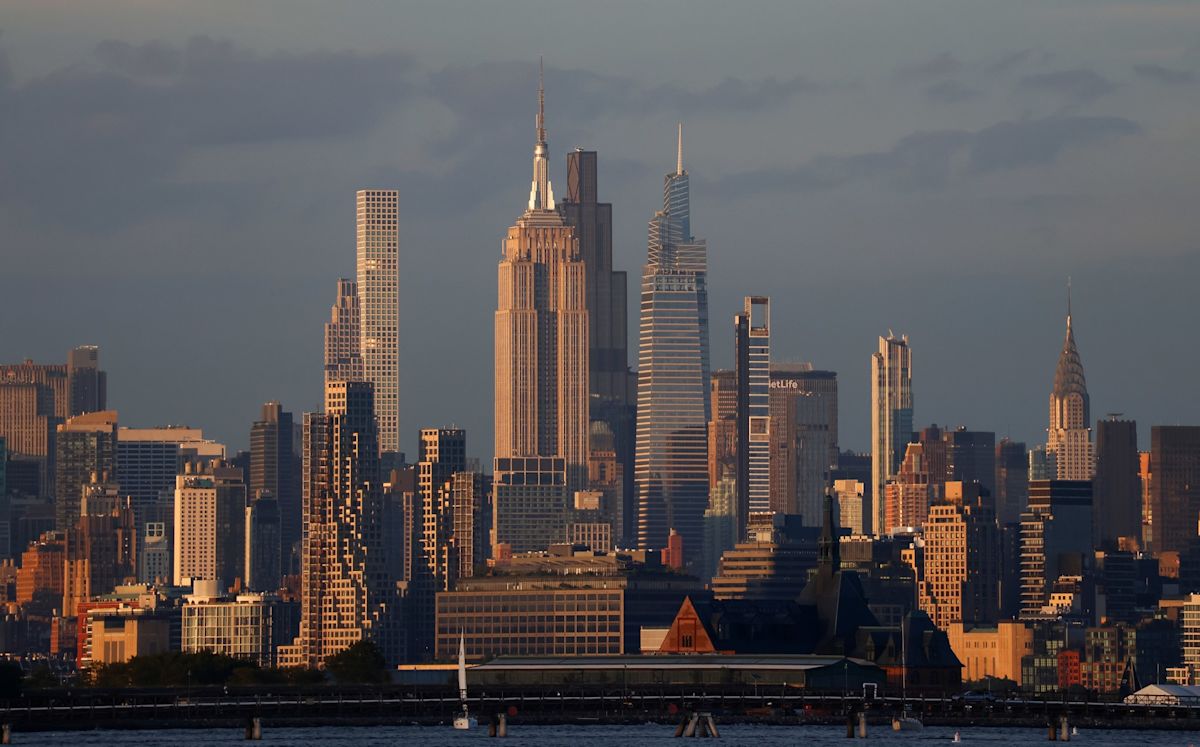
The sun sets on the skyline of midtown Manhattan and the Empire State Building in New York City on August 26, 2026, as seen from Jersey City, New Jersey.
New York renters’ struggle goes far beyond these two boroughs alone: New York City’s net rental vacancy rate has fallen to just 1.4 percent, according to the New York State Assembly, its lowest level since 1968.
Rentals in New York are hard to come by, and expensive when available; more than half of the city’s households were rent-burdened in 2024, according to the city’s Department of City Planning.
Pro-housing elected officials, advocates, and community leaders are calling for one immediate solution to this growing issue: build more housing in New York City.
Why Is New York City So Expensive for Renters?
There is one simple reason why New York City is so expensive for renters, and it is one of the core principles of economics: supply and demand.
In Manhattan, while rental inventory dropped 22 percent year-over-year, the number of signed leases rose 3 percent over the same period.
“This increased demand for apartments in the borough, coupled with reduced supply, has created a pressure cooker,” Gary Malin, Chief Operating Officer at The Corcoran Group, said in a statement. “Too many would-be tenants are seeking a shrinking number of available apartments.”
A similar situation was happening in Brooklyn, where leasing activity was up 1 percent year-over-year in July – the first annual increase in three months.
But this is hardly a new issue for New York: according to the city’s Department of City Planning, housing production in the Big Apple started failing to keep up with demand shortly after most of its housing stock was created in the first place in the first half of the twentieth century.
Behind this now acute shortage there are New York City’s strict zoning rules, which have severely limited opportunities for new homebuilding since the 1960s.
What Is Mamdani Doing to Address Rising Costs?
Mamdani knows that increasing the city’s housing inventory is necessary to improve affordability in the city, as his agenda has shown. His administration has repeatedly said that the city “cannot become a more affordable city without building a lot more housing” and that every neighborhood should contribute to new housing growth.
His administration’s plan for the city includes:
1. Building 200,000 new affordable homes over 10 years
The headline goal of his “Block by Block” housing plan is the construction of 200,000 new affordable homes across New York City over the next decade. The administration says this would be paired with the preservation of another 200,000 existing affordable homes.
2. Increasing city funding for housing construction
Mamdani’s plan calls for a $22 billion city capital investment in housing over five years, including billions of dollars for new affordable housing development through the Department of Housing Preservation and Development (HPD).
The administration said this investment is intended to finance substantially more subsidised housing than the city has recently produced.
3. Pursuing land-use and zoning reforms
The plan includes what City Hall describes as an “ambitious land-use agenda” aimed at creating more housing across all five boroughs.

New York City Mayor Zohran Mamdani listens as Gov. Kathy Hochul speaks during a press conference on Immigration and Customs Enforcement (ICE) actions on August 12, 2026 in New York City.
4. Using new financing tools to accelerate projects
City Hall said it will deploy “innovative financing tools” to help build and preserve housing more quickly and efficiently, with the goal of stretching public dollars further and speeding affordable-housing production.
5. Expanding homeownership programs
The administration said it will double the Open Door program and launch a new one called “Our Home,” which is intended to create permanently affordable co-operatives and expand affordable homeownership opportunities.
6. Making the most of city-owned land and public housing assets
Last month, the Mamdani administration released a map highlighting city-owned properties that could potentially be redeveloped into housing.
The city’s website states that they are working on over 100 city-owned properties across the five boroughs that could result in over 50,000 new homes, adding: “Every year over the next four years, the Mamdani administration will issue requests for proposals to develop housing on five or more new sites, using public land to deliver homes for New Yorkers.”
Newsweek contacted Mamdani’s office for comment by email on Thursday morning.
Can the Rental Shortage Be Fixed?
In December 2024, New York City passed the so-called “City of Yes for Housing Opportunity”, the biggest update to the city’s zoning code since 1961. The measure makes it easier to build more housing across the city, and the Department of City Planning estimates it will lead to about 82,000 additional homes over the next 10 years.
New York City built more new apartments last year than it had in 60 years, according to The Wall Street Journal, adding 38,682 units to its stock in 2025. It was the biggest single-year increase since 1965.
But the city still faces a 400,000-unit affordable housing gap, based on Zillow’s estimates. Even at last year’s unprecedented pace of construction, it would take 10 years to close the existing deficit.
New York Assemblymember Tony Simone has unveiled a report this week, called State of the Yes, which outlines 32 legislative actions that if enacted by Albany “would be the strongest pro-housing package in the nation,” his office said.
“Today, elected officials, housing providers, tenants and organized labor came together with one message, Albany must build new housing and protect tenants,” Simone said in a statement shared with Newsweek.
He added: “The State of Yes presents the solutions we need to confront the housing crisis in a big and bold way. If New York is not growing, New York is dying.”
In 2024, more than 113,000 New Yorkers left the city, according to Simone, and a recent study from the Citizens Budget Commission, a nonprofit civic think tank, shows that the city’s net population dropped by 12,000 last year. The study pointed at high housing costs as the main reason why New Yorkers are leaving the city.
Contact Newsweek editors on this story: Matthew Robinson and Cristina Diciu.
Related Articles