
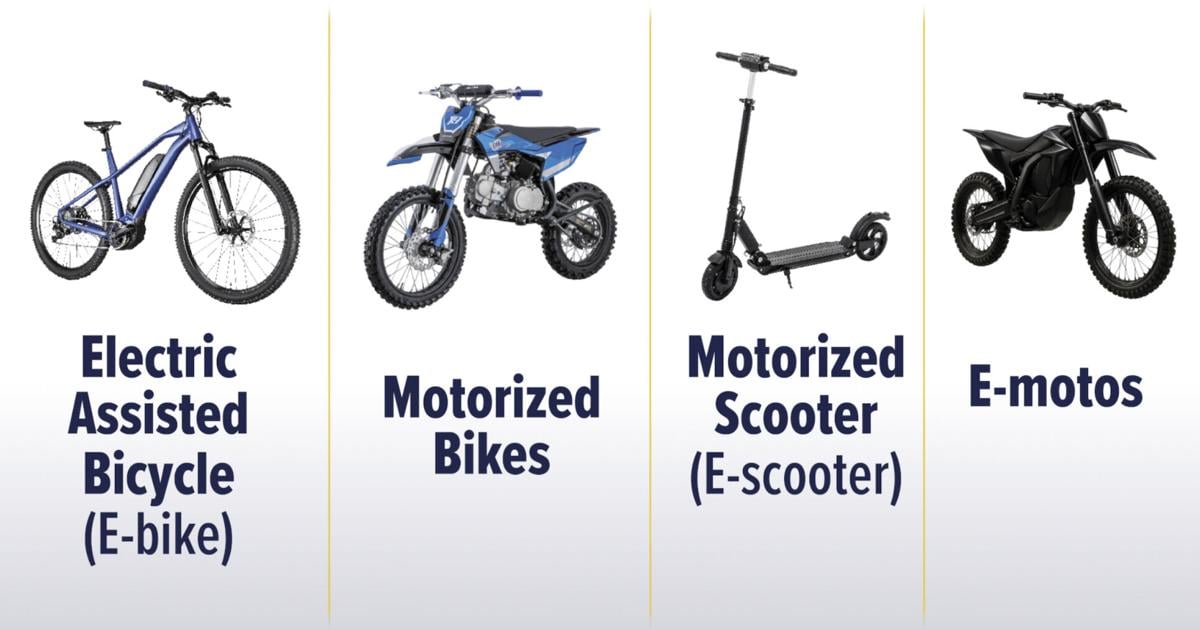

A graphic from the city of Brooklyn Park is meant to help the public identify the visual differences between e-bikes, e-scooters, e-motos and motorized bikes.
(Submitted graphic)
Earlier this month, as local public safety officials stopped to talk with residents during National Night Out, Brooklyn Park Police Chief Mark Bruley heard one particular question raised repeatedly: What can the city do about electric bikes and scooters?
The safety issue has come into stark focus this summer.
On the afternoon of July 10, a 9-year-old boy riding an e-scooter was fatally struck by a pickup truck at the intersection of Candlewood Drive and Brunswick Avenue N.
Weeks later, on the afternoon of Aug. 15, two children riding an e-bike collided with a vehicle at Pearson and Sierra parkways. Both children were taken to the hospital in stable condition, according to police.
“We’re seeing these increased crashes throughout the entire country … and we’re seeing those here in Brooklyn Park as well,” Brooklyn Park Police Inspector Matt Rabe said.
Rabe joined Chief Bruley in speaking about the issue during the Aug. 24 City Council meeting.
Rabe said the police department has seen a “huge increase” across the city in e-bike, e-scooter and other e-vehicle usage.
And with that increase in usage has been heightened confusion over the rules and laws in place around the various types of e-vehicles that have become increasingly popular in recent years.
A common e-vehicle type seen locally is the e-bike, which have pedals and an electric motor. Under state law, anyone under the age of 15 is prohibited from operating any of these types of e-bikes.
There are different classes of e-bikes. For Class 1 e-bikes, the motor assists only while pedaling and up to 20 miles per hour. For Class 2, there is a throttle lever and the motor can propel the e-bike without any pedaling, also up to 20 miles per hour. Class 3 is similar to Class 1, but is faster with a maximum assisted top speed of 28 miles per hour.
“They all three have pedals, and just by looking at them from afar you can’t tell really if they’re Class 1, 2 or 3, which makes it difficult to immediately take action on them,” Rabe said.
The smaller motorized foot scooters are called e-scooters. These include the Lime branded scooters, which can be rented by the minute in some cities. The minimum age to ride an e-scooter is 12, and helmets are required for any rider under the age of 18.
The higher-powered e-motos don’t have pedals, look similar to a motorcycle and can easily exceed 30 miles per hour. The minimum age to ride one of these is 16.
A graphic from the city of Brooklyn Park shows the different requirements and restrictions for e-scooters, e-bikes, motorized bikes and e-motos.
(Submitted graphic)
Rabe noted that e-vehicles are not addressed in any current city ordinance due to the fact they are still relatively new.
Under state law, there is limited action local police can take, Rabe added. The penalties under the state statutes that govern e-bike and e-scooter issues are a petty misdemeanor. Additionally, a new state law that went into effect Aug. 1 bars any prosecution for children under 13 (raised from the previous age limit of under 10).
“We know that 10-, 11-, 12-year-olds are riding e-bikes, and there is no mechanism for accountability there, so the state law is not particularly helpful in that area,” Rabe said.
E-motos, on the other hand, have to be registered with the state and are governed by all of the rules that a motorcycle would be governed under.
“E-motos are much easier to deal with. … Those are regulated by state law, and we can take action on those pretty easily,” Rabe said.
He noted that actions the city could take include adding signs to trails noting which e-vehicles are restricted. He said the city could work to lobby the state for law changes and, locally, update city ordinance to specifically address e-vehicles.
“The goal here is really about educating parents,” Rabe said. “If we impound that bike so that kid can’t ride it back, and we just let the parent know … it gives us an opportunity to pass off a little bit of information to the parents and educate them.”
In nearby Maple Grove, a city ordinance was recently passed that gives them more authority related to e-vehicle violations. A first violation in Maple Grove will result in a juvenile receiving a warning and the parent or guardian being given notice. Any subsequent violations within a 12-month period will have an administrative citation issued to the parent or guardian if reasonable steps have not been taken to prevent future violations. A further step may include confiscating the e-vehicle.
“It seems like if we want to have an impact, my suggestion is that we go down the road of potentially making this a misdemeanor by ordinance and then allowing us to at least remove the bike and seize it. And then it’s a significant inconvenience to have to come up and go through the process of recovering the bike,” Chief Bruley said. “That seems to be the only lever that I can see us able to pull right now.”
The police chief said he plans to come back to the council with some proposals for an ordinance change that would allow the city to potentially seize e-vehicles when they are being operated in an illegal manner in the city.
“And then we’ll figure out what else might be some options for council to consider [and] what that ordinance might look like to give us some teeth, and then use that as a tool to be able to educate and hold those accountable that reoffend,” the police chief said.