
Parade Pets and Yahoo may earn commission from links in this article.
Shadow started life as the only black puppy in a litter of yellow siblings, a little ball of fur who spent his earliest weeks trying to figure out where his own paws were. Today, he is learning how to navigate New York City with his blind pet parent.
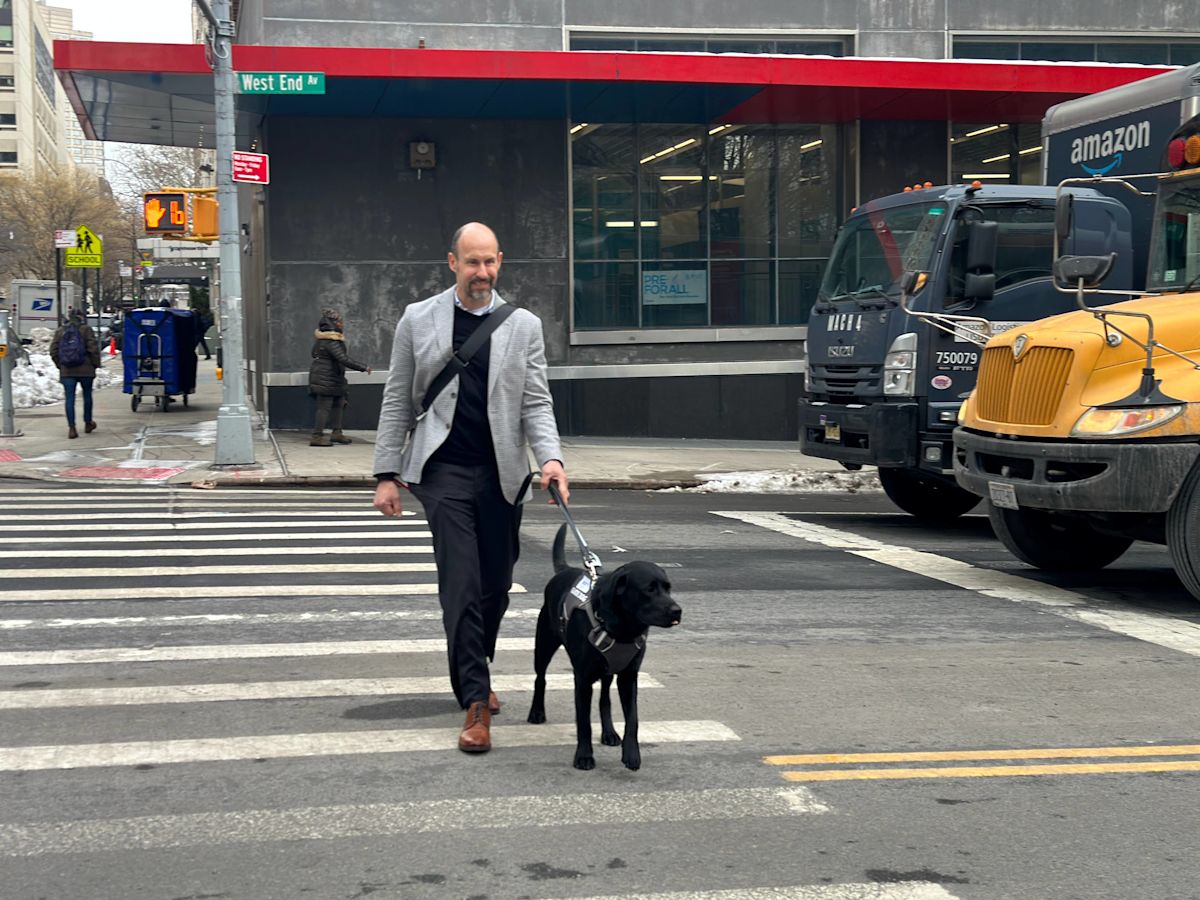
Thomas Panek, the president and CEO of Lighthouse Guild, chose Shadow as his guide dog, and he has a different approach to training. Their relationship has become a fascinating real-world experiment in what it takes to train a guide dog to navigate a bustling city.
🐶SIGN UP to get “pawsitivity” delivered right to your inbox with inspiring & entertaining stories about our furry & feathered friends🐾🐾
From a Pet Dog to a Service Dog
Courtesy Lighthouse Guild
Initially thought of as a pet, Shadow was adopted by Panek’s family when he was only eight weeks old; however, they quickly noticed his energy and instinctiveness. He followed people around the house like a shadow, played ball and developed a particular love of water after Panek gave him his first bath.
The moment that changed how the family viewed Shadow came at a grocery store. Panek and his wife had him in harness when the puppy found the doughnut aisle. Shadow would pull on the harness in a way that he tried to communicate that he found something Panek couldn’t see. From that moment, Panek started wondering whether his family dog might have the instinct and knowledge to become a guide dog.
Panek’s wife, Melissa, raised Shadow while he ran Lighthouse Guild, one of the country’s leading vision and healthcare organizations for the blind and visually impaired. From the beginning, he had the qualities of a good service dog: physically and instinctively quick, never aloof or anxious, and always a step away.
“My entire family could see it,” Panek tells ParadePets. “Those qualities matter enormously in a working dog, and they are not things that can be trained into an animal that does not already have them.”
Related: A Blind Woman’s Impossible National Park Dream Came True Thanks to Her Hero Dog
Rejecting the Traditional Model
Most guide dogs follow a traditional route, spending their early months with a puppy raiser before they go through formal training at a guide dog school. Thomas chose a different route.
Panek wasn’t a newcomer to training guide dogs. He spent a decade leading a guide dog school.
“I’ve had guide dogs who did everything right on a calm campus or familiar route and then really struggled once we hit the noise and unpredictability of the city,” he says. “It’s a lot like someone who learns to drive in a small town and then tries to merge onto the freeway.”
Panek took Shadow from Westchester County in New York’s Hudson Valley into Manhattan and exposed him to the environment where the dog would eventually work: Grand Central Station, escalators, busy crossings, construction sites, rush-hour crowds, trains, planes, and everything in between.
Shadow started working in the busy environment from the start. “He’s not just learning how to guide me. He’s learning how to guide me everywhere,” Panek says.
The city teaches something that a campus cannot. A sidewalk that was clear yesterday can be blocked tomorrow.
Guide dogs trained in predictable environments might struggle with the unpredictability of a busy city. Shadow has never known anything other than the real thing.
That constant movement means a guide dog cannot memorize a route and repeat it. That dog has to respond to what is happening.
Technology Helps, But Shadow Does Something Different
Courtesy Lighthouse Guild
Panek has spent years working in technology, previously at Google on Project Guideline, an AI navigation system for blind runners. He has also collaborated with Meta on technology for people who are blind or have low vision.
Panek says Shadow does something AI and technology cannot. “Technology can give me information about what’s around me. Shadow does something technology can’t quite replicate. He can recognize an obstacle, make a decision, and respond to something unexpected in real time,” he says.
Panek’s hand on Shadow’s harness transmits information instantly, while AI processing through a camera takes longer. When walking through Manhattan’s crowded streets, those split-second decisions make a difference.
And there is another benefit. “I met my wife because of my guide dog. If I had Meta glasses on, she might have run the other way,” Panek says jokingly.
He has two requests for sighted people who pass him and Shadow on the street. First, do not hesitate to offer help to someone who cannot see. Ignoring a person entirely is the worst response, and most people hesitate because they’re not paying attention. Second, if you are able, consider volunteering to raise a guide dog puppy. Shadow started as a family pet and then became someone who changes a life every single day.
“The world is built for people who can see,” Panek says matter-of-factly. “When that’s not how you take in the world, getting around takes more work. That’s just true, not a complaint.”
This story was originally published by Parade Pets on Aug 28, 2026, where it first appeared in the Pet News section. Add Parade Pets as a Preferred Source by clicking here.