
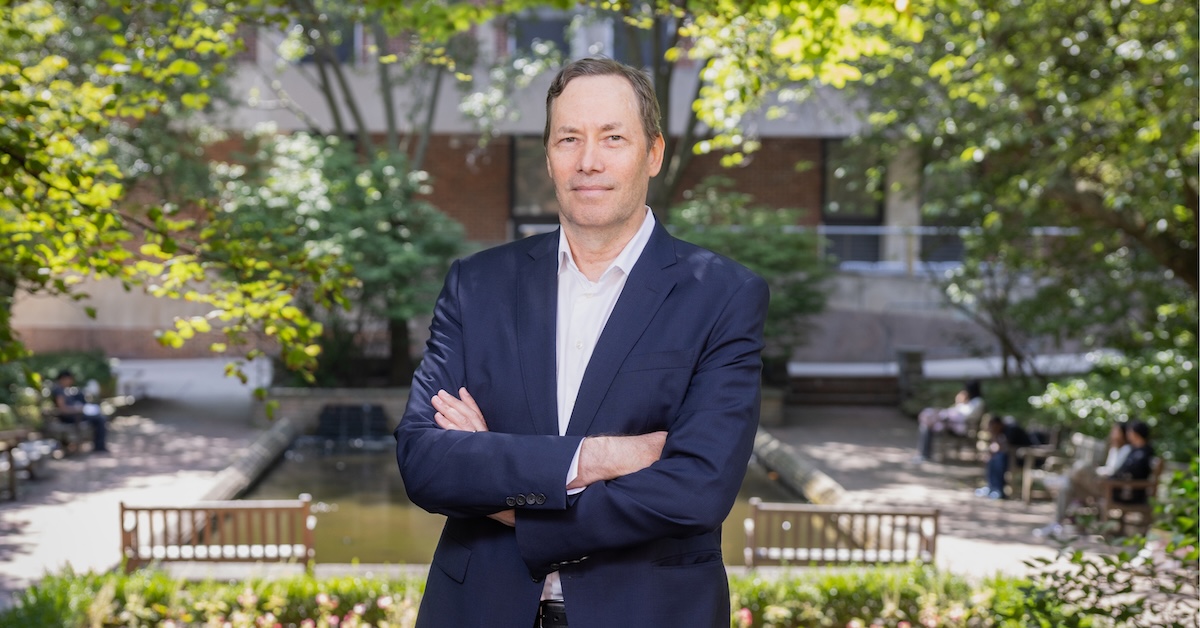
The Brooklyn College Cancer Center was pleased to recently announce the appointment of Professor Alexander Greer as its new director.
A standout scientist in the Chemistry and Biochemistry Department, Greer is known for researching how light interacts with chemicals and biologics. This work in photochemistry and photobiology explores tackling tough cancers like ovarian cancer and gliomas—a type of brain tumor, as well as wound care.
A recipient of the 2026 Photon Award from the American Society for Photobiology, a major honor in the field, he has 150 peer-reviewed publications and obtained $6 million in external funding. Greer’s distinguished career reflects both scientific excellence and a passionate commitment to mentorship.
As he steps into this role, his goal is clear: to broaden student opportunities, drive innovative research, and amplify the center’s impact, including within underserved communities.
How do you integrate your research with mentoring students and advancing new therapies?
As a research scientist, this role meshes well with my research efforts in photochemistry, including compound adjuvanticity and photo-priming for improved cancer cell eradication, wound care, and bacterial disinfection. Infections in wounds caused by bacteria that don’t respond to antibiotics are a big problem. To tackle this, I co-founded a company that’s developing special materials that absorb light to generate reactive chemicals to kill bacteria instead of drugs. Early tests on mice show encouraging results.
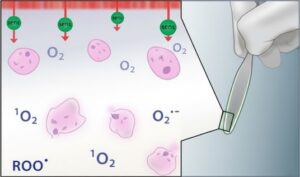
A concept drawing of a handheld photodynamic therapy device that delivers reactive oxygen species to specific sites.
The other rewarding part of my career has been working with students. I’m especially excited to celebrate my 14th Ph.D. graduate, Serah Essang, whose thesis explored how light interacts with tiny gold particles and other chemical systems. Her research could help us better understand how certain substances become toxic when exposed to light.
Similarly, other research faculty at the Brooklyn College Cancer Center focus on understanding the inner workings of complex chemical and biological processes and contribute to research efforts that could lead to new approaches in fighting cancer.
What sparked your passion for basic science and cancer research, and how has that passion evolved?
My interest in science really took off when I was a student and came across a book on theory and mechanism in organic chemistry that really captivated me. It opened my eyes to how molecules behave and interact, especially when light is involved.
That curiosity led me to explore how light-driven chemical reactions, photochemistry, could be used not just to answer scientific questions, but also to tackle real-world problems in biology and medicine. Over time, my passion deepened through collaborations with amazing researchers.
Who are the researchers who inspired you?
I collaborate with Theresa Busch and Timothy Zhu at the University of Pennsylvania to develop small, handheld devices for light-based cancer treatments—tools that could be used directly in clinical settings to help patients.
I also collaborate with Tayyaba Hasan at Harvard Medical School, focusing on ovarian cancer. It’s a particularly tough challenge because every patient’s cancer looks a little different, which makes it hard to treat with a one-size-fits-all approach.
I’ve also been inspired by Herbert Stepp’s work in Germany, where he’s using light to help treat brain, bladder, and head and neck cancers. His innovations in guiding surgery with light and delivering treatment directly into tumors have shown me just how powerful these techniques can be.
Through all of this, I’ve stayed grounded in my roots as a chemist, but I’m always looking for ways to turn that knowledge into something that can make a difference in people’s lives.
What makes the Brooklyn College Cancer Center unique in the fight against cancer?
Unlike traditional cancer centers housed in hospitals, the Brooklyn College Cancer Center does not provide clinical care, diagnose or treat patients, or manage end-of-life care. Instead, it fills a critical and often overlooked niche: advancing cancer research and education within the community.
As an initiative within Brooklyn College, the center offers unparalleled opportunities for students and faculty alike. It actively fosters collaboration, supports cutting-edge research, and provides students—from undergraduates to graduate scholars—with hands-on experience that bridges the gap between the lab and real-world impact.
By translating scientific discoveries into actionable knowledge, the center not only contributes to the broader fight against cancer but also cultivates the next generation of innovators and leaders in the field.
What goals or innovative directions are you eager to pursue for the Brooklyn College Cancer Center?
We are aiming for a three-prong approach: collaborate with the college and help propel research to the next stage; connect to community and build on existing outreach efforts of cancer education in the borough, including underserved communities; and promote the transition from lab bench to business with cancer treatment innovations. In addition to addressing these needs, we will deliver outstanding educational opportunities to our undergraduate and graduate students as well as highlight success stories in cancer efforts.
What advice or inspiration would you share with students dreaming of making their mark in the field of cancer research?
For students to think in terms of scholarship, future mentoring, and entrepreneurial aspects to try to take findings in the laboratory into cancer care practice. To try to go for creativity, leadership, and a collaborative spirit in their cancer research. If students have passions such as collaborating with researchers in Latin America or India or elsewhere, go for it to help strengthen outcomes of cancer research and encourage future generations of researchers. Lastly, strive to inspire new members of the field.