
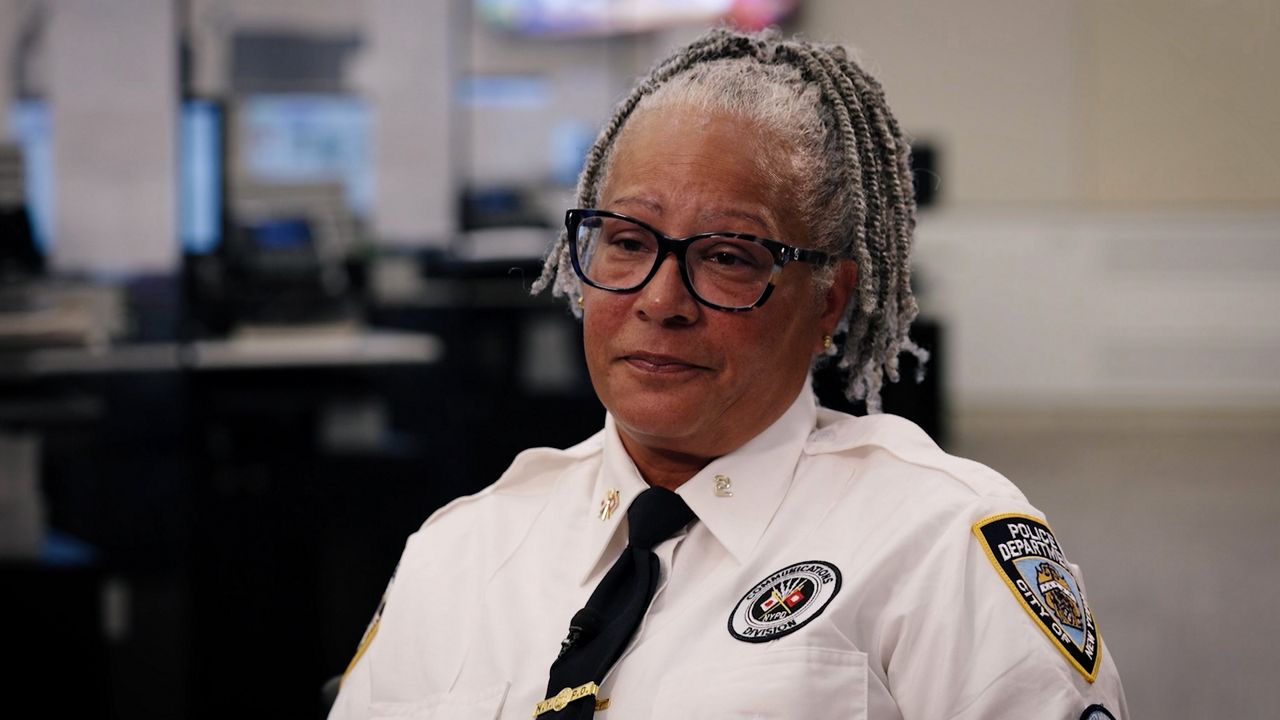
Crystal Johnson was home on her day off, getting ready to watch a new television show, when a news alert came across the screen.
A plane had crashed into the north tower of the World Trade Center. She said she watched as the south tower was hit shortly after 9 a.m.
“I decided, you know, to call to see if I needed to come in. And then it came across the TV,” she said.
The city had requested all 911 operators who were off that day to head into work.
She picked up a coworker, and they headed to the 911 center in Brooklyn.
“Driving across the Brooklyn Bridge. And there’s no other vehicles on the bridge but me, looking out and seeing the soot that covered from the towers all the way to the top of the Brooklyn Bridge,” she said. “The smell, I will never forget.”
She had been a 911 dispatcher for three years. She had always been told dispatchers develop a thick skin. Johnson said she never understood that.
Until that morning.
When she got to the office, both towers had fallen. Many of her colleagues had been working while the towers were on fire, directing first responders heading into the buildings and trying to assist callers trapped inside.
“There were some in tears, you see, some hugging each other,” she said. “Some were basically walking around like, I would say, numb.”
Johnson said she monitored the queues of calls from across the city, from people needing help in lower Manhattan and beyond.
“We were all overloaded. And a lot of us was emotional trying to figure out what’s going on,” she said.
“As a dispatcher, you have to multitask. You have to answer the phone. You have to speak to the unit. You have to type and talk. You are moving constantly all the time.”
Some of the people she had to call back were searching for loved ones they believed were in the World Trade Center, asking questions Johnson said she often could not answer.
“Even if you felt inside that it wasn’t going to be all right,” she said. “You trained to have compassion and to be emotional to help.”
With other calls, she had to evaluate whether the issue rose to the level of pulling resources from lower Manhattan, where rescue efforts were already underway.
Sept. 11 was a double shift for Johnson and many of the other dispatchers.
“So you just keep pushing and pushing and pushing and keep working and working to get the help that the public needs,” she said.
Johnson said she believes she got the thicker skin her colleagues told her she’d develop that day.
But the impact of Sept. 11 hit home. She thought about her dad, who was a cook at a restaurant across the street from the World Trade Center. He had just shortened his work schedule from Monday through Friday to Wednesday through Friday.
Nearly a decade later, she was taken back to 9/11 when an earthquake rattled New York City.
“As I’m running down the stairs, all I thought in the back of my mind was, the building is crumbling down behind me,” she said, her mind racing back to the images she saw on television from 9/11 as she said her own building swayed.
She still works for the NYPD at a 911 dispatch center in the Bronx, a job she found to be a calling.
“I wasn’t just a 911 operator or the voice behind the radio,” she said. “I was saving lives.”