
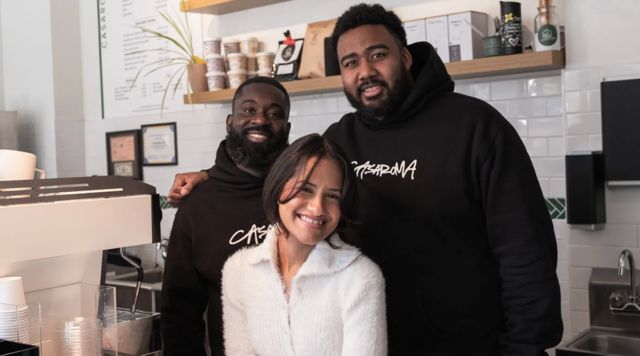
 From left, Casaroma founders Donnell Culver, Yaretsy Flores and Kevin Rucker. Photo courtesy of Casaroma Café.
“Evenings are the biggest unused asset most cafés have, and most cafés just turn the lights off,” asserts coffee maven Kevin Rucker, a co-owner of New Rochelle’s reopened Casaroma Café, where imaginative evening programming complements the all-day, community-focused coffee-drinking scene.
He shared further insights into Casaroma’s distinctive approach to coffee in a recent interview with Westfair’s Westchester County Business Journal, highlights of which are featured below.
Kevin, congratulations on the reopening of Casaroma, and thanks for speaking with the Journal. Let’s start with the founders. Who owns Casaroma, what are your professional backgrounds, and what brought you together to create a specialty coffee business?
Casaroma is owned by three of us: myself, Yaretsy Flores and Donnell Culver.
My background is in business operations management. I’m also our roaster, so I own the coffee itself, from green bean through to what lands in the cup. Yaretsy comes out of hospitality, food and beverage, and human resources, and Donnell is a video producer with a long history in media production, making large- and small-scale content for print, digital and social.
All three of us had spent years building community in different ways, and we wanted a physical place where that could happen every day. The name is a blend of two words, casa and aroma. House of aroma. That’s the whole idea.
And your connection to New Rochelle. Why did you choose the city — and this particular location — for Casaroma?
Yaretsy and I moved here in 2020. I’m originally from the Bronx, so New Rochelle was already familiar to me. I came up here for the movies, laser tag, bowling, pool. I’ve always had love for this city.
391 Huguenot St. wasn’t our first choice. The building wasn’t even finished yet. We reached out to a lot of retail spaces, and many of them never returned our calls or turned us away outright. Then we met Frank Chechile, our landlord. He believed in what we were trying to do, and he understood this was our first time doing it. He helped us navigate the buildings department and even connected us with some of our contractors.
What did it take financially to get Casaroma off the ground?
Everything we had, and a lot of favors. Yaretsy and I moved in with family for a year to save. From there, it was a crowdfunding campaign, a business loan, maxed-out credit cards, and a landlord who was genuinely willing to work with us on the lease. We raised money any way we could, but we never gave up ownership. That was the one line we held.
How is the business structured between the café and the wholesale operation, and what role do you expect wholesale coffee to play in Casaroma’s revenues over, say, the next three to five years?
We have four revenue streams: the coffee shop, the cart, e-commerce and wholesale. The shop is the main source, roughly 70% of revenue, and that’s mostly by design. We haven’t put a heavy focus on e-commerce yet, and we’re deliberately picky about wholesale and catering.
Roasting in-house means we control the coffee from green bean through to the cup, and that controls both quality and margin. We’re not reselling someone else’s beans with our sticker on the bag.
Casaroma describes itself as being about “Culture, Community and Collaboration.” How do you turn that philosophy into a sustainable business rather than simply a branding exercise?
Culture, community and collaboration aren’t a mantra for us. Our book club is about 18 months in and has grown to around 400 members in the community. We have a crochet club that’s seen huge growth. We’ve recently organized Paws & Portraits at our content studio, where we offered pet owners free portraits, and they’ll be displayed at the Vanda Gallery next door to us. We’ve hosted the mayor and state senators for meet-and-greets with residents. We’ve partnered with a long list of groups across New Rochelle, and we still feel like we’ve only scratched the surface.
And you also have plans for movie nights, cultural gatherings and workshops. What do you envision these events becoming, and who are you hoping they will attract?
The book club and crochet club are already well past the planning stage. What I want the rest of the calendar to become is the same thing: a reason the room is full at 6 p.m. on a Wednesday, not just 10 a.m. on a Saturday.
Evenings are the biggest unused asset most cafés have. We’d rather hand the keys to somebody in the neighborhood who has a group and a good idea.
Casaroma received support from New Rochelle’s Retail Tenant Improvement Fund. What difference did that grant make to the project?
It let us build the space we actually designed. When we first opened, we couldn’t afford a lot of what we’d planned. You open with what you can pay for and you tell yourself you’ll fix the rest later. The grant is what let us do “later” sooner.
So, what does success look like for Casaroma five years from now — and what would you like the business to have contributed to New Rochelle by then?
Consistency and growth, in that order.
You see a lot of companies grow and the quality quietly drops off. That’s the thing we’re most protective of. Success is growing in a way where the product and the service are the same no matter who’s behind the bar.
Five years out, the goal is to keep delivering culture, community and collaboration here in New Rochelle, and to grow in a way that helps make New Rochelle a destination. Not a place people pass through on the train, but a place people come to on purpose. If Casaroma is one of the reasons somebody decides to spend a Saturday downtown, that’s the contribution.
Located at 391 Huguenot St., Casaroma is open Mondays to Saturdays, 7 a.m.-7 p.m. and Sundays, 7 a.m.-5 p.m.