
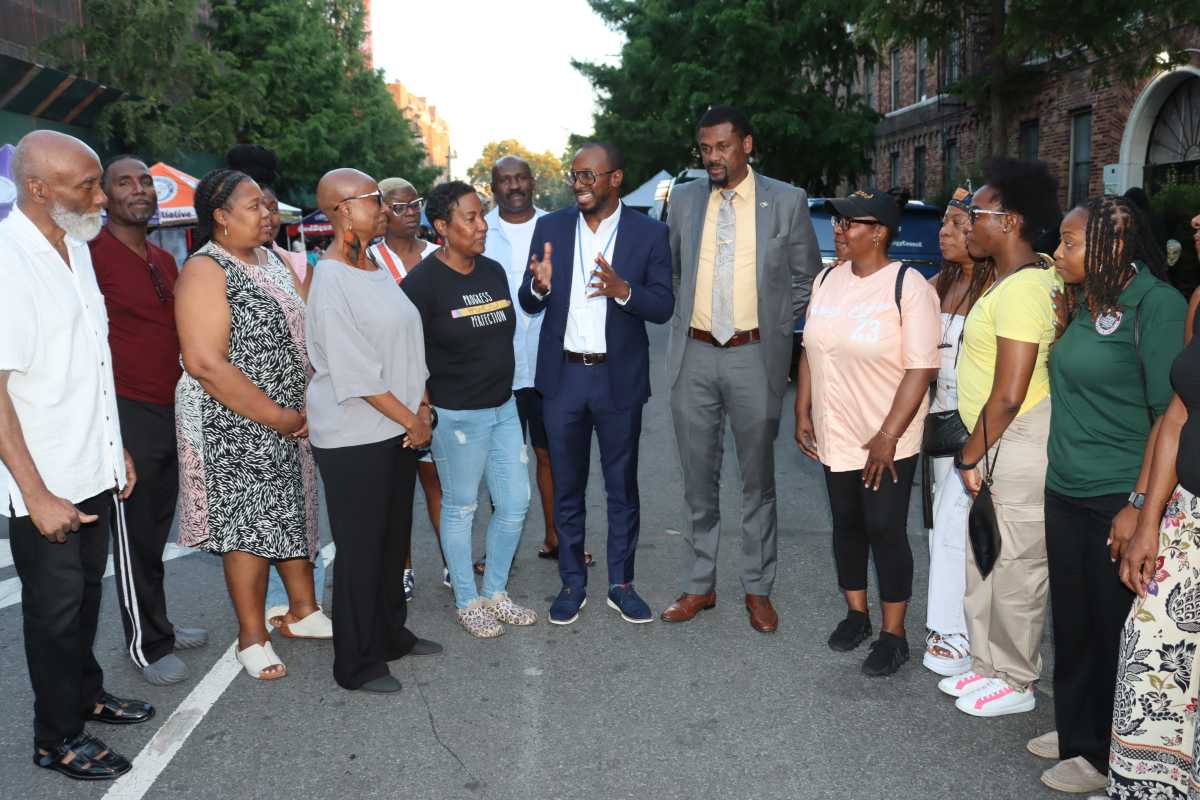
As Trinidadians in New York City express outrage over the reported cancellation of a permit by the New York City Police Department (NYPD) for an inaugural Independence Parade for Trinidadians in Brooklyn, Pastor Louis Straker, Jr., the lead pastor of Reflections Church on Utica Avenue in Brooklyn and “a proud citizen of Trinidad and Tobago,” said he finds himself “torn” by the decision.
The Trinidad and Tobago Independence Day Parade was slated for Sunday, Aug. 30, starting at Church Avenue and Ocean Parkway in Brooklyn.
Pastor Straker, the son of a Trinidadian mother and a Vincentian father, told Caribbean Life on Friday, Aug. 21, that he is “torn” not because he believes the parade should have been permitted under the circumstances.
“My views regarding the proliferation of individual Caribbean island parades, as expressed in a recent article in Caribbean Life News, remain unchanged,” said Pastor Straker, whose father is Sir Louis Straker, a former Deputy Prime Minister and Foreign Affairs and Foreign Trade Minister in St. Vincent and the Grenadines.
“Rather, my mixed emotions stem from what this cancellation now produces and what it reveals about the challenges facing our Caribbean community,” added Pastor Straker, also board chair and acting executive director of the 67th Precinct Clergy Council, Inc., in Brooklyn, popularly known as the “The GodSquad,” a faith-based anti-gun violence organization, under the NYC Office of Neighborhood Safety and Mayor’s Office of Community Safety, providing “Safe J’Ouvert/Labor Day” public safety support for the past 10 years.
“First and foremost, it is important to acknowledge why the Trinidad and Tobago Independence Day Parade was cancelled,” he continued. “The permit was denied by the NYPD, citing concerns about the proposed route and traffic management. The recent Jamaican Parade was a great indicator as to the magnitude of these types of parades, and the logistical challenges that it produces for our borough.”
He said the NYPD anticipated a turnout of about 2,000 to 3,000 people for the Jamaican parade, “only to see attendance grow substantially beyond those expectations, with some estimates placing the crowd at more than 10,000 people.
“These events have the potential to grow larger each year, and as attendance increases, so do the challenges involving traffic, public safety, emergency access, noise, sanitation, and the disruption of surrounding communities,” he added. “We must admit cultural celebrations cannot continue to expand without careful consideration of the area in which they are being held.
Straker further said that his concern about the event’s cancellation is that has the potential to create division within the community.
“However, once a precedent is established for one island, the question inevitably arises: If Jamaica can have its parade, why can’t Trinidad and Tobago?” Pastor Straker asked. “If one group receives an opportunity to celebrate its national heritage in the streets of Brooklyn, others will understandably expect the same opportunity. That is where the public perception of this decision becomes particularly important.”
He said while the NYPD may have legitimate reasons for denying the permit, the decision may not fare well in the court of public opinion.
Meanwhile, Straker noted that there is a separate issue emerging that could unite the community: The increasing number of “noise complaints” being made through 311.
“While, of course, there are legitimate noise complaints, and we should never dismiss the rights of residents to enjoy peace and quiet in their homes, we must also acknowledge the changing nature of our neighborhoods,” he said. “Brooklyn’s Caribbean communities are experiencing significant demographic and economic changes, including continued gentrification.”
As new residents move into neighborhoods that have historically been shaped by Caribbean culture, Pastor Straker said “there is often a disconnect between those residents and the traditions that have long defined our communities.
“The reality is our culture is vibrant, energetic, musical, colorful, and sometimes loud,” he said. “It is an outward manifestation for the many years were held silent.”
For generations, Pastor Straker said Caribbean people have celebrated through music, street festivals, sound systems, steelpan, masqueraders, and dancing, among others.
“These traditions are not merely entertainment; they are expressions of identity, history, and belonging,” he said. “But we must also recognize that location matters as well.”
Pastor Straker said there is a reason the West Indian American Day Parade is held on Eastern Parkway, “one of the widest and most suitable corridors in Brooklyn for an event of that magnitude.”
He said taking the cultural “big truck” experience and placing it on narrower streets creates “a very different acoustic and logistical environment.”
Pastor Straker said sound can reverberate between buildings, intensifying noise levels for surrounding residents.
“These are the kinds of consequences that must be considered when cultural events are planned,” he said. “If noise complaints continue to increase, and if those complaints become part of the justification for restricting or cancelling cultural events, we could eventually find ourselves facing a much larger problem.
“What may be tolerable for the J’Ouvert/Labor Day Weekend, may be intolerable for successive individual parades happening on multiple weekends,” the pastor added. “Even when events are permitted, organizers may be subjected to increasingly restrictive sound limitations that diminish the very cultural experiences these celebrations were created to preserve. These matters should be a concern for all of us.
“This is why I believe the cancellation of the Trinidad and Tobago Independence Day Parade should be a wake-up call,” he continued. “Our community needs to come together, not simply to seek individual parades, but to develop a sustainable strategy for preserving Caribbean culture in Brooklyn for generations to come.”
Pastor Straker said there’s a need for conversations with city agencies to discuss appropriate logistical resolutions.
“We need stronger communication with surrounding residents enlightening them of our cultural expressions,” he said. “We also need our elected officials, community organizations, cultural leaders, and parade organizers to work collectively rather than separately. Most importantly, we need a plan for succession.
“Our responsibility is not merely to preserve what we have today; it is to ensure that our children and grandchildren will still have the opportunity to experience, celebrate and understand the cultures that brought our communities to Brooklyn in the first place,” Pastor Straker added. “It is time for our people to unite and think beyond our respective individual islands.
Pastor Straker called for the creation of “a sustainable future, one with a clear plan of succession that solidifies who we are as a people and ensures that the legacy we have built in this city can be maintained, honored and passed on to generations yet to come.”