
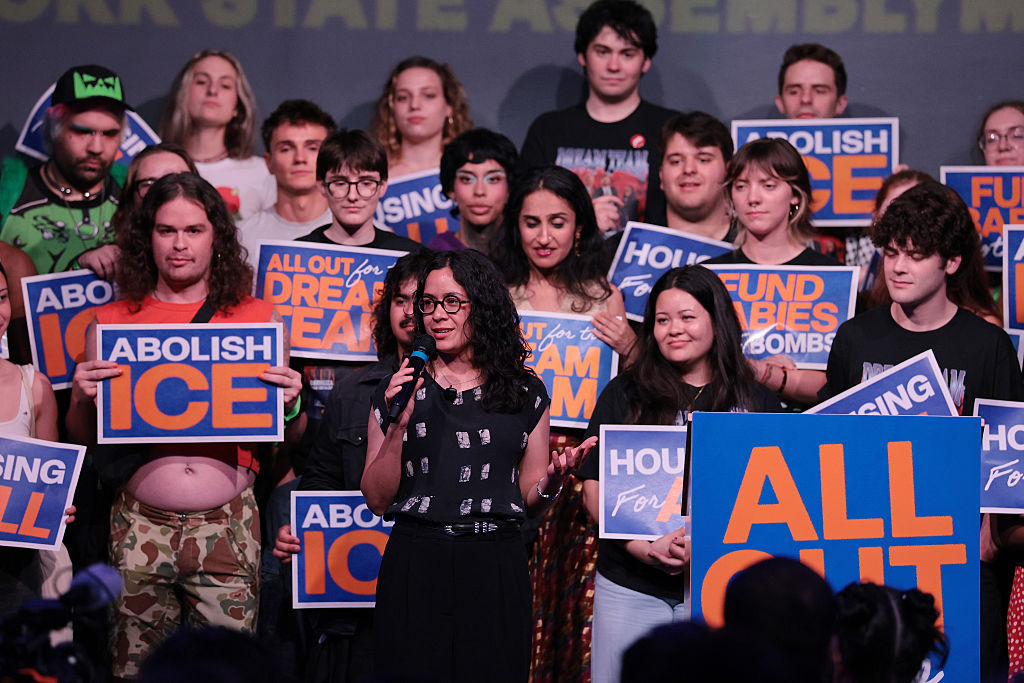
The two highest-profile races for NYC-DSA were for congressional seats: Claire Valdez’s run for Nydia Velázquez’s vacated seat in New York’s Seventh Congressional District (NY-7) and Darializa Avila Chevalier’s run against incumbent Adriano Espaillat in the Thirteenth District (NY-13).
In NY-7, Valdez brought out a whopping four thousand volunteers for her race — nearly half the total number of volunteers that showed up for the whole slate.
By May, the largest source of new volunteers in socialist campaigns came from those who were neither DSA members nor previous Mamdani volunteers.
“Something we kept telling our canvassers, the establishment wants everyone to believe that Zohran was a moment — just a flash in the pan, viral social media, charismatic personality — and not about the substance and the politics and the policy,” said Christian Long, a field lead for Valdez. “This was our statement to say, no, this is for real. This is a movement, and we’re growing — and this is the next step.”
Across the river in NY-13, with one full-time field staffer, Avila Chevalier’s campaign organized 3,500 volunteer shifts with over a thousand canvassers, averaging three shifts each — roughly a quarter of whom were not previously affiliated with DSA.
“There was a sense on this campaign that the volunteers were the ones who were driving it, were the ones who are crafting the strategy, who were ultimately responsible for its success,” said Andrew Basta, a volunteer for Avila Chevalier’s congressional race. “I think I took a lot of ownership as well as many, many other people on the campaign to say that this has to be a success.”
During the campaign’s final four days of get out the vote (GOTV) alone, volunteers knocked over 155,000 doors and made roughly 250,000 calls — a level of grassroots mobilization more typically associated with statewide or presidential campaigns than a single House primary. For perspective, during the last weekend of October before the 2024 general election, Kamala Harris’s campaign reported knocking one hundred thousand doors across the entire state of Georgia.
“We relied heavily on what makes NYC-DSA campaigns so impactful: a mass volunteer-led apparatus,” said Sebastian Leon Martinez, the sole field staffer for Avila Chevalier’s campaign. “It was the field program that benefited from trusting volunteer leaders with new responsibilities.”
There was a sense on this campaign that the volunteers were the ones who were driving it, were the ones who are crafting the strategy, who were ultimately responsible for its success.”
These volunteers weren’t only knocking doors and making calls. For Avila Chevalier’s campaign, a dozen regular volunteers fulfilled responsibilities typically doled out to staff like training field leads who assigned turf to canvassers, handling peer fundraising, reviewing campaign data, working on video production, serving as points of contacts for other volunteers, and creating campaign merchandise.
“That layer of leadership was the strongest I’ve seen in a campaign beside Zohran’s and builds up the confidence to take ownership of projects that lead to potential future staffers,” Leon Martinez said.
For downballot races, these campaigns were drawing in hundreds to thousands of volunteers — rivaling, and in some cases exceeding, some of the best-known insurgent campaigns of the past decade. Archival records suggest Alexandria Ocasio-Cortez’s 2018 congressional campaign involved roughly 500 active volunteers, 103 of whom were Queens DSA members.
Aber Kawas’s campaign for state senate alone mobilized more than 1,100 volunteers to knock over 104,000 doors. Christian Celeste Tate’s campaign for state assembly drew in roughly 315 volunteers who knocked nearly 45,000 doors in his district.
In the “Commie Corridor,” a moniker coined by political writer Michael Lange to designate the zones of Queens and Brooklyn that came out the strongest for Mamdani during the mayoral race, multiple DSA-backed candidates were running in overlapping or adjacent districts. Claire Valdez was running at the top of the ticket, while Kawas, Samantha Kattan, David Orkin, and Tate were running downballot races, alongside Diana Moreno’s campaign for reelection in Mamdani’s old assembly seat.
Organizational emphasis on ushering in a socialist bloc up and down the ballot — rather than electing individual candidates — helped turn out volunteers to canvass for multiple candidates at once and pool resources.
“Just the idea that we can elect an entire slate that is unified in our goals to make our society work better for the masses — that was an opportunity that I think we all knew we couldn’t let that slip by,” said Sara Abiboutros, an attorney and field lead for the “Sunny Slate” in Sunnyside, Queens.
That the candidates were running on nearly identical platforms made it easier to say to perspective voters, “If you like Valdez, you’ll like Kawas and Kattan, too.” The trust by association that came with Valdez running at the top of the ticket — in the same way an endorsement extends trust from current electeds to candidates — proved an advantage at the doors.
“There was a lot of joint canvassing happening. And it just felt like coming off of Zohran’s win, it was the perfect opportunity to carry that momentum, and this would be the next step, the next phase of the movement,” Abiboutros said.