
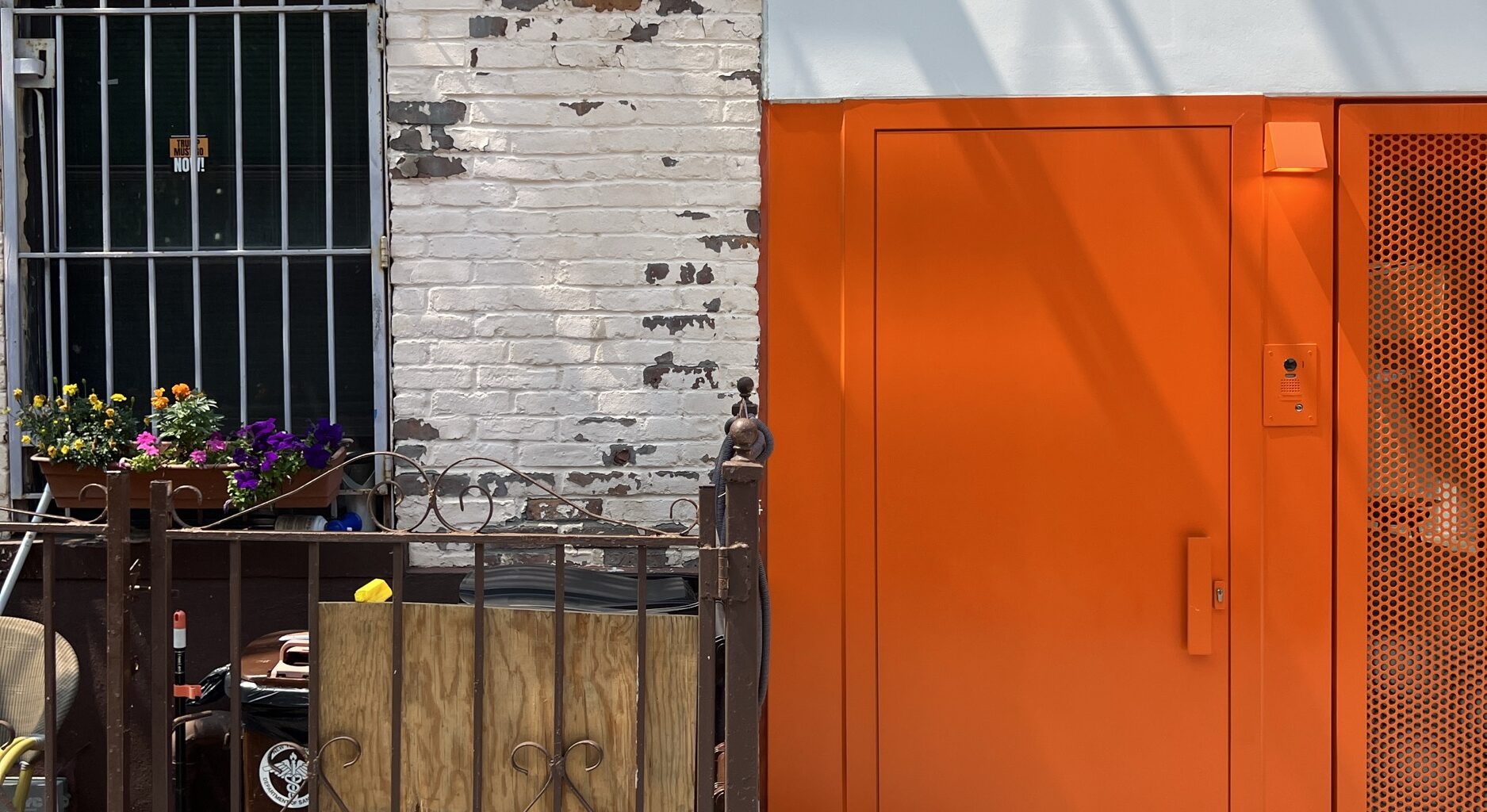
On a corner that formerly housed a gas station in the gentrifying neighborhood of Clinton Hill, a clean white box with massive windows and orange entry points, 272 Greene Avenue, designed by Inès Lamunière of Switzerland and architect Matthias Müller of New York, has joined NYC’s built environment. In an age of saturation, when nearly every architectural gesture has already been made, catalogued, and is available for reference, the five-story, two-family house is not a standard developer project, nor a passive house wrapped in a nineteenth-century townhouse, but an exercise in the International Style—a structure that could have easily been at home in 1932 in Philip Johnson and Henry-Russell Hitchcock’s Modern Architecture: International Exhibition at MoMA. In its codified language, is this project transposing history, quoting history, reinterpreting context, or expressing an opinion about how one should live? The building is an unapologetically strong contribution to an evolving neighborhood, and as such, garners attention and elicits questions.
Architectural language once tended to emerge through the surrounding built environment or a cultural zeitgeist. Historically, rising architects were blessed with first projects that elicited early designs for homes or small housing projects that could lay the foundations for the development of an architectural language. Initial projects of Le Corbusier, Mies van der Rohe, David Adjaye, Herzog & de Meuron, Tadao Ando, and Wallace K. Harrison were residential. When seemingly all things have been done, can architecture still operate as a consequential language, when it runs the risk of becoming yet another system competing for relevance? In other words: What does this condition of saturation mean for architectural language? Is all-access media freedom or disorientation? Does it leave architectural language unmoored? Is form a non sequitur?