

Mayor Zohran Mamdani announced Wednesday that the nation’s largest public school system will impose a one-year moratorium on student-facing generative artificial intelligence (AI) from 2-K through eighth grade, while experimenting with a small group of vetted AI tools in high schools.
The decision to keep the technology off-limits to most of the city’s public school students came eight days before the first day of school on Sept. 10 — and after parents, teachers and elected officials spent months urging the administration to pump the brakes on the technology.
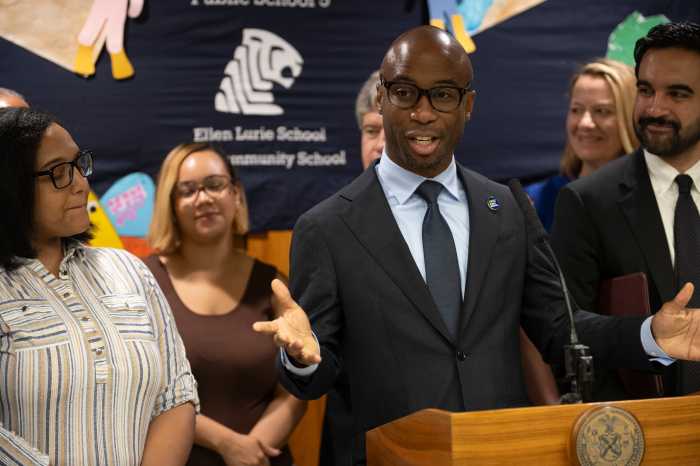
“Children need their teachers and human connection in order to learn and in order to grow,” Mamdani said at a press conference at the Brooklyn Navy Yard STEAM Center. “The tech industry wants us to believe that AI in early education is not only inevitable, but that it is necessary. We do not see it that way.”
Mamdani said he had yet to see research demonstrating benefits from AI for elementary and middle school students, aside from studies sponsored by companies that stand to profit from the technology.
The moratorium will affect nearly 600,000 students, or about two-thirds of the public school system, according to City Hall. Companion chatbots will be prohibited across all grades. But the policy includes exceptions for assistive technology used by students with disabilities, multilingual learners and students participating in career-readiness programs such as computer science.
The changes also reach AI already embedded in city classrooms. Mamdani said the Education Department will disable AI components in nearly 40 previously allowed education programs that do not meet its new safety and oversight standards.
Senior education adviser to the First Deputy Mayor Ailish Brady said that includes AI features in curriculum products such as Amira and HMH. Where the AI component can be turned off, it will be, she said. If it cannot, the product will be removed from schools altogether.
Brady later said assistive technology can be included in a student’s IEP (individualized educational plan) or 504 plan. She cited eye-tracking software used by some students with severe disabilities as an example of technology that would be exempt from the new screen-time limits, and a DOE-approved translation app used by multilingual learners as another permissible tool.
 NYC Public Schools Chancellor Kamar SamuelsPhoto by Lloyd Mitchell
Samuels says AI moratorium aims to stop ‘productive struggle’
Schools Chancellor Kamar Samuels said the policy is intended to preserve what he called the “productive struggle” involved in learning.
“I don’t want technology to do our students’ thinking for them,” Samuels said, adding that elementary and middle school classrooms should remain focused on instruction, play, discussion, creativity and working through difficult problems without “outsourcing it to a machine.”
The new rules follow a months-long review that began after NYC Public Schools issued preliminary AI guidance in March and opened it for public comment. The initial framework used a “traffic light” system that permitted some AI uses with safeguards while barring the technology from decisions involving grades, assessments, discipline, surveillance and counseling.
Pressure for tighter restrictions grew over the summer. A coalition of parents, educators, students and elected officials called in June for a two-year moratorium, citing concerns including privacy and critical thinking. By Aug. 26, parents and educators were still pressing Samuels for clarity on the final policy ahead of the Sept. 10 start of classes.
Mamdani said on Sept. 2 that the March guidance was intended as the beginning of a conversation and credited Samuels with gathering feedback from parents, students and educators before settling on the new policy.
High school students will face a different approach under the guidelines.
Five AI programs will be piloted under direct teacher supervision, with students limited to no more than 45 minutes of use per week. Mamdani stressed that the pilots do not include general-purpose chatbots such as ChatGPT or Claude.
Samuels said every high school student will be required to take two 45-minute AI literacy modules during the year, with more extensive instruction for students participating in pilots and career programs.
The administration is also limiting screen time for younger students, with Samuels saying there will be no one-to-one device use through second grade and recommended daily caps of 30 minutes for grades three through five and 45 minutes for grades six through eight.
‘Falls short of what is needed’
Not everyone who pushed for tighter restrictions was satisfied.
State Sen. Kristen Gonzalez, chair of the state Senate’s Internet and Technology Committee, and Council Member Carmen De La Rosa, chair of the City Council’s Technology Committee, called the policy “a step forward” but said it still “falls short of what is needed to meet this moment.”
The lawmakers welcomed the moratorium for younger students but urged Samuels to postpone the five high school pilots until clearer criteria are established for evaluating safety, bias and outcomes. They also said two 45-minute AI literacy modules are insufficient and called for more comprehensive digital, online safety and media literacy education.
The AI Moratorium Coalition, which helped lead the push for a two-year pause, also welcomed the restrictions while saying they did not go far enough. The group raised concerns about the high school pilots, continued teacher use of generative AI and the fact that recommended screen-time limits for grades three through eight are not mandatory.
“So we’re thrilled that our organizing has produced significant restrictions on the use of AI in NYC schools,” said Craig Garrett of D14 Families for Human Learning. “But we have a lot more work to do.”
The administration has left open what happens after the coming school year. Mamdani said the moratorium could be extended or amended based on what officials learn from students, teachers and principals.
“If we find over the course of this year that this policy needs to be extended, then we will extend it,” Mamdani said.