
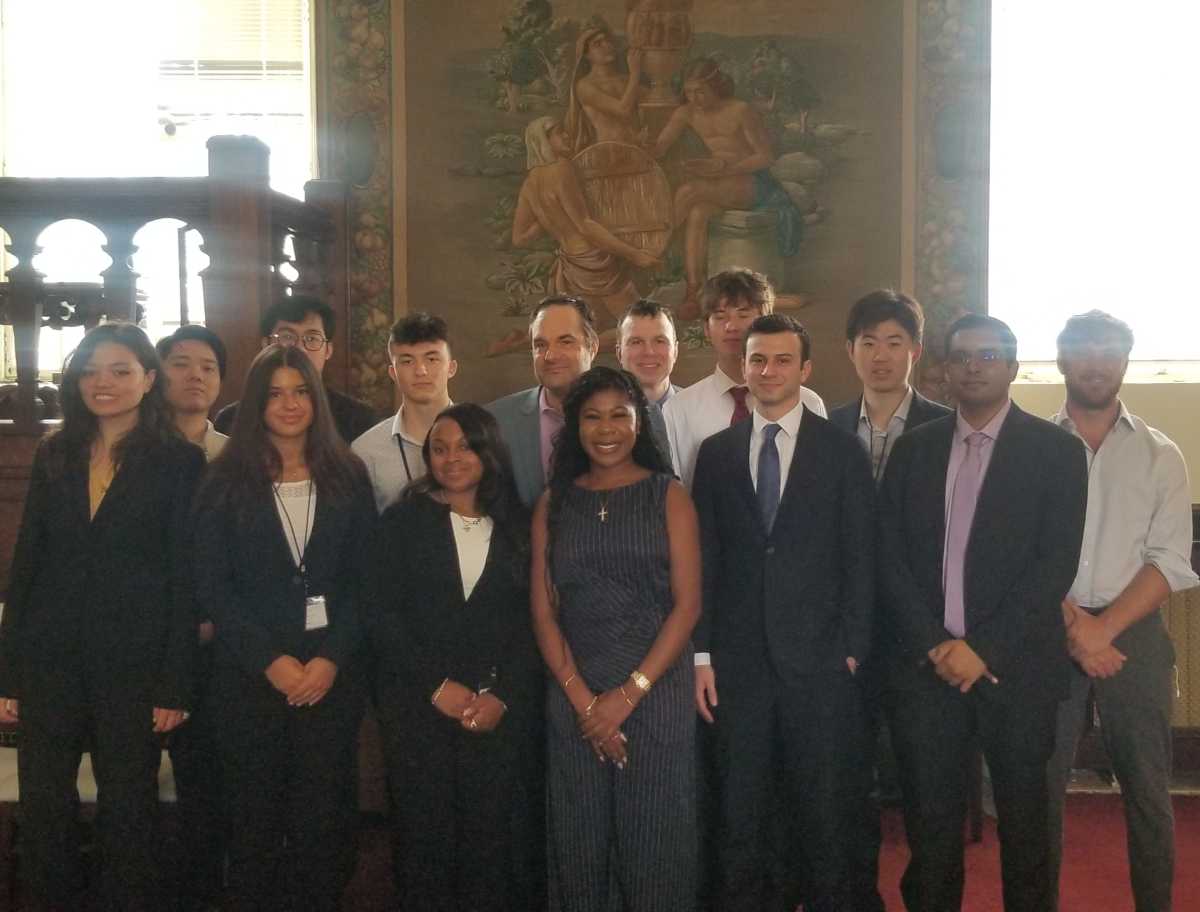
The interns also participated in periodic “Lunch and Learn” sessions, featuring judges, lawyers and other professionals. The programs, curated by Kawtar Merfouk and Larisa Blinderman, provide opportunities to learn, network, and hear firsthand accounts about public service.
The following pieces were authored by Eric Martin, Emory Law, and Hana Carlson, Jason Chen, Tyrone Dayaram, and Yeva Kyrkova.
A look at the Manhattan courts with AJ Suzanne Adams
By Eric Martin, Emory Law
When the New York County Courthouse at 60 Centre St. opened in 1927, there were no women’s restrooms. Nearly a century later, Administrative Judge Suzanne Adams of the New York Supreme Court, Civil Term, stood in that same building’s Paul G. Feinman Ceremonial Courtroom and addressed a group of international human rights and legal scholars on how one of the country’s busiest trial courts has evolved since. She traced the geography of Manhattan’s judicial infrastructure: 60 Centre St., a hexagonal Classical Revival landmark on Foley Square, houses the Supreme Court’s civil branch; 100 Centre St., the Art Deco tower, steps away, is the borough’s principal criminal courthouse, where arraignments and prosecutions begin. Justice Adams likened a trial judge to a teacher, an administrative judge their principal, and she spoke candidly about the emotional intensity of the disputes that come before the court. They demand passion and thoughtfulness from those who preside over them, Adams said.
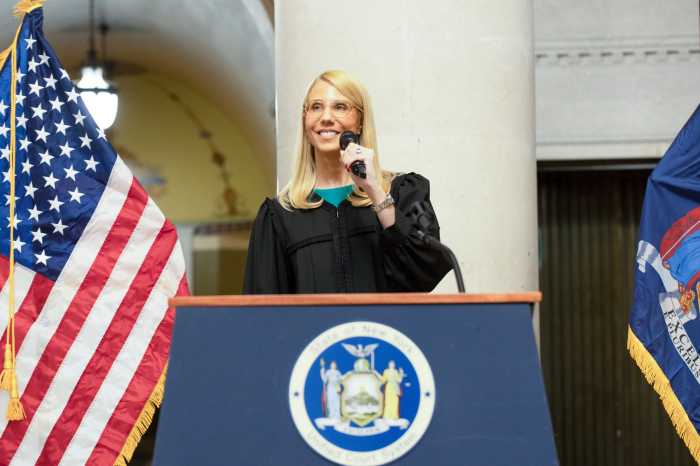 Civil Supreme Court Administrative Judge Suzanne Adams speaks at an event.Courtesy of Hon. Suzanne J. Adams / OCA
The bulk of the presentation centered on who the New York judiciary serves and how. Justice Adams described the reality in 2026: people arriving with problems that feel insurmountable, some of whom struggle to read and rely on Legal Aid to navigate the system for them. Whether a party appears pro se or with counsel, the court’s duty remains the same. The court is “the neutral,” Justice Adams said, showing what that means at scale: interpretation in more than 120 languages and forums like Small Claims Court and night court. Justice Adams also invited students and young attorneys to seek out small claims arbitration roles as early opportunities to become adjudicators. She then walked the group through the mechanics of trial from discovery through jury empanelment, distinguished six-member from twelve-member juries, explained voir dire, and contrasted the standards of proof in civil and criminal cases: preponderance of the evidence against beyond a reasonable doubt.
The conversation turned global when Justice Adams engaged attendees from India on the court’s adoption of Zoom during the COVID-19 pandemic and the technological advances that followed. Among those present was a geopolitics student attending as part of a human rights course, a reminder that the questions Justice Adams raised that afternoon, including who has access to justice, what judicial neutrality demands, and how a courthouse built without women’s restrooms can become one that serves speakers of 120 languages and reaches well beyond the legal profession.
A look at entertainment law
By Hana Carlson, Jason Chen, Tyrone Dayaram, and Yeva Kyrkova
Ayana McPherson is an entertainment attorney and an Associate at Bruns Brennan Berry Pikulin & Jacobs LLP. She first joined as an intern in 2020 before becoming an associate once she graduated from the Benjamin N. Cardozo School of Law in 2021. Before law school, she earned her Bachelor of Fine Arts degree in Dance from the University of Michigan. She then went on to work at Clear Talent Group in New York. While at Cardozo, she was a member of the Moot Court Honor Society, where she served as Competition Editor for the Broadcast Music, Inc. competition. Ms. McPherson was also co-president of the Minority Law Student Alliance, received the 2020 BALLSA Scholarship Award, and earned her first legal credit through the Filmmaker’s Legal Clinic working on Netflix’s “The Last Blockbuster.” She also interned at Franklin Entertainment at Twentieth Century Fox in Los Angeles, Volunteer Lawyers for the Arts, and SAG-AFTRA, and is a current member of the Black Entertainment and Sports Law Association.
Ms. McPherson spoke about entertainment law. She specified a distinction between the legal work involving actors and the legal work that surrounds the music industry, even though both fall under the same broad umbrella of entertainment law. On the television and film side, the work focuses on actors and the unions that represent them, such as SAG-AFTRA. Additionally, it focuses on the studios and networks negotiating those deals, with project-specific contracts driving much of the legal work. On the other hand, the music industry tends to revolve around recording and publishing agreements between artists and labels, questions of royalties and ownership over masters, and licensing arrangements. Ms. McPherson framed the two as remotely related practice areas, as both required a different working knowledge of the industry and the people operating within it.
Subsequently, Ms. McPherson spoke about networking, as she considers it one of the most important tools available to people who look to enter the legal field. She framed networking as something that can open doors that a resume alone cannot, and should be treated as more than a formality. This is evident from her own path from working in talent agencies to eventually finding herself in an associate position at the same firm where she once interned.
Finally, Ms. McPherson offered a few tips for putting that philosophy into practice. She encouraged us to keep track of the people we meet along the way, instead of letting a single conversation fade into the background once the moment passes. She also returned to the importance of doing research before reaching out to someone, particularly on LinkedIn. Ms. McPherson explained that most professionals are genuinely willing to help when approached thoughtfully, and are often eager to share information about a firm, a practice area, or a career path that simply is not accessible in any other way. Overall, her advice made networking seem more like an ongoing habit that can help you nurture a successful legal career.