
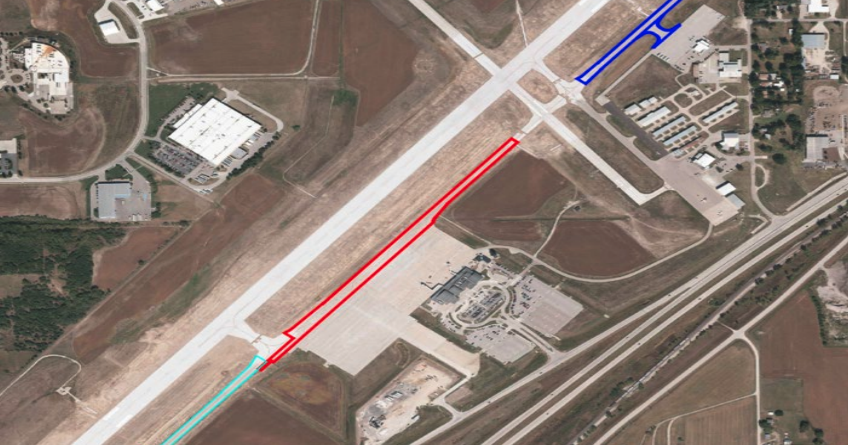
Manhattan Regional Airport will reconstruct its primary taxiway after Manhattan city commissioners unanimously approved nearly $15 million in federal grant funding for the project Tuesday.
The commission voted to accept $14,882,460 in Federal Aviation Administration grant agreements, approve a $1,474,700 task order with Olsson Inc. and award a $12,927,663 construction contract to Clarkson Construction Co. for the taxiway alpha reconstruction project.
The project will replace all three sections of taxiway alpha, which runs parallel to the airport’s primary runway, rather than replacing the two oldest sections as originally planned.
The taxiway is about 7,400 feet long and 50 feet wide. The oldest section was constructed in 1982, another in 1994 and the newest section was constructed in 2002.
The FAA considers taxiway pavement to have a useful life of 20 years, making the sections eligible for federal funding once they pass that threshold.
Before October 2025, the airport had planned to replace only the two older sections using FAA entitlement funding. The airport receives about $1.3 million annually in entitlement funding and can carry over up to four years of funding.
Airport director Brandon Keazer said the opportunity changed in October when the FAA notified the airport that discretionary funding was available. The FAA offered about $7.5 million in discretionary funding, with additional money coming through the Infrastructure Investment and Jobs Act.
The additional funding also allowed the airport to pursue a 95% federal, 5% local cost split under FAA reauthorization for fiscal year 2026.
The airport’s local share is expected to be about $800,000, which Keazer said will be covered by charges collected from passengers departing Manhattan Regional Airport.
The airport collected roughly $350,000 in passenger facility charges last year. Keazer estimated that, at the current rate, the debt associated with the city’s share could be paid off in about two and a half years.
He said the airport plans to submit an application to the FAA after the project is completed to use PFCs to reimburse the city for the eligible project costs.
The airport had to accelerate its design process to meet a June 1 deadline for the grant application. Keazer said that in about five months staff members completed a design that would normally take about a year.
The project is planned to begin construction in March 2027 and complete in November 2027.
Construction will be divided into five phases, allowing all four airport ramps to maintain access to the primary runway during construction. Airport officials said the phasing is intended to avoid flight disruptions and prevent a shutdown of commercial operations.
“No flight impacts. That’s the big piece,” Keazer said.
The airport’s advisory board unanimously supported moving forward with the project.
The commission also repealed a previous resolution related to financing the taxiway design. A city official said the original resolution covered only the design cost, while the new resolution covers the full cost of design and construction.