
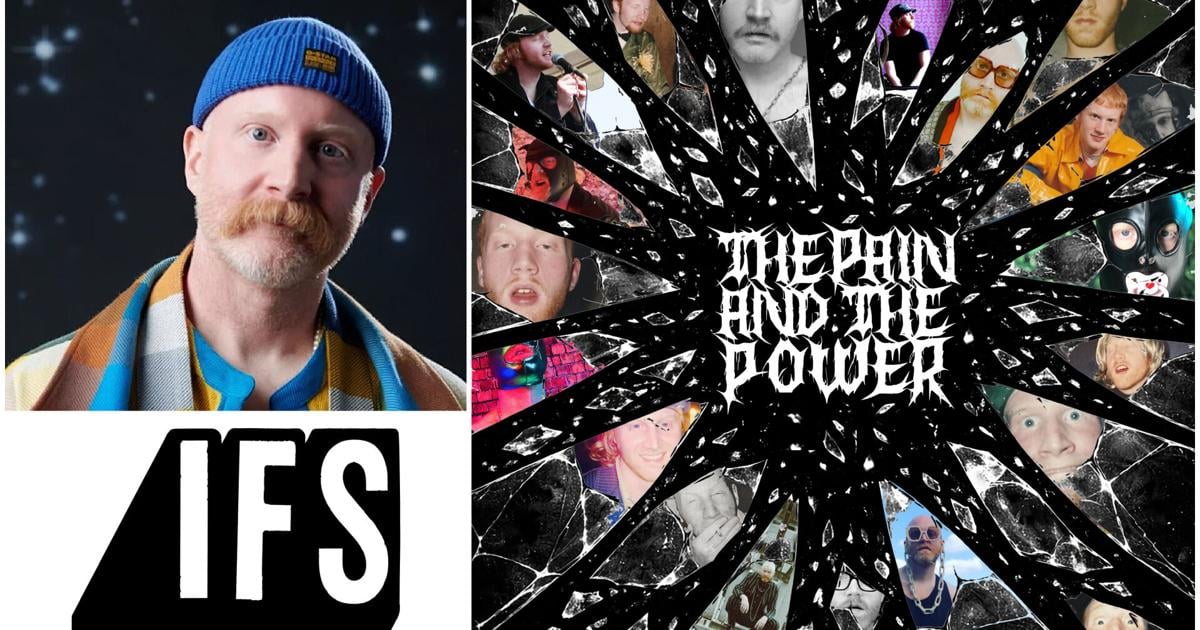
The word “survivor,” particularly when it comes to entertainers, has become such a trope. For goodness’ sake, it’s the ultimate reality/game show on the tube. And when a Real Housewife or Love Island contestant groans about being a “survivor,” you can’t reach for the remote fast enough. But then there’s Logan Lynn.
Addiction dragged his life through the dregs; he has been a guest at the White House (during the Biden administration) for his LGBTQIA+ activism; he has suffered homophobic abuse and harassment via orchestrated online attacks; and he’s been singled out with the National Council for Mental Wellbeing’s Award for Excellence for his commitment to mental health and substance use treatment. But, in our recent conversation, when I said “miracle,” it was almost as if it was a bit of a trigger word.
“Well, that’s an interesting word … a loaded word … from my childhood,” said Lynn. Indeed, he was referring to his childhood in a fundamentalist Christian home, hostile to anything that was not heterosexuality. But when I assured him that I was referring to his nearly 19 years of long-term sobriety, he nodded approvingly.
“Actually, I think it’s the right choice or word. Part of my deep gratitude is that I remained myself. I’m still me.”
The documentary “The Pain and the Power” confirms that in every way. The film, named Best Documentary at the London Independent Film Awards, will be showcased by the Idaho Film Society in Boise on Wednesday, Sept. 9, and will feature a rare in-person appearance by the man who is the centerpiece of director Cai Indermaur’s film.
There are so many ways to approach a documentary, especially with a force of nature as its centerpiece. Some artists have been known to round the edges for their own biopics. Others amplify, soften, or stretch the truth to ridiculous lengths. But “The Pain and The Power” is moment-to-moment truth. It stings. It hurts.
And that’s where the “pain” is. Your heart will break a few times in the first thirty minutes of the film, particularly when you watch a young Logan hiding his truth. You see, his queerness came early. In fact, he doesn’t remember anything before being gay.
“Yeah, even before I had language, that’s how I identified,” Lynn told me. “I just came by it with honesty.”
But the pain is also in the fact that he grew up in a home of fear. Fear of damnation. Fear of hell. Fear of … well, just about anything that was not defined by fundamentalism.
“You don’t get to pick the family you’re born into … or the church,” said Lynn. “Gay was not good in that environment.”
Naturally, I had to ask him to reflect on his upcoming visit to Idaho, knowing there are young men and women, just like the young Logan, living in their own shadows of fear.
“It’s similar to how it was when I was a kid. I think of social justice as a pendulum, swinging back and forth. Hopefully, someday we’ll meet somewhere in the middle,” he said. “But my heart is broken because of all the work we’ve done. I feel for people in Idaho. I feel for the queer and trans youth that are growing up in an environment where they’re told they’re not good enough. That they don’t belong.”
He took a breath.
“I guess my call to all of those young kids is just to hang on. There are people that love you. There are places where you belong.”
Perhaps my favorite scene in “The Pain and The Power,” wasn’t the most visceral. In fact, it’s quite light-hearted. I double dare you not to smile when it happens. Early on, we see a home movie where a young boy, grinning ear to ear, stares right into the camera.
“Hello, I’m Logan Lynn and I am going to sing for you.”
So, it’s the 1980s. Does he sing Barry Manilow or the Bee Gees? No way.
“I am going to sing Debbie Gibson and ‘I get lost in your eyes.’”
It’s adorable. And between then and now, Logan Lynn has recorded 12 studio albums, including the soundtrack of “The Pain and The Power”, 70 EPs, 42 singles, and 48 music videos.
And that’s the “power.”