
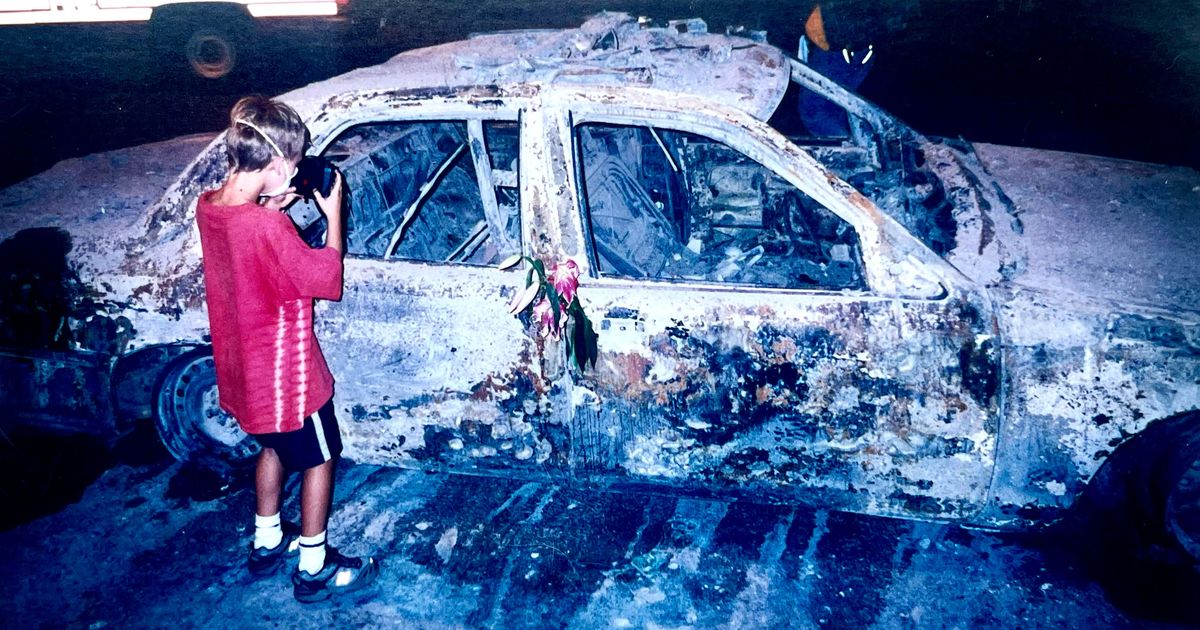
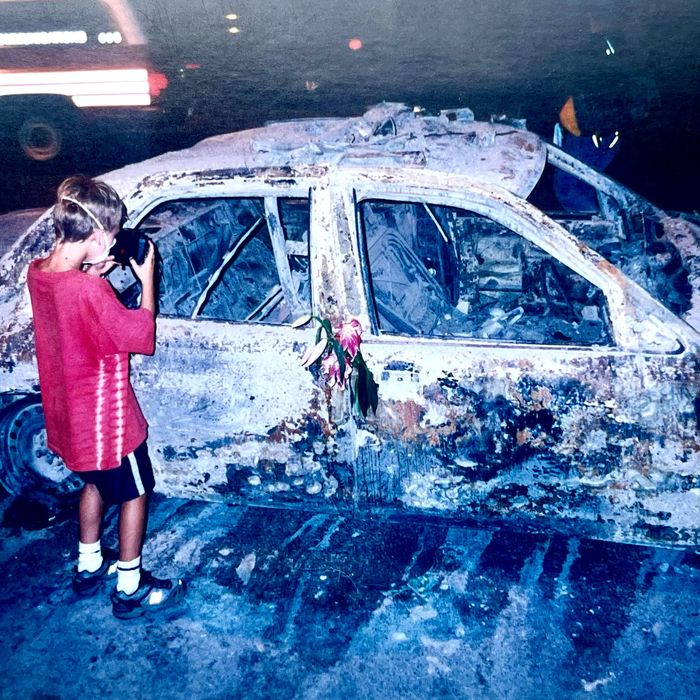
It took 18 years for me to realize I was a victim of September 11.
In 2019, I received an email from Chaka Ferguson, a former colleague from the New York City bureau of the Associated Press, asking for a favor. We had worked together at Ground Zero in the weeks and months after the Twin Towers collapsed, but I hadn’t heard from him in over a decade. Ferguson told me he’d since been diagnosed with thyroid cancer, believed it was connected to the toxic air around the site, and was planning to apply to the World Trade Center Health Program and Victim’s Compensation Fund. Could I write an affidavit swearing he had been there?
I told him I was happy to and that I was particularly sympathetic. I had also been diagnosed with thyroid cancer four years earlier. The significance of his email didn’t register with me until later.
“I don’t think it’s just a coincidence,” he wrote back to me. “That both of us had thyroid cancer after working at Ground Zero.”
Up until that moment, it had never occurred to me that my illness might have any connection to September 11. The picture most people have in their minds of a 9/11 victim is of an office worker trapped in the burning buildings or a firefighter rushing into the towers. I was neither of these. Ferguson and I had been journalists who spent several weeks reporting from the scene. We didn’t know at the time — because the government, in its rush to get the country back to work, had suggested otherwise — that the air we were breathing was poisonous. After the exchange, Ferguson recommended I speak to the law firm he was working with, and I soon learned there were tens of thousands of people like me.
There are many numbers that are inextricably linked with that terrible September morning. There are the 2,977 people who died at the World Trade Center, at the Pentagon, and in Shanksville, Pennsylvania. There are the 343 FDNY members, 23 NYPD members, and 37 Port Authority police officers who died trying to save lives. There are the 100 days that the stubborn fires burned beneath the rubble at Ground Zero. There are the more than eight months it took for workers to clear the nearly 1.8 million tons of debris at the site. The enormity of these numbers is still hard to grasp, but they remain fixed. One measure continues to grow: the number of people getting sick.
In the 25 years that have passed since that day, 154,700 people have entered the World Trade Center Health Program, which provides care and health monitoring to people who were exposed to toxic air after 9/11, many of whom have come down with illnesses linked to the attack. Of those, 9,224 have died, according to the Centers for Disease Control and Prevention. Every year, the number of sick people rises. In 2025, some 10,500 more people enrolled in the program — an all-time high.
You might expect that these deaths and illnesses were largely confined to the people who rushed in to help after the planes struck. In the early years of the health program, which launched in 2011, the majority of applicants were rescue and recovery workers: New York firefighters have by far the highest enrollment rate of any occupational group. They were people like former battalion chief Richard Alles. He had been sitting down with a pile of paperwork at Battalion 58 in Canarsie after a busy 24-hour shift when he turned on the news and saw a report about a small plane crashing into the World Trade Center. “We arrived at Ground Zero maybe about 20 minutes after the second collapse,” he said. Alles got to work organizing a search-and-rescue operation and did not stop for weeks.
A marathon runner, he started feeling the effects of the air almost immediately. “When I would come home, I would always try to go for a run,” he said. “I didn’t have the wind at all. That scared the crap out of me.” After he stopped working at the site, Alles’s breathing improved. But in 2023 he was diagnosed with prostate cancer. (A 2019 study found that an “excess incidence” of prostate cancer among 9/11 responders may be the result of “inflammatory and immune responses in prostate tissue” resulting from exposure to World Trade Center dust.) “If I’m speaking to responders, it’s always about getting checked. You don’t have to be a hypochondriac, but you’ve got to stay on top of things because, as I tell everyone, it’s not a question of if you’re going to get sick, but when.”
Of the 15,500 FDNY members who have been enrolled — which the agency believes account for nearly all its members known to have been at the site — 77 percent have developed a verified 9/11-related illness or injury, said Dr. David Prezant, the FDNY’s chief medical officer. Of those, some 4,257 have been diagnosed with cancer. More than 600 members of the department have died of suspected 9/11-related illnesses, eclipsing the 343 who were killed on September 11.
It’s now clear, though, that while the impact was more immediate for first responders like Alles, they were not the only people getting sick. By 2019, people who lived or worked near the towers had eclipsed responders among new enrollees in the program. In 2025, that group represented two-thirds of new enrollees.
These new enrollees may only be the beginning. The collapse of the towers rained down at least 70 carcinogens over miles of lower Manhattan and beyond, from dioxins, asbestos, and PCBs to lead and other heavy metals. It was one of the worst environmental disasters in American history in the heart of one of the most densely populated urban areas in the world. “You can’t collapse gigantic skyscrapers into highly respirable particulate matter and not create a huge environmental problem,” said Kimberly Flynn, director of 9/11 Environmental Action, which campaigns for greater transparency about the health impacts of the attacks. “The dust penetrated buildings. It was sucked into HVAC systems; it came through closed windows. It went everywhere.”
In people’s homes, dust was in rugs, curtains, and bedding and coated children’s toys, and residents, by and large, were left to their own devices to clean it up. Many building owners turned to immigrant laborers for help, often providing minimal protective gear, if any at all. As the fires continued to burn, more pollutants were being pumped into the air every day. Scientists eventually likened it to multiple municipal waste incinerators going around the clock.
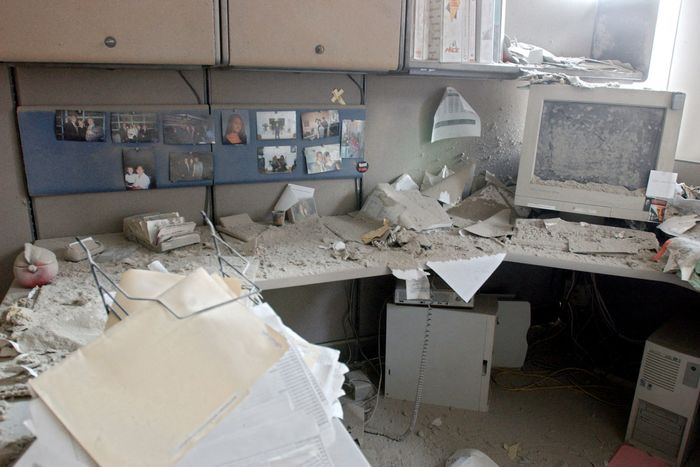
Many offices near the World Trade Center were covered in dust after the attack.
Photo: Eric Feferberg/AFP/Getty Images
According to the Centers for Disease Control and Prevention, an estimated 400,000 people were exposed to toxic contaminants. Dr. Michael Crane, the medical director of the World Trade Center Health Program Clinical Center of Excellence at Mount Sinai, told me it may be impossible to predict how large the population might ultimately become. “It was so large and diffuse,” he said. “The cloud went over Brooklyn, and it dropped on people. What that level of exposure was we really don’t have any data on.”
Studies of the program participants have found higher rates of respiratory ailments, cardiovascular disease, and cancer, but because the types and levels of exposure vary so widely over such a large area and so little data was collected early on, researchers have far from a complete picture. For instance, there were 25,000 children living or attending school in the exposure zone. “The children growing up,” Crane said, “we just don’t know what became of a lot of them.”
But what is known is harrowing. A study of people below the age of 30 on September 11, 2001, who had considerable exposure to the air at Ground Zero found that 20.1 percent had developed cancer by July 2021. “Many of the cancers documented in this cohort,” the authors wrote, “are relatively rare in the general population and especially in younger age groups.”
After the attack, government officials were eager to get the city back to work. “Given the scope of the tragedy from last week, I am glad to reassure the people of New York and Washington, D.C., that their air is safe to breathe and their water is safe to drink,” EPA administrator Christine Todd Whitman said just a week after the attack. New York City mayor Rudy Giuliani largely echoed that sentiment while urging rescue and recovery workers to wear masks. In the 25 years that have passed, it is clear that the decisions made to return the city to normal as quickly as possible have had the opposite impact, prolonging the tragedy of September 11 for many of us.
Dana Nelson was starting her fourth day of ninth grade at Stuyvesant High School just blocks from Ground Zero when the towers fell. As she and thousands of her classmates poured out of the building, emergency workers rushed in to turn it into a triage center. She saw people covered head to toe in white dust. It was less than four weeks later that Nelson returned to school. Armed National Guard members patrolled the pedestrian bridge leading to the building. Street-cleaning trucks passed through the area frequently, spraying water on the ground to keep the dust at bay. A burning smell would waft out of the pages of textbooks when she opened them.
“I remember people walking around in Hazmat suits taking air-quality measurements while we were just, like, living normal life and doing high school,” Nelson said.
In 2020, 11 months after giving birth to her son, Nelson discovered a lump in her breast. She was diagnosed with an aggressive form of breast cancer at 33. “I was a young person,” she said. “I was just starting the next phase of my life.”
She was already enrolled in the World Trade Center Health Program after struggling for years with rhinosinusitis. Her doctor performed a lumpectomy followed by more than a year of chemotherapy and radiation treatments. She’s been cancer free ever since. “I have gotten sick. My dad, who has since passed away but worked on Rector Street, got kidney cancer. My favorite high-school teacher has gotten breast cancer. My best friend has breast cancer right now and is in treatment for it. We went to high school together. Her mother-in-law was volunteering down there as a Lutheran minister and has gotten oral cancer. Another relative of mine, who worked downtown, has gotten uterine cancer,” she said. “I shouldn’t know this many people who were down there who have gotten cancer at this point.”
At the beginning of the 9/11 health program, people were mostly diagnosed with aerodigestive disorders — things like chronic rhinosinusitis (inflammation of the nasal and sinus passages) asthma, and gastroesophageal reflux disorder. “Within a year at the most, I began to notice that my children were getting chronically ill,” Mariama James, who lived in the Southbridge Towers a few blocks east of the site with her three kids, told me. “Breathing, ear infections, just over and over, like upper-respiratory issues.”
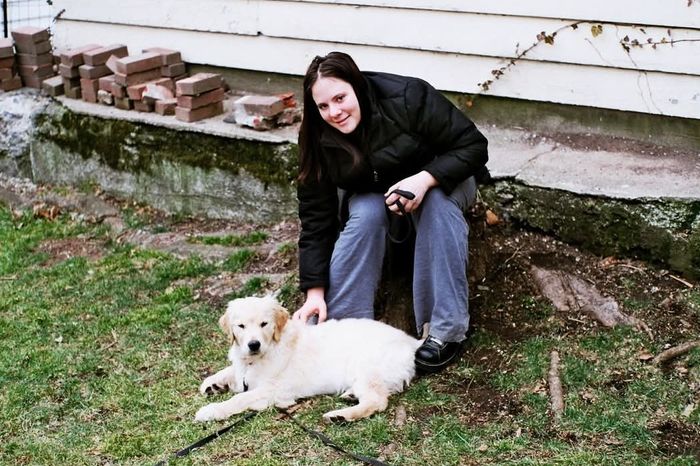
Dana Nelson went to school around the corner from the World Trade Center. She developed breast cancer at 33.
Photo: Courtesy of the subject
Cancer cases among enrollees took longer to develop. But they have since become the single most common diagnosis. Over the 12 months preceding August of this year, nearly 71 percent of the newly certified cases were cancer. “Age is the hidden force,” Crane, of Mount Sinai, told me. “It’s changing everything. The risk pool changes. The population changes.”
With more people now getting sick, the profile of the victims of 9/11 is changing. New enrollees are often those who worked, lived, or went to school in the area, not first responders. “I thought it was just the first responders that were working on the actual towers. People that were working to find the bodies and all that,” said John Mormando, who worked downtown as a commodities trader for BNP Paribas back in 2001. “I didn’t think it was just normal people like me, you know, just workers.”
Mormando had taken the day off to take care of his 2-year-old son at home in New Jersey on 9/11. When he first heard about the attacks, he figured people he knew at the New York Mercantile Exchange nearby would probably be okay. The trading floor didn’t open for another hour. Mormando later found out there had been an early meeting that day and nearly 25 of his acquaintances had died. Only six days later, he got a phone call telling him to head back to work. “I’m like, ‘Oh, God, really? We’re going back there?’ I’m looking at the news, and it still looked like a war zone,” he said.
When Mormando walked onto the trading floor the following Monday, he was struck by how clean it was. Senators Chuck Schumer and Hillary Rodham Clinton, Mayor Giuliani, and Governor George Pataki rang the opening bell. “They were thanking us for getting the markets back open. It was a great patriotic thing that I thought we were doing,” he said. “We were telling the terrorists, ‘You didn’t win.’ And it was a big rah-rah thing.”
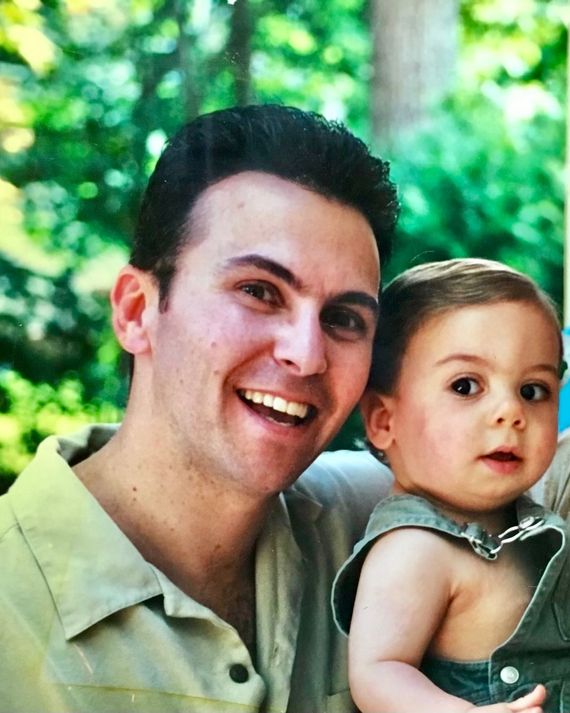
Just six days after the attack, John Mormando was asked to go back to work near the World Trade Center.
Photo: Courtesy of the subject
In early 2018, Mormando was watching TV with his wife when he felt a lump on his chest. He was eventually diagnosed with male breast cancer. Mormando had recently run the New York City Marathon; he was training for an Iron Man Triathlon. After the cancer diagnosis, he had to have a mastectomy. Chemotherapy treatments blistered his feet, rendering him unable to walk, and extensive radiation left his skin with purple-colored burns.
Initially, like me, Mormando didn’t connect his cancer with 9/11. But after learning that several former colleagues had gotten sick, he put it together. “A lot of my friends were coming down with some weird cancers. You know, stuff that you don’t normally see,” he said. “My friends were getting bladder cancers and bone cancers. These are young guys.” It was not until “years later, we find out that the EPA really wasn’t telling the truth,” Mormando said. “And now all these people were coming down with cancer. There’s no way that air was good to breathe.”
Whitman, the EPA administrator, told me the assurances she made at the time about the quality of the air around Ground Zero were “entirely based on what scientists were telling me.” But she acknowledges that it’s now clear the assessment of the data was inadequate and that scientists failed to understand the long-term health impacts. “There had been nothing like this. There was no yardstick to go by. There was no standard we could use,” she said. “No one played with the data, and I think everyone did the best they could with the information and tools we had at the time.” Still, she said she feels “sick to my stomach” every time September 11 comes around. “Always at this time of year, I feel awful because I know people blame me. But the blame lies first and foremost with the terrorists.”
Federal health officials continued to say the air was safe through December of that year. But a memo sent in October 2001 to then–Deputy Mayor Robert Harding by a lobbyist working for City Hall warned that the city could potentially be hit by tens of thousands of toxic-exposure lawsuits. It predicted that the suits would claim public-health advisories led people to “return to the area too soon.” It also suggested the city ask Congress to set up a victims’ compensation fund — similar to the one created for families of those who had died that day — to protect the city from “toxic tort claims that might arise in the next few decades.”
Giuliani, whose actions after the attack led him to be dubbed “America’s Mayor,” and who based his 2008 presidential run around the perception of his heroism in leading the city through the tragedy, has insisted he only passed on information he had received from federal officials. In May of this year, after Giuliani developed life-threatening pneumonia, a spokesperson for the former mayor said his condition had been complicated by restrictive airway disease he linked to his time spent near Ground Zero. A lawyer for Giuliani, Michael Barasch, said he planned to enroll in the World Trade Center Health Program. Giuliani didn’t respond to requests for comment.
How many people got sick because they thought the air was safe? “Had the government in October, November, December said, ‘Well, maybe we should slow down, maybe we should be more careful,’ maybe less people would have been affected,” said Benjamin Chevat, the former chief of staff for former congresswoman Carolyn Maloney, who co-sponsored the bill that established the health program in 2011. “More importantly, maybe there would have been a response to the health problem years earlier.”
I think a lot about the randomness of September 11. In talking to many survivors, responders, and people near Ground Zero it strikes me how little many of us actually have in common. Yet we are all drawn together by having passed through lower Manhattan during this one terrible moment in history.
For me, the irony was that I wasn’t even in New York that day. I was nearly 8,000 miles away on vacation in China, completely unaware of what was going on. It was not until I checked my email the following afternoon that I learned of the disaster at home. “The world trade center just blew up. I think everyone we know is okay. More later,” a friend wrote.
It took me over a week to get back to New York. The AP, where I worked as a general-assignment reporter in the New York City bureau, had made a decision early on to keep someone around the site just in case any survivors were found in the debris. I was assigned to Ground Zero for the next several weeks. No survivors were found during my shifts there, so I spent most of my time trying to talk to firefighters and other rescue workers going in and out of the site. Much of that time remains a blur to me. I filed a few minor stories and pretty much just tried to stay warm. The only thing I remember clearly was the smell from the fires.
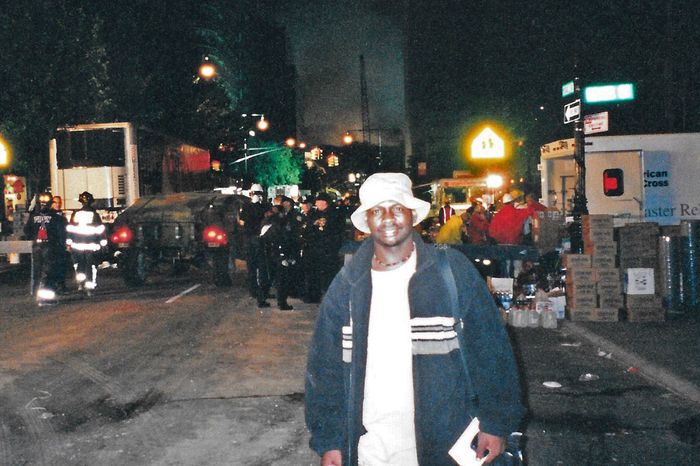
Chaka Ferguson, an Associated Press reporter who would later develop cancer, after the September 11 attacks.
Photo: Courtesy of the subject
Years later, I began experiencing occasional tightness in my throat when I swallowed. In late 2015, a scan and biopsy revealed I had a malignant nodule on the left side of my thyroid. I ended up having surgery to remove half of it. At the time, I felt lucky. Five-year survival rates for the kind of thyroid cancer I was diagnosed with are nearly 100 percent. Aside from a small scar on my neck, it was almost like it had never happened. I used to joke that if you got to choose your own cancer, this was the one you wanted.
After I realized I met the criteria to be enrolled in the program, I applied. It took 14 months, but in 2020 my case was approved. Since then, I have undergone regular health-monitoring visits and all treatment related to my cancer has been paid for by the program.
This was the hope when the World Trade Center Health Program came into being after President Barack Obama signed the James Zadroga 9/11 Health and Compensation Act into law: to provide some aid to incidental victims like me. It had taken five years to get the bill through Congress, where it met significant resistance over its cost — what ultimately passed had a price tag of $4.3 billion. “It wasn’t easy at all,” recalls Congressman Jerry Nadler, the Democrat whose district included the World Trade Center and who co-sponsored the bill. “Republicans were very opposed to it. They were opposed to any compensation to New Yorkers.”
The bill set broad contours for the health program and compensation fund. But it established geographical boundaries for the exposure zone — lower Manhattan south of Houston Street for the health program; below Canal Street for the compensation fund. The requirements are specific, but anyone who lived, worked, or went to school in the exposure zone is potentially eligible. “The process is non-adversarial. This is not a lawsuit,” said attorney Michael Barasch, whose firm, Barasch & McGarry, represents not just Giuliani but over 50,000 claimants. “If you meet the criteria, you’re in.”
Many have argued that the boundaries that were set made little sense. The dust did not suddenly stop at Canal or Houston Street. “When we drafted the bill, we had to make arbitrary decisions,” Nadler admits. “We could have said 14th Street. And what about the people in Brooklyn? The cloud didn’t stop there. So we arbitrarily chose Canal Street.” He said the decision was purely a financial calculation. “The Congressional Budget Office would tell us, ‘If you make the boundary 14th Street, it’s going to cost $10 billion. If you make it Tenth Street, it’s going to cost $5 billion. It’s too many people,” he said. “Charlie Rangel, the head of the Ways and Means Committee, said, ‘You get $4.3 billion; that’s all you’re going to get. Make it work.’”
John Feal, a retired construction worker who was injured at the site and became a prominent advocate for responders and survivors, said he believes the difficulty to secure the program stems from long-running resistance to acknowledging that mistakes had been made. “Nobody ever apologized. Nobody said, ‘We lied to you.’ Nobody ever said ‘sorry.’ But what they did was create the World Trade Center Health Program,” he said. “But like a carrot on the end of the stick they put the program on the end of the stick, and we had to go chase it for two decades.”
As time has passed, resistance to the program in Congress has faded. As part of the compromise to get the bill through, it was initially funded for just five years. When the Zadroga bill was set to expire in 2016, a bill to extend it another five years passed overwhelmingly. In 2019, an effort to reauthorize the program through 2090 passed overwhelmingly.
Funding for the program did come under assault last year, however, when President Donald Trump empowered Elon Musk to enact broad spending cuts across the government. Among the agencies Musk’s quasi-governmental initiative, the Department of Government Efficiency, targeted was the National Institute for Occupational Safety and Health, which oversees the health program. These cuts initially resulted in the dismissal of the health program’s longtime director and about 20 percent of its roughly 90-member staff. Following a bipartisan outcry, the Trump administration walk backed those cuts and announced plans to expand staffing to 120.
The program has ultimately helped a great deal of people. A 2022 study found that the mortality rate among a group of over 60,000 people who had been exposed was not markedly higher than that seen across the general population. (Though people with very high levels of exposure did seem to fare worse.) The study’s authors theorized that the comprehensive medical monitoring and health services offered by the government may have improved outcomes for enrollees.
Among the program’s 154,700 enrollees, nearly two-thirds so far have been people responding to the attacks — rescue workers, journalists, construction workers, volunteers, and cleanup crews. The program will likely grow significantly in the coming years as more people who worked or lived in the surrounding neighborhoods realize they were exposed. Crane said there are many people who haven’t connected their health issues to 9/11. So far, the program has “only succeeded in enrolling a proportion of the actual, exposed population,” he said.
Crane believes the program has also been up against a certain level of survivor’s guilt where people worry their case isn’t bad enough to qualify for care. Tony Stone, a friend I knew from growing up in the city and later went to college with, was raised in Tribeca. He woke on September 11 to the roar of a Boeing 767 about 1,000 feet above his building. He barely got out of the area ahead of the dust cloud after the towers collapsed. When he came home, his entire apartment was covered in dust. “It was like a construction site that’s done, like, a lot of sheet rocking and taping and is covered in drywall dust. That’s a lot in a 3,000-square-foot apartment,” he recalls. “That first night, I got into bed; I didn’t even wash the sheets or wash the blanket. We vacuumed ourselves and didn’t get officially cleaned until December. Then there were the fumes, you know, that noxious smell.”
It didn’t occur to him to leave. “It was my neighborhood. I loved it. I just felt like I needed to be there,” he said. “I was born and raised there.”
Five years later, shortly before he got on a plane to Japan — only his second flight since the attacks, as post-traumatic stress had left him uneasy about flying — he went to the bathroom and spotted blood in his urine. “I was just literally peeing blood and blood clots for the next 14 hours. I thought I was dying of internal bleeding and also was just totally terrified of flying, so it was just a terrible experience,” he said. When he returned to the U.S., Stone saw a urologist and was ultimately diagnosed with stage-one bladder cancer. He was 27 years old.
“I was, like, the youngest patient that doctor had ever seen,” Stone said. “I’d be in his office with all these old guys in their 60s and 70s, so he asked me, ‘Well, what have you been surrounded by? What chemicals? What kind of exposure?’ And I was like, ‘Well, 9/11.’”
The cancer was found early and had not spread, so he was able to avoid chemotherapy or radiation treatment after having surgery to remove the tumor. So far, it hasn’t returned. Still, Stone has struggled with anxiety and depression. He knows so many people who have died of cancer, and it’s hard not to wonder if they had also been unknowing victims of the attacks. A filmmaker, Stone now lives in Hudson, where he founded the Basilica Hudson art space with his wife, the musician Melissa Auf der Maur. “For a long time, I had this attitude that we survived and we were the lucky ones; what did we have to worry about?” he said. “You did take the government at face value — which is crazy.”
I feel that contradiction, too. Yes, the government never formally apologized. But they gave us this program, which has provided a great service to me and thousands of others. I don’t dwell on the choices made in those chaotic days after the attack when we all just wanted normalcy. More care should have been taken to protect people. But I still think those of us who survived the initial attack are the lucky ones. Even if we have gotten sick, most of us are still here.