
“The Rainbow stretches across the land and represents the people of our country. This Division cannot fail because America cannot fail,” Gen. Harry J. Collins told trainees of the Rainbow Division in 1943 when they were preparing to fight in World War II.
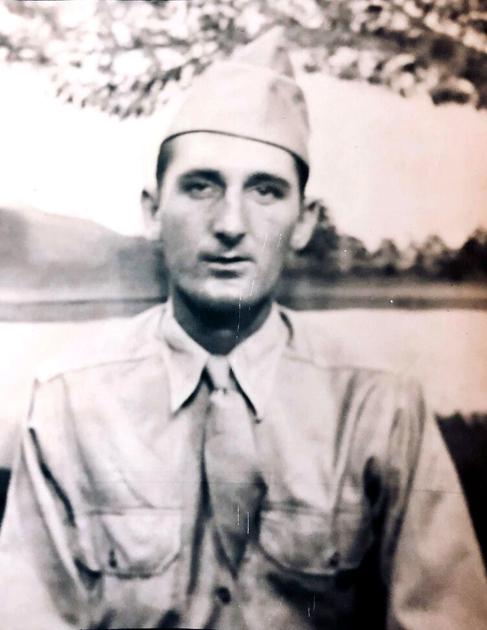
One soldier, Private First Class George “Chuck” Jahosky, would come to embody that ideal when he risked it all to courageously man a machine gun on the outskirts of Nuremberg, Germany, sustained an eye injury from enemy fire, and received a Bronze Star for his act.
Jahosky was born in a historic Queens neighborhood called Winfield, which is now part of Woodside, and lived on 44th Avenue. He was trained as a rifleman in Camp Blanding, Fla., and was deployed to Europe at age 27. Jahosky was shipped overseas as a replacement in the winter of 1944 after the vicious Battle of Hatten’s high casualties, and joined the 242nd Infantry Regiment of the 42nd Rainbow Infantry Division in France in January 1945. He served in Company A, suffered frostbite in both feet that February, and was promoted to Private First Class in March.
Jahosky’s Rainbow Infantry Division was so named by Gen. Douglas MacArthur, who, in 1917, proposed drawing National Guard units from 26 states and the District of Columbia into a single division, which he said would “stretch across the country like a rainbow.”
The Rainbow Division, which originated in World War I, was significant in World War II because it helped other divisions break the German line, fought back against Nazi Germany’s last offensive, the brutal Operation Nordwind, in January 1945, and liberated the Dachau concentration camp on April 29, 1945.
Michael Jahosky, a humanities professor at St. Petersburg College, who lives in Clearwater, Fla., was recently able to learn more about his grandfather’s service with the help of investigative war historian Erin Faith Allen, who founded Fortitude Investigative War Research, and was able to piece together George Jahosky’s story through archival records.
Jahosky told the Chronicle that one aspect of Allen’s discoveries that fascinated him was knowing “exactly what months he spent in the war. As a historian myself that gave me insight, general insight into knowing what theater of war he was in and when.
“The other thing is I didn’t know that he got frostbite in both his feet. I never knew that about him. He never talked about it.
“So it was exciting to learn what he had been through.”
George Jahovsky’s most notable act in the war, according to his grandson, was when he manned a machine gun so his fellow soldiers could move forward in their attack. Michael Jahosky recounts, “he was being fired at by sniper rifles and machine guns and he was drawing all the fire to himself to allow some of his company to move forward. This resulted in an injury that he received from an anti-tank weapon.”
George Jahosky took shrapnel to the eye that day in April. After the injury, he was sent home days before the liberation of Dachau concentration camp.
Allen noted that in the three months George Jahovsky spent on the battlefield, he “went through a lot of vicious fighting and really key battles that broke the back of the German army” including Operation Undertone, the March 1945 assault on the Siegfried line through the Hardt mountains, the ensuing capturing of German cities and the Battle of Würzburg the next month, where troops fought hand-to-hand against Germans popping out from hiding in the sewers.
In addition to uncovering the specific months Jahosky was in Europe to pinpoint which battles he fought in, Allen was also able to provide a month-by-month breakdown of his movements, which his grandson said “are very personal because it put me in the shoes of my grandfather, allowing me to see what he was doing in certain days and months of the war. It’s incredible.”
Allen points out that “it just goes to show how when families work together with historians, a very whole picture of a man’s service can emerge. And it’s a really beautiful thing when all those dots connect. He will be remembered as a full human, as a full man who went home, raised a family, dealt with the aftermath of the wound sustained in war.
“He’s not just a name on a sheet with a serial number.”
After the war, Jahosky took various jobs and went on to have 13 grandkids, all while having an injured eye for the rest of his life and some shrapnel still in his body that would show itself when scratched.
“One of his eyes was hazy,” Jahosky remembers. “I think he had a cataract in it because he had received a shrapnel injury.”
Though George Jahosky didn’t often talk about his time in war, Michael Jahosky recalls, “he never wanted to go back to Europe again after that. That definitely affected him to the point where he distrusted even going back to Europe on vacation.”
George Jahosky lived to 77 and died on Veterans Day in 1994.
In diving into his story, Allen said, she was amazed by the way that:
“This man came home after the war and he just went about his life. He went to work, raised his family, and he had a damaged eye that was visibly damaged, that still gave him trouble. He really did that for his country and for our future. And I mean, for you and me sitting here having the freedom we have, we can thank George Jahosky for that.
“And also remember that this is not just George Jahosky, this is every man and woman now who goes to war.”
As for Michael Jahovsky, he beamed with pride for his grandfather, telling the Chronicle, “I’m extremely proud. I never knew as a kid all that he did. What makes me most proud of him is what he did to protect and serve his fellow soldiers and his country. I just think it’s incredible that he risked his life for others. I think that’s the essence of love, and he never bragged about it. He never asked for recognition.”