
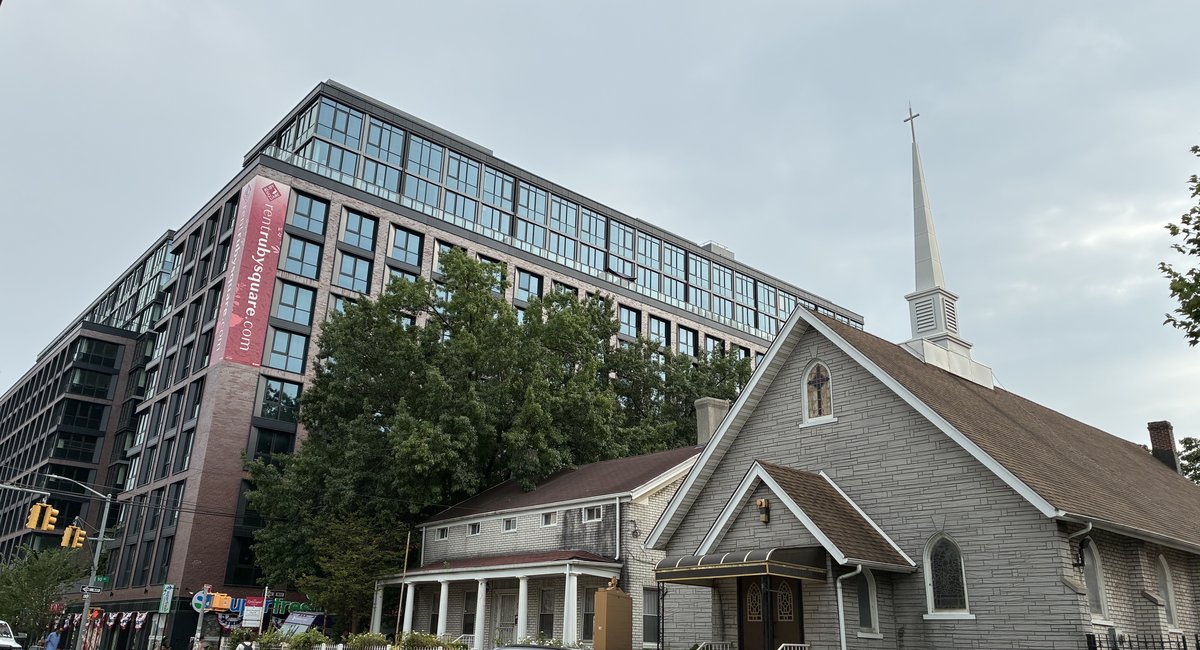
Lori Von S. Lucas learned nearly two weeks ago that her Queens’ neighborhood church, the historically Black St. Stephen’s Episcopal, will soon shut its doors after more than 120 years. The congregation will merge with that of another church about 2 miles away.
“The minute you walked through the door, you felt the calming come over you,” said Lucas, who has spent more than 25 years living in Jamaica and lives just down the block from St. Stephen’s. Lucas said she’ll miss the short Sunday commute and the church’s “beautiful stained glass.”
The doors of St. Stephen’s Episcopal Church in Jamaica, Queens.
Willow Higgins/Gothamist
The corner lot where the church sits is on the market for nearly $12 million, and the building “is certainly likely” to be demolished, said Kevin Schmitz, the real estate agent handling the sale. But the church’s transition is part of a broad wave of change sweeping the neighborhood, likely to shape the streetscape and community for years to come.
The St. Stephen’s lot is situated in the center of the Jamaica Neighborhood plan, a sprawling rezoning passed in October encompassing some 230 blocks. The plan paves the way for thousands of new housing units, including much-sought-after affordable units, as well as significant infrastructure improvements.
St. Stephen’s Episcopal Church in Jamaica, Queens.
Willow Higgins/Gothamist
At once, longtime local residents and historians are coming to grips with what the transition might cost, including the historically Black church, which has operated since 1902 and long been at the center of Black life in Jamaica.
“It’s no longer a place of quietude where you can drive in quietly, where we can have worship service quietly on a Sunday or anytime during the week,” said the Rev. Frederick Walker, who presides over St. Stephen’s. Even in the four years since his arrival, the neighborhood has changed “big time,” with the addition of new housing and an upscale grocery store. “It has become a noisy area. It has changed rapidly,” he added.
A busy street in Jamaica, Queens.
Willow Higgins/Gothamist
The neighborhood has changed so much, Walker said, it’s no longer the right fit for his congregation. St. Stephen’s is merging with St. Gabriel’s, another Episcopal church in Hollis, Queens.
“ We have been waiting for the time, and I think this is the right occasion for us to merge with another church rather than slowly die as a congregation,” Walker said.
Major development in Jamaica has been years in the making. The Jamaica Planning Initiative, which began in 2014, culminated in a $153 million investment for development, including new housing and improvements to transportation services and public spaces.
The Jamaica Neighborhood Plan approved in October upped the ante. That initiative paved the way for 12,000 new homes – including 4,000 affordable units – 2 million square feet of new space for commercial use and community groups, and more than 7,000 projected new jobs, according to the city.
The neighborhood plan increased the value of the land on which St. Stephen’s now sits, by allowing substantially more housing density, according to Schmitz, the real estate agent.
The listing for the church property requires that the lot be “delivered vacant.” The new zoning allows developers to build almost anything: residential units, office space, commercial storefronts, a school. Schmitz said it’s too early to say what will come next, though he takes note of the new apartment construction in the area.
City Council Deputy Speaker Nantasha Williams, whose district includes St. Stephen’s, shepherded the neighborhood plan to approval.
“It is certainly difficult to see a longstanding institution like this close its doors,” Williams said in a statement. “With respect to the Jamaica Neighborhood Plan, I have consistently viewed the Plan as an opportunity to guide Jamaica’s growth while making sure that the people, institutions, and history that have shaped the community are not left behind.”
For Lucas, the closing of St. Stephen’s is part of a larger pattern she has watched unfold in Jamaica. She pointed to the Jamaica Colosseum, a mall that closed in January after 40 years.
“The price of rent has gone so high that the establishments cannot afford to pay,” said Lucas, who is experiencing neighborhood change in other ways. It was only in March that she moved into an affordable apartment in a new luxury building.
As for the church, Lucas added, “I’m sorry to see it go. Really, I am.”
A church with deep roots in history
According to St. Stephen’s website, the church was founded by a community of Black Episcopalians who worked primarily as the drivers, housekeepers and servants for affluent white families in Jamaica.
The Black workers would take their employers to worship at Grace Episcopal Church, but were not welcome to worship there themselves. During those services, the workers would drive the carriages they drove to a nearby barn where, according to St. Stephen’s website, they likely prayed, read scripture and sang hymns.
Grace Episcopal Church in Jamaica.
Willow Higgins/Gothamist
That barn is where St. Stephen’s now stands. The Diocese of Long Island purchased the land in 1902 to establish a church for African Americans who were already accustomed to worshipping there, though without the benefit of an official congregation.
Maureen Grey, a Queens historian, said she is worried that this history is not being preserved, but also that community members don’t know about it at all.
“There’s a lack of awareness of the importance of this church in this neighborhood,” Grey said.
Just blocks away from St. Stephen’s is a community that was formerly known as The Green. In the 1830s, after the abolition of slavery in New York, a residential community of Blacks, some of them freed enslaved people, put down roots in the area, according to Grey and other research. Black people owned the land itself, which Grey noted was a rarity at the time.
The Green was one of the city’s oldest African American communities. Grey also has a hunch that it could have been a stop on the Underground Railroad, but says that may never be known with any certainty.
The Black community dwindled there around 1930, when they lost ownership of the land, according to Grey. Part of that land is now occupied by a large waste management service. St. Stephen’s, Grey said, is a fleeting marker of Black history in the area.
The waste management service where The Green used to be.
Willow Higgins/Gothamist
“With the pending sale and potential demolition of St. Stephen’s Episcopal Church, the last symbol of the Queens’ history of Black Civil Rights, the Emancipation, the Underground Railroad, economic independence, and existence of a Black Community will be forgotten,” Grey said in a statement.
Preserving important history
“We try our best to stay in the limelight historically speaking,” said Jason D. Antos, the Queens Borough Historian. “But there is a tremendous lacking of landmarking in the borough of Queens.” Even so, he said, landmarked buildings get torn down “under the cover of darkness.”
Antos said that churches are often the last buildings to go in a changing neighborhood.
“Once the church leaves, it takes a part of the identity of the neighborhood with it,” he said.
Williams, the council member, said that she understands the concerns about preserving Black history and community in Jamaica. But she added, “growth and preservation do not have to be mutually exclusive.”
“As Jamaica continues to experience new development and investment, there must also be an intentional effort to document, recognize, and preserve the people, places, and stories that have made Jamaica what it is today, particularly its rich Black history,” Williams said in a statement.
Confronting change
Lucas, who attends the church, uses a walker to get around. She said she plans to follow the St. Stephen’s congregation as it merges with St. Gabriel’s, so long as her transportation service will take her there.
And Walker, the reverend, says he has spent months consoling and counseling church members upset by the move. Most are coming along, he said, and he, too, is ready for what’s next.
The priest said he grew up in Liberia and spent many years as a refugee, running from violence. St. Stephen’s is his sixth parish in the United States.
“ That’s how I’m able to talk to the congregation in the midst of departure from what they love, and what they do, and all that they have done here,” Walker said. “And I always share my own story with them.”
He added, “ It’s a hard thing. I get it.”
St. Stephen’s will be deconsecrated this Sunday, during its final service.