
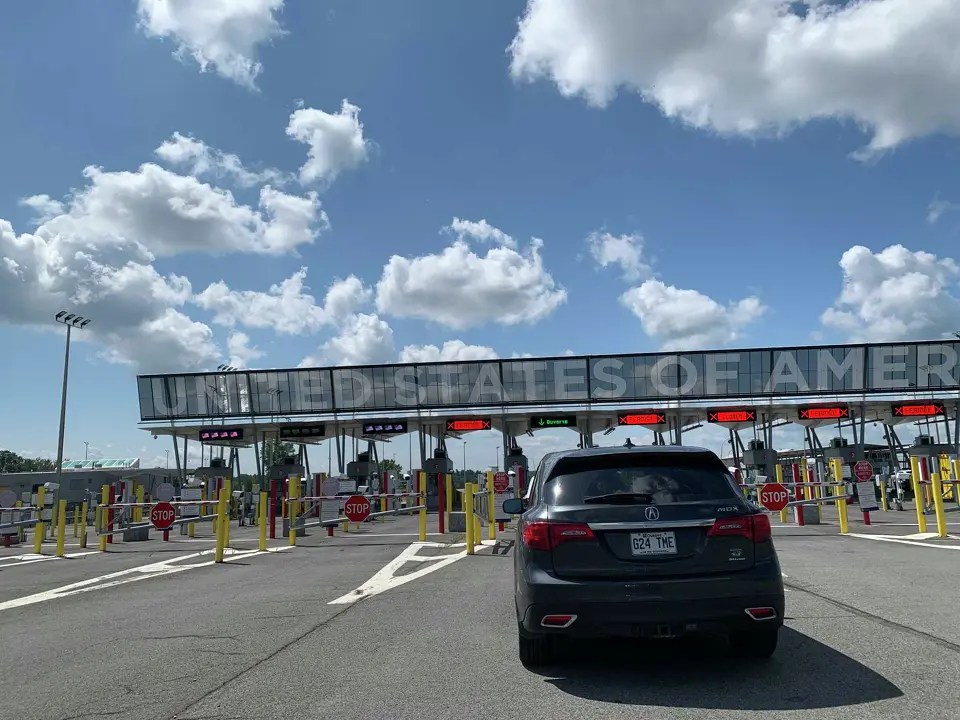
Business organizations on both sides of the U.S.-Canada border are scrambling to try to convince their respective governments that their ongoing trade war threatens to bring far more harm than good.
The two countries have historically shared strong ties that included free trade agreements, freedom of movement between the world’s longest land border and a longstanding military alliance. But that close relationship has been tested since President Donald J. Trump assumed office for his second term and has sought to use aggressive tariffs to maximize U.S. leverage in trade negotiations.
Under the Trump administration, the U.S. has viewed Canada less as a unique partner and more like an adversary, with Canadians taking strong offense at the president’s rhetoric attacking the country’s sovereignty. The already-fraught relationship further diminished in recent weeks as a prospective trade deal between the two sides instead escalated into a trade war, with the U.S. imposing a 50% tariff on $27.6 billion worth of Canadian goods and Canada vowing to match the tariffs dollar for dollar.
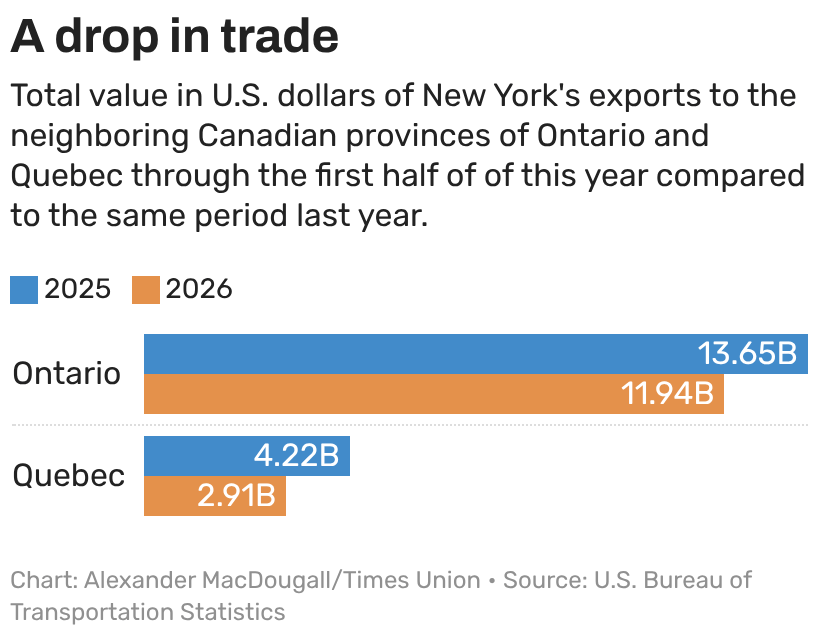
The increase in trade tensions bears a negative outlook for New York, which shares 445 miles of border with Canada and already has seen a diminishing exchange of goods. Exports from New York into the provinces of Ontario and Quebec dropped through the first half of this year compared to the same period in 2025, with trade down 12.6% with Ontario and 31% with Quebec, according to the U.S. Bureau of Transportation Statistics.
Tariffs criticized
Speaking to reporters on Aug. 25 in Albany, Gov. Kathy Hochul sharply criticized the new tariffs and pledged to do “everything I can in my power” to help state residents impacted by them.
“This is forced on the American people to deal with this new chapter in insanity of going to war with Canada,” Hochul said. “To insult their sovereignty in a way that is probably going to take a long time for that wound to heal, we will continue suffering.”
Bruce Blakeman, Hochul’s Republican opponent in the upcoming gubernatorial election, expressed more recalcitrance to address the issue directly when asked about the tariffs the following day in an interview on “Capital Tonight.”
“I’m not going to talk about federal issues,” said Blakeman, who has been endorsed by Trump. “I’m going to talk about the things that I can change.”
Economic uncertainty ‘on steroids’
The economic pain might be felt more acutely in New York’s North Country, which is nestled along much of the state’s land border with Canada.
Businesses and tourist attractions in the region rely on Canadian visitors, and areas like Plattsburgh are closer geographically and economically to Montreal than to New York City. Dairy products, including milk, cheese and whey, a key industry in the region, are included in the new tariffs issued by Canada.
Garry Douglas, CEO of the North Country Chamber of Commerce, said the biggest impact the trade war escalation would have on the region is something that can’t be measured by statistics — that of economic uncertainty, with businesses in the region unlikely to make major decisions in the face of the trade war.
“Our country, particularly border regions, are wracked by postponements of things that would have been happening otherwise: expansions, investments, new equipment, new hirings,” Douglas said. “What we’ve done is put uncertainty on steroids.”
Douglas said the problem also extends beyond a mere trade dispute between the two governments. Trump’s insulting rhetoric toward the United States’ northern neighbor, such as remarks about wanting to make Canada the 51st state and a recent executive order to rename Lake Ontario as “Lake America,” have turned many Canadians off to the idea of visiting the U.S., including New York.
“These are direct attacks in the viewpoint of the Canadian public, on their nationality, their status as a people, so… they’re naturally very angry and feeling very betrayed,” Douglas said. “We have unnecessarily hurt a friend, and we need to heal that relationship.”
Hurt on both sides
On the other side of the border, Canadian businesses with strong ties to New York are also expected to feel the reverberations of the trade war. In the province of Quebec, industries including aerospace, automobiles and microprocessors often send products back and forth over the border before their final assembly and commercialization.
“It’s hurting our economies on both sides,” said Veronique Proulx, president and CEO of Quebec’s provincial chamber of commerce. “For businesses on both sides of the border, this isn’t to their benefit.”
Proulx said that exports from Quebec into the U.S. this year are down more than 40% from last year. The drop was led by heavy tariffs on one of Quebec’s main exports, aluminum, an essential raw material used in military production. Proulx noted that the drop in importing aluminum from Canada did not result in more domestic production of the material in the U.S.
“The U.S. isn’t producing more aluminum; it’s getting it from countries that aren’t natural allies,” Proulx said. “It’s not the policies that were put in place for the tariffs. We understand the will for the U.S. to want to source back more production, but it’s not sourcing back; it’s substitution.”
Political implications
The issue of tariffs and the U.S. relationship with Canada is likely to play a role in the upcoming election in New York’s 21st Congressional District, which includes the North Country. Republican candidate Anthony Constantino has supported Trump’s tariffs, while Democrat Blake Gendebien has opposed them and said he supports a more equitable deal between the two countries.
In a lengthy social media post on Monday, Constantino defended Trump’s policies with Canada, while also defending the president’s desire to rename Lake Ontario as “marketing genius.”
“President Trump showed strength in negotiations with Canada by playing a card he had available to play,” Constantino wrote. “The smart move, when negotiating with another country, is to unify and show strength.”
Gendebien also took to social media to criticize the escalation of tariffs in a series of posts last week.
“Up here in the North Country, Canada isn’t some distant trading partner; they’re our neighbors and customers,” Gendebien wrote. “Washington treats this relationship like a bargaining chip.”
Tourism tanks
Between 2024 and 2025, border crossings from Canada into New York saw a decline of more than 3 million people traveling in personal vehicles, or a 21% decrease, according to the U.S. Bureau of Transportation Statistics. That decline continued at the start of 2026 but began to tick back upward beginning in April. But with tensions flaring up again, Douglas said he expects that upward trend to cease.
“We wholly anticipate a reversal of those gains and probably returning back to levels that we saw in 2025,” he said.
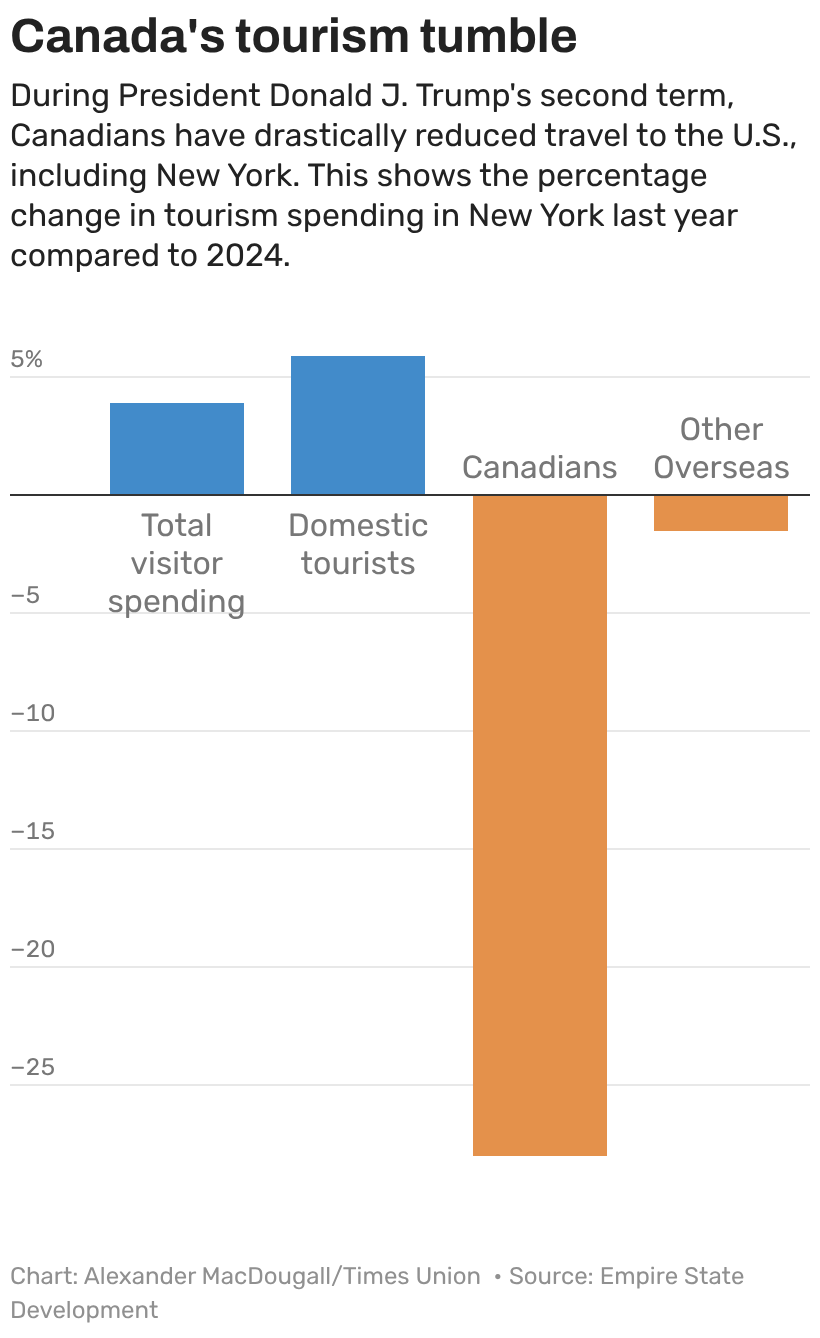
The decline of visitors from Canada has had a noticeable impact on New York’s tourism industry. According to a report by Empire State Development, visitor spending by Canadians in 2025 declined 28%, or about $480 million, from the previous year. Total out-of-state spending from domestic and overseas visitors still increased from 2024, but at a lower rate than in previous years, part of a trend of diminishing returns from the past five years.
“Growth was driven solely by the domestic market, as international arrivals fell 6.3%, a result of a sharp decline in Canadian visitors,” the report states.
Hope for an end
Douglas said he had met separately with both Constantino and Gendebien to brief them on the importance of the relationship between the U.S. and Canada on the district’s economy, and that both had committed to traveling to Ottawa and Montreal with him should they win the election.
“It’s certainly a major issue,” Douglas said regarding the tariffs’ impact on the congressional race. “It’s something that has very shallow, very little support in our region of the state, which understands the damage that’s being done and the mistake that’s being made.”
Proulx also said she was working with chambers of commerce on both sides of the border to try to bring a unified message to end the trade war.
“Our governments need to find a way to come back to the table and find a solution that will be beneficial for our companies on both sides of the border,” Proulx said.