
This column originally appeared in On The Way, a weekly newsletter covering everything you need to know about NYC-area transportation.
Sign up to get the full version, which includes answers to reader questions, trivia, service changes and more, in your inbox every Thursday.
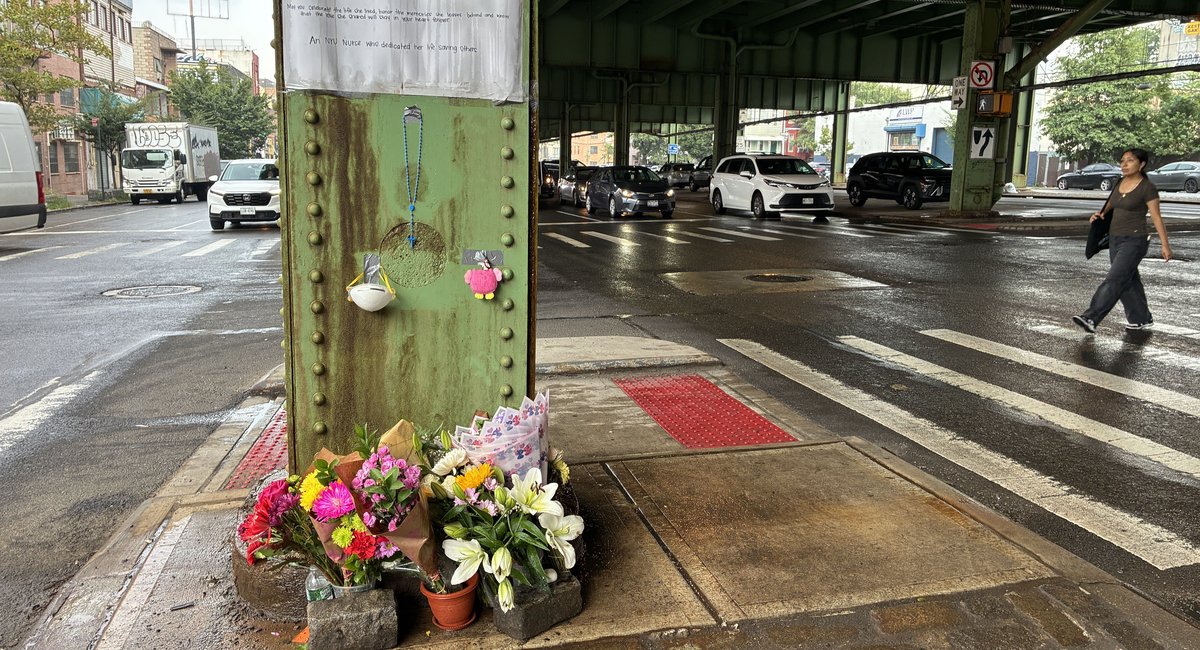
Seventeen people have died in crashes over the last decade along a notorious stretch of Third Avenue in Sunset Park, Brooklyn, where the Brooklyn-Queens Expressway looms overhead.
The latest was Jiayi Zheng, a 28-year-old nurse who had just clocked out of her shift at NYU Langone Hospital-Brooklyn on Saturday when a driver slammed into her as she crossed the avenue at 55th Street. NYPD officials said they have not found the killer, and the crash remains under investigation.
Meaza Temesgen, an assistant nurse manager at NYU Langone, said she worked closely with Zheng. She was fuming over the city’s failure to implement any changes to Third Avenue despite the danger.
Temesgen noted that another nurse at the hospital on the Sunset Park waterfront, Clara Kang, 31, was killed by a motorcyclist in 2020 while riding her bicycle home after an overnight shift.
“I feel like nothing has changed. We don’t want to wait for another nurse or another person, anyone who’s walking around here to have the same fate as my nurse, Jiayi, and also Clara,” she said.
The eight lanes of traffic on Third Avenue where Zheng was killed forces pedestrians to hurry across the roadway. Residents have been calling for changes for years.
“ It’s dangerous, especially since the lights don’t last that long for walking,” said Amanda Ferndandez, 14, who rushed Tuesday across the intersection where Zheng was killed.
“I actually saw this one girl almost got hit by a car. People just drive however they want.”
City officials reduced the speed limit on Third Avenue to 25 mph in 2020, after Kang’s death. In 2023, former Mayor Eric Adams pitched a redesign for the roadway that he later walked back.
State Senator Andrew Gounardes, whose district includes the part of Third Avenue in Sunset Park, said that the community has been “crying out for help.”
“[The Adams administration] just ghosted the neighborhood and here we are now left with the consequences, another dead pedestrian because of reckless speeding that we know we can fix,” Gounardes said.
The 17 people killed in crashes on Third Avenue since 2016 include four bicyclists, seven pedestrians, three motorists and three motorcycle or moped drivers — averaging more than one death a year. The tally includes two elderly pedestrians killed by a hit-and-run driver last year just three blocks away from where Zheng was killed.
The transportation department under Adams presented a “road diet” to the local community board that featured three different plans, including one that would have reduced the number of traffic lanes on Third Avenue, added protected bicycle lanes and redesigned intersections for better visibility. Gounardes said he’s in touch with the Mamdani administration to see how they can revive a version of the proposal.
In a statement, transportation department spokesperson Vincent Barone said they plan on sharing a design plan with the local community board soon, but could not offer a specific timeline.
NYC transportation news this week
A Citi Bike device that makes you feel the disparity in rent-burdened areas. Justin Blinder, 41, built a device he calls “Ground Truth” that attaches to the fork of a Citi Bike and is outfitted with a GPS locator along with a card loaded with census data detailing where people have the hardest time paying their rent.
Subway fans pay over $2K for old MetroCard vending machines. A select group of those transit aficionados gathered at a warehouse in Queens after they were notified they’d won one of more than 60 MetroCard vending machines the MTA sold at an official auction.
NJ Transit lost nearly $4M on World Cup service. According to a report by the agency’s CFO, NJ Transit lost about 7 cents for every dollar spent on the service. But it also notes the agency typically loses about 85 cents on the dollar when serving events at MetLife Stadium, making the World Cup games a win by comparison.
Inwood locals are tired of street racing. A high-speed early morning crash earlier this month was the latest in a string of dangerous crashes in the Upper Manhattan neighborhood.
Rideshare program for domestic violence survivors gets more funding. The HOPE Rides initiative will receive $80,000 in new funding to help more domestic violence survivors in New York City.
Listen to us talk about all this! Download our app and tune in to “All Things Considered” at 4:50 p.m. on Thursdays — and watch some of our recent work on YouTube.
Curious Commuter
Have a question for us? Use this form to submit yours and we may answer it in a future newsletter!
Question from Murray in Brooklyn
Are there any plans to install additional countdown clocks at subway stations where they can’t be seen from the entire platform?
Answer
The MTA has expanded the ways in which it shares train arrival information both inside and out of subway stations. We think of traditional countdown clocks that hang from platform ceilings, often two on each end. But the MTA said in recent years they’ve begun featuring train times in new formats. According to an MTA spokesperson, there are 4,000 “customer info centers” on station platforms and mezzanines, which show advertisements and arrival times. There’s also 500 “sidewalk screens” at subway station entrances. Riders can also use the MTA app to get live train time arrival information on their phones.