
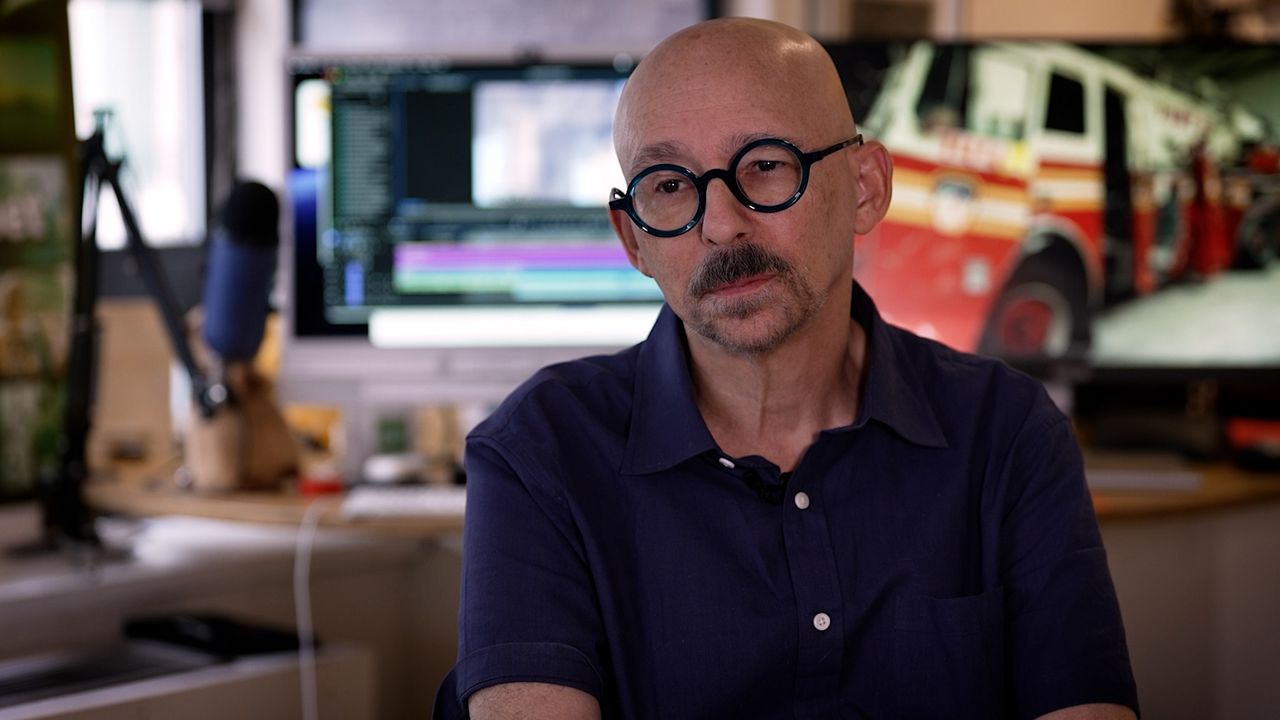
Steven Rosenbaum knew his day was changing as soon as he saw United Airlines Flight 175 hit the south tower of the World Trade Center.
He already had several documentary crews with him in his office on Fifth Avenue. Rosenbaum and his wife had co-founded the media company Broadcast News Network.
They were preparing to start recording a series for Animal Planet.
“We were in the room, in the conference room, watching a large TV when the second plane hit,” he said. “And from that second, everything changed.”
“We wanted to be there, and one person who was leaving turned to me and said, ‘Well, what do we shoot?’ I said, you’ll all be down there, there’ll be lots of news crews,” he recalled saying. “They’ll all be pointing at the buildings. Just see where the news crews are pointing. And point in the opposite direction.”
He said the goal was to see how the day was affecting the city. It turned into what Rosenbaum said is the largest archive of 9/11-related video.
Some of his crews shot video through the night. When they came back in the morning, they asked what was next.
Rosenbaum said he knew the Animal Planet project was not going to happen.
“So I said, ‘We’re going to keep shooting,’” he remembered. “And someone said, ‘Well, for how long?’ And I said, ‘Seven days.’”
Every day, they would come up with a list of potential stories to showcase. Some may have been traditionally newsworthy. Others were not.
Rosenbaum showed NY1 a sequence of a video showing someone who ran a fruit stand in lower Manhattan. He was taking each piece of fruit, one by one, and trying to remove the dust from the World Trade Center.
His crews shot the massive volunteer efforts underway at the Javits Center, where people brought food for the rescue workers.
They went to the Upper East Side to a mosque, where Muslims were raising money for the victims of the terrorist attacks.
“We’re trying to, in fact, also with these donations, show that we are also Americans. And we are just as much involved in this tragedy as everybody else,” one woman shared at the time. “And we are doing our part to help the families and victims who have been involved in this great tragedy.”
Rosenbaum wanted more footage. He decided to place an ad in the Village Voice asking anyone with footage from 9/11 or the immediate aftermath to contact him.
“Our phone went bananas,” he recalled. “So that became our job for a month and a half was, footage would come in, we’d watch it, we’d say, we absolutely want this.”
That is how his film, “7 Days in September,” was born.
“I knew that I wanted historians to be able to look at the film in 25 years and know that not only was it interesting and complicated, but it was also historically accurate, and that every moment of footage you saw that was dated Thursday was from Thursday,” he said.
In all, Rosenbaum and his wife’s collection of 9/11 footage — up through about the first week — is 700 hours.
“If you talk to people in the archive business, what they’ll tell you is things that aren’t cataloged and archived become invisible to history because there’s no way to see it,” he said.
They didn’t anticipate being archivists, but Rosenbaum said no one has stepped in who has that background.
“What do you do when you have the world’s largest archive of 9/11 video? I mean, you don’t throw it away,” he said. “You don’t leave it out in the street and hope somebody picks it up like a refrigerator.”
He said that’s why they started having conversations with the New York Public Library about the library taking the entire collection. Last year, the library announced Rosenbaum was donating it all.
“We knew it needed to be somewhere. We knew that it needed to be stored somewhere with public access,” he said.
He believes long-term, that’s what is best for the footage he has accumulated.
“We’re stewards of the material, but we’re not owners of it. So at the end of the day, we think there are scholars who will say, I want to know about how X, Y or Z community was treated on 9/11, and they’ll need to sit and look at hundreds of hours of material, and they’ll discover something we didn’t see,” he said.
He said he believes that will happen, and is far more likely to occur at the public library.
“If you talk to historians, they will tell you everything up to 25 years is current events, and everything after 25 years is history,” he said.
“So really, we’re at the moment where history really begins,” he added. “And the footage is part of that. The films are part of that.”