
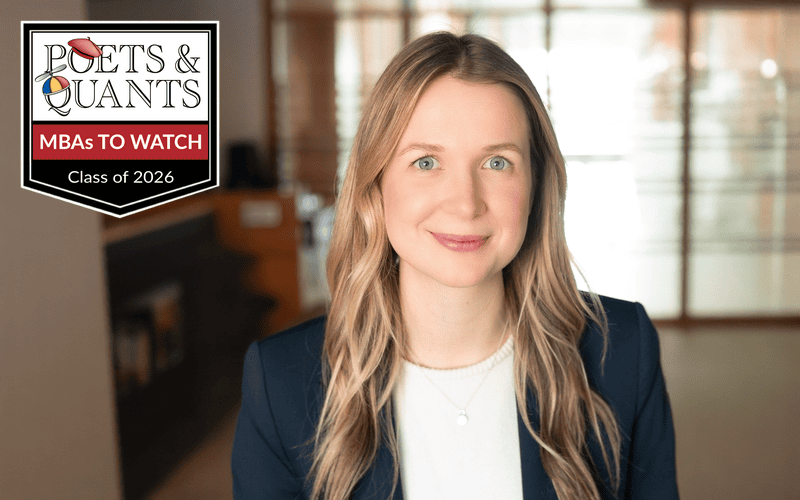
“Strategic, curious, and challenge-driven; I navigate work and life with heart, hustle, and purpose.”
Hometown: Montréal, Québec, Canada
Fun fact about yourself: I ski in challenging terrain and I’m avalanche-trained; I like to be ready for any conditions.
Undergraduate School and Degree:
Bachelor of Commerce, HEC, University of Montréal
Law Certificate, University of Montréal
Where was the last place you worked before enrolling in business school? I was Director of Partnership Development at Oak View Group Canada, a global leader in live experience venue development, management, and hospitality.
Where did you intern during the summer of 2025? N/A – Smith’s Full-time MBA program continues through the Summer term.
Where will you be working after graduation? Bain & Company as a Consultant
Community Work and Leadership Roles in Business School: I was a Forté Fellow and Dean’s Scholar.
Which academic or extracurricular achievement are you most proud of during business school? Smith’s team-based learning model shaped my MBA experience in fundamental ways. I was part of a team of seven who approached every project wholeheartedly and with genuine care for one another’s growth. We worked hard, stayed closely aligned, disagreed openly, and made space for fun. Our team was recognized as Team of the Year, a distinction voted on by our peers and program staff based on the team’s performance throughout the year. What makes me most proud is not the recognition itself, but the standard we set for how our team could perform at a high level while remaining deeply respectful, supportive, and genuinely enjoyable to be a part.
What achievement are you most proud of in your professional career? Before my MBA, I worked in partnerships in Sports and Entertainment, including for CH Group — owner of the Montréal Canadiens Hockey Team and major cultural properties like the Osheaga Music Festival and the International Montréal Jazz Festival. After the pandemic, with sponsorships largely on hold, I was part of the team tasked with rebuilding sponsorship revenues for the cultural properties the group owned. Doing so in such a risk-averse market required persistence, creative deal structuring, and disciplined pipeline management. I’m proud of this work because helping artists reconnect with the public also generated amazing business results.
Why did you choose this business school? First, Smith is one of the top business schools in Canada and is consistently recognized for having a very strong alumni network. I was intentionally seeking an environment where relationships and collaboration matter long after graduation.
Second, the intensive one-year format meant being fully all-in. That level of commitment resonated with me, and it also shaped the type of cohort the program attracts — classmates who are focused, engaged, and eager to make the most of a demanding year together.
Finally, Smith’s team-based learning model stood out. The program is not just about working in teams, but about learning how to navigate different perspectives and work through challenges. Now that I have completed the program, I can confidently say that learning alongside talented and diverse classmates has been incredibly enriching. Their perspectives have been just as impactful as the coursework itself.
Who was your favorite MBA professor? My favorite MBA professor was Jim Hamilton, who taught both Marketing Fundamentals and the Sales Management elective. While his engaging teaching style, deep industry experience, and real-world examples made his classes compelling, what truly set him apart was the passion and energy he brought to every session.
What was your favorite course as an MBA? I deeply enjoyed my Consumer–Focused Marketing class, taught by Monica Labarge, for the way it shaped my definition of true customer centricity. The course taught us what to analyze in consumer behavior, and how to dive deep and extract actionable insights. I loved how it bridged consumer research with strategic marketing decisions.
What was your favorite MBA event or tradition at your business school? While there were many memorable events during my MBA, my favorite tradition was Queen’s Homecoming. Being on campus during Homecoming, attending celebrations with my classmates and seeing alumni from every generation was a tangible reminder of the strength and longevity of the Smith and Queen’s network.
Looking back over your MBA experience, what is the one thing you’d do differently and why? I would have taken even more courses outside my comfort zone. For me, that would mean even more finance classes. The MBA, especially during the electives period, offers a rare opportunity to explore new disciplines in a supportive and very safe environment. It’s one of the few moments in a career to build knowledge in unfamiliar areas without immediate performance pressure, and I would have leaned into that even more.
What was the most impactful case study you had in business school and what was the biggest lesson you learned from it? An impactful case was “Medlee: In Pursuit of a Healthy Joint Venture,” a Harvard Business School case we completed as a role-play in our Negotiations course. The exercise simulated a cross-border joint venture discussion, requiring each party to reconcile strategic objectives shaped by different cultural and organizational contexts.
Coming from a background negotiating largely within culturally similar environments, the case sharpened my awareness of how assumptions around pace, hierarchy, and relationship-building influence outcomes. It reinforced the importance of calibrating style and framing to align counterparts without diluting substance.
What did you love most about your business school’s town? What I loved most about Kingston was how it made connection simple. Kingston is a small tow. With Smith and Queen’s at its heart, the university’s spirit is everywhere: at the cafés, in the downtown core, and on the pickleball courts. The town feels both intimate and profoundly vibrant.
What business leader do you admire most? My mother. She earned a bachelor’s degree from an art school and started in advertising as a set painter. Through her dedication to her craft, the respect she had for the talent of the directors she worked with, and her relentless focus, she worked her way up and became president and owner of the firm, driving revenues, forging alliances, and discovering and mentoring new talent. She is both a model and a mentor.
What is one way that your business school has integrated AI into your programming? What insights did you gain from using AI? As part of our Strategy class, AI was integrated into coursework through an interactive AI model assuming the role of a company’s CEO or senior executive. Rather than receiving information through a traditional case, we had to uncover it by asking the AI persona the right questions. The experience reinforced that effective leadership is often less about having immediate answers and more about framing the right questions — a lesson I continue to carry with me into boardroom-style discussions.
Which MBA classmate do you most admire? I learned from every classmate I worked with at Smith, but one stands out in particular. I most admire my classmate, teammate, and close friend Ali ten Hove. As an Olympian and former professional athlete, she brings exceptional discipline, perspective, and a team-oriented mindset to everything she does. Working alongside her, I was consistently reminded that sustained excellence depends as much on mindset as on skill. Academically, her curiosity and engagement were contagious — her contributions in class and in hallway conversations added immense value for both me and the cohort.
What are the top two items on your professional bucket list? First, I want to make an impact internationally — taking on global projects, traveling, and learning from diverse approaches to business. Second, coming from the sports and entertainment industry and moving into strategy consulting, I hope to merge my two worlds: leveraging my background to consult on high-profile strategy projects that shape how organizations deliver unforgettable experiences at scale.
What made Jeanne such an invaluable addition to the Class of 2026?
“Great leaders shape their environments. Students who invest in actively studying, practicing and doing the hard work of leading are critical to the transformation which is taking place in the marketplace today. Leading is tough work, yet Jeanne Labelle is one of those leaders who does it with a smile.
Jeanne brought that powerful mix of preparedness and curiosity to every class. I always knew that when the discussion got supercharged, Jeanne’s hand would be among the first to pop up. Her questions were always on point, thoughtful and forced us to think more critically about the topic. Like all great leaders, Jeanne had this wonderful skill of using structured, forward-moving questions to drive reflection and action. She made learning in a community so much richer.
Outside of the classroom, Jeanne was engagingly witty and had a joie de vivre that energized the people around her. She knew that doses of fun coupled with caring and hard work were keys to team success, competitions, club events, and ensuring that you leave the place better. Jeanne actively shaped the Smith environment and had an outsized positive impact on those around her.
It is so very fitting that as Jeanne moves on from her time at Smith, she is taking on a leadership role in partnerships. My bet is that Jeanne is going to do for a lot of companies what she did for us at Smith.”
Jim Hamilton
Lecturer & Distinguished Teaching Fellow of Sales Management
© Copyright 2026 Poets & Quants. All rights reserved. This article may not be republished, rewritten or otherwise distributed without written permission. To reprint or license this article or any content from Poets & Quants, please submit your request HERE.