
For the past nine years, some of New Jersey’s most acclaimed craft spirits have been distilled in Newark’s industrial fringe.
Gil Spaier and his team at All Points West Distillery make award-winning whiskey, gin, rum and vodka out of a small space in the city’s Ironbound neighborhood. It’s an operation that Spaier takes great pride in, holding his business up as the current torchbearer in Newark’s centuries-long legacy as an alcohol production hub.
But that will all soon end as All Points West plans to relocate its operation out of Brick City and out of New Jersey entirely. The distillery’s next chapter will be set in Kingston, New York, bringing another tourist attraction to the Hudson Valley town.
Craft distillers in New Jersey say state regulations are holding back their businesses, limiting their adaptability at a time when the industry faces serious headwinds nationally. Their wish list includes being able to ship spirits directly to customers and to serve food in their tasting rooms – things that other states allow. They’ve spent years making their case to state leaders, but calls for reforms have yielded few results.
Spaier and his business partner Kate Zuckerman say New Jersey’s regulatory landscape has simply become untenable, and they believe moving to New York is the best plan for the business.
Spaier, a Long Island native who lived in Newark for 20 years before recently moving away, opened All Points West in 2017.
Today All Points West holds one of 18 full licenses in the state, according to the Division of Alcoholic Beverage Control. Another 19 distilleries are operating under temporary permits, mostly issued after 2019. Allison Inserro, an ABC spokesperson, said the state is now working to convert the temporary permits into full licenses.
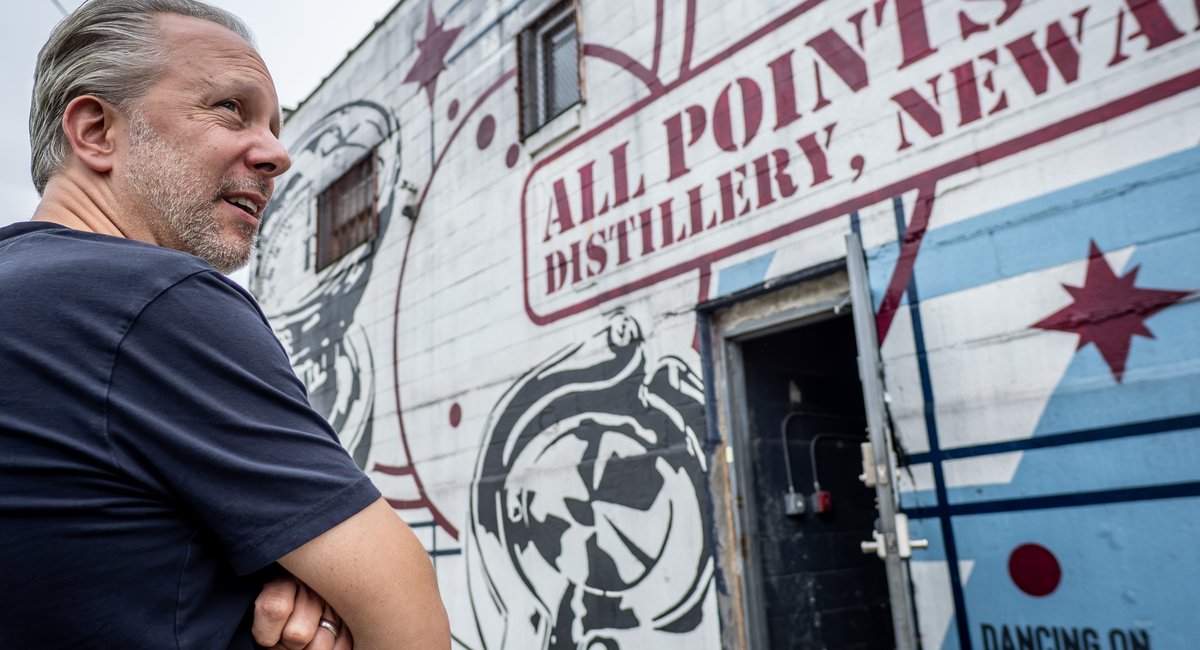
All Points West is housed inside a single story cinderblock building, in the shadow of the railroad viaduct that carries trains in and out of Newark. NJ Transit and Amtrak passengers passing by can easily spot the vivid mural painted on the distillery.
Inside, most of the space is dedicated to a pair of stills making the spirits, and the barrels in which those spirits are stored for aging. A small tasting room can serve about 20 people.
“ When we started we looked at industry averages, and craft distilleries were doing 20% to 30% of their revenue through the tasting room. The tasting room was not the main revenue driver. The tasting room was how to create awareness, how to create an experience, how to get access to customers,” Spaier said. “That’s what we aimed for, and that’s what we achieved.”
That remains the model today. All Points West offers tours by reservation on weekends, with 16 spots available on each tour. Spaier said they regularly sellout, with customers coming from across New Jersey, New York and Pennsylvania.
Gil Spaier, founder of All Points West Distillery
Ian Peters Photography for Gothamist
National challenges, local restrictions
The greater alcohol industry is having a hard time. Supply chains disrupted during the COVID-19 pandemic have remained unsteady amid international conflicts and President Donald Trump’s tariffs.
But a generational threat has taken shape. More people, especially young people, are turning away from drinking. A Gallup poll last year found just 54% of Americans said they drink alcohol, a record-low. The poll found that Americans appear increasingly concerned about alcohol’s health effects.
National brands are experimenting with more and more product variety to try and win back customers. That means the big players are demanding more shelf space in liquor stores, making it harder for craft makers to keep the spots they have or find new retailers to take them on.
Consolidation among distribution companies is stifling competition according to John Granata, the president of the New Jersey Craft Distillers Guild and co-founder of the Jersey Spirits distillery in Fairfield.
New Jersey allows craft distillers to self-distribute, but only in-state. Getting their spirits in out-of-state stores means working with a distributor, and there are fewer potential partners than ever.
All Points West has seen its wholesale revenue drop roughly 20% since 2022, Spaier said.
“ You can go in and sometimes count 30 to 40 bottles from the same distillery on a single shelf, and that’s something that didn’t really exist when we opened,” Spaier said. “We didn’t see how fake craft would crowd out real craft.”
It’s all made it more critical, Zuckerman said, for All Points West to find ways to get more customers on premises.
“ If you don’t invest in that kind of communal space, you’re not going to survive,” Zuckerman said. “We can’t survive in the wholesale market.”
But their current physical space and location makes any sort of expansion difficult. And state rules in New Jersey bar craft distilleries from serving food or other types of alcoholic beverages, making the type of investment Zuckerman envisions impossible.
All Points West Distillery will move from Newark to the Hudson Valley in New York next year.
Ian Peters Photography for Gothamist
Calls for reform
These problems are not unique to All Points West or New Jersey. The Biden administration in 2022 released a report about the national challenges facing alcohol producers, and called on states to take a hard look at their own regulations and become more flexible.
New Jersey has made some changes, including allowing distilleries to sell at farmers markets, which Granata said has been a big help. But recent state reform efforts have largely benefitted craft breweries over distilleries.
That includes a law signed by former Gov. Phil Murphy in 2024 which allowed both breweries and distilleries to host special events, collaborate with food trucks and sell nonalcoholic outside beverages. But it went farther for breweries, increasing their production limits and easing restrictions on how they can distribute their beer.
Granata said he knows his guild and its small membership simply doesn’t have the political cache of the larger Brewers Guild of New Jersey.
“ We’ve gotten some scraps that beer has fought for, but nobody listens to us no matter what we say or fight for,” Granata said. “ It’s discouraging.”
At least a half-dozen bills to change craft distillery rules are pending in Trenton. They include measures that would allow distilleries to ship directly to customers; allow distilleries, breweries and wineries to sell each other’s products in their tasting rooms; and expand production limits for distilleries.
But Granata notes that many of these bills have been floating around for years, introduced session after session only to languish.
“ They’re never going to see the light of day,” Granata said.
Of all the reforms New Jersey distillers say they want, the ability to ship spirits directly to consumers tops the list. Spaier says the industry is trending that direction around the nation, and warns the Garden State is being left behind.
“ Direct-to-consumer shipment is what saved the wine industry 20 years ago, and it’s presumably what can change the craft spirit industry today,” Spaier said.
State Sen. Kristen Corrado, a North Jersey Republican whose district includes Granata’s business, is a primary sponsor on the direct distribution bill. She said the measure was first proposed in 2018, and she’s frustrated it’s not gotten traction yet.
“ We’re not reinventing the wheel with this bill. It’s based on a bill that is now a law in Kentucky, and they call it Bourbon Without Borders,” Corrado said. “ We’re just doing what other states are doing, and we want our local distilleries to stay here and continue to thrive.”
Also critical, Spaier said, would be allowing distilleries to offer local beer and wine and to serve food in tasting rooms.
“ You can’t really [grow on-site sales] if you’re not allowed to have food. You can’t do that if you’re not allowed to offer a wider selection, such as local beers or local wines,” Spaier said. “You can only get people into your tasting room who want to drink spirits without food, which is a very small subset of the consumer base.”
One bill would create an entirely new class of craft distillery license in New Jersey, which would allow restaurants already holding a liquor license to operate a distillery onsite. The catch is that the license would be limited to businesses in a Garden State Growth Zone – a legislative definition that only applies to the cities of Paterson, Passaic, Trenton, Camden and Atlantic City.
Assembly Majority Leader Lou Greenwald, a South Jersey Democrat who is sponsoring the bill, said these cities need economic boosts that more thriving places like Newark or Jersey City do not.
“ Think about this more of like creating a draw or an attraction that people would want to go to these communities, that you would want to live near these communities,” Greenwald said. “ We are trying to get folks to get to these locations to redevelop these cities.”
One notable change has come recently: Sherrill last week signed a law that permanently legalizes takeout cocktail sales in the state. The practice had been introduced as a temporary measure during the pandemic.
Granata praised the new law, because it codifies that distilleries are allowed to serve cocktails generally. He said that had been a grey area in the regulations. But Spaier was less impressed; he said to-go cocktails were more beneficial for restaurants and bars than distilleries.
“ [Customers] will not go to pick up food, and then while that food is getting cold, come here and get a cocktail, or get a cocktail, and while that cocktail is getting warm, go and pick up food,” Spaier said. “If you can tie it to food, great, but standalone it doesn’t help. It helps restaurants, and that’s good, but it doesn’t help us.”
Inside All Points West Distillery in Newark.
Ian Peters Photography for Gothamist
Across the border
Much of what distillers wish they could do in New Jersey is possible in New York. That’s why Spaier and Zuckerman decided to move All Points West.
New York began allowing its craft distillers to ship directly to consumers during the pandemic, a temporary measure that became permanent when Gov. Kathy Hochul signed it into law in 2024.
“ It’s been a big success. It’s been wonderful for our distillers,” said Jason Kramer, a spokesperson for the New York State Distillers Guild.
New York also allows its 222 craft distilleries to serve food on-site, and sell other craft beers and wine produced in the state. Zuckerman, who has a culinary background, said they plan to run a full kitchen in Kingston.
And critically, Spaier said, New York offers a tax credit based on production volume to help craft distillers offset excise taxes.
“ They realize that the New York producers are at a disadvantage in terms of energy cost, labor cost compared to, let’s say, Kentucky or the Caribbean,” Spaier said. “So they incentivize that by giving tax credits, which actually makes your cost of goods more competitive. And then New Jersey doesn’t.”
Altogether, Spaier said the advantages offered in New York were “phenomenal.”
“It seemed like a really sensible move given that we’re not sustainable here in New Jersey,” Spaier said.
Kramer said he thinks New York leaders approach craft distilleries as an agricultural industry rather than a tool of local economic development, and he believes that has made them more willing to adapt to distiller’s concerns.
“ New York, under a couple administrations now, has put a lot of emphasis onto the agricultural nature of our industry. As they have done for craft beverages, as they’ve done for the cideries that have really flourished, across Upstate New York,” Kramer said. “It’s just a fundamentally different approach.”
Granata said the differences between the two states show how far behind New Jersey is.
“ They’re actually progressive and contemporizing and trying to stay ahead of the pack, and realizing that consumerism is changing,” Granata said. “It’s changed dramatically.”
September of next year would mark one full decade in Newark for All Points West. Spaier said there’s no specific date planned yet for the relocation, but they’re hoping to make the move in the spring so he doubts they’ll reach the anniversary.
Spaier said he’s optimistic about the future in Kingston. But he knows he’ll miss Newark.
“ I know I’m gonna miss the vibrancy of its music scene, of its art scene,” Spaier said. “It’s very specific here, the mix of Afro-Caribbean culture, the mix of African American culture, the mix of Brazilian culture. It’s unique in the world, and where I’m going to has a lot of great things, but it does not have that very special mix. So yeah, I’m going to miss it.”